ISO 45001 Stakeholder Analysis: A Practical Guide to Compliance & Engagement
How to Identify & Engage Stakeholders for ISO 45001 Success
Understanding stakeholder needs and expectations is a fundamental requirement of ISO 45001. Together with understanding organisational context, stakeholder analysis forms the foundation for designing an effective occupational health and safety (OH&S) management system.
Before organisations can analyse stakeholder needs, they must first identify who those stakeholders are. Once identified, their expectations, influence, and potential impact on safety objectives can be assessed and integrated into the design of the OH&S system.
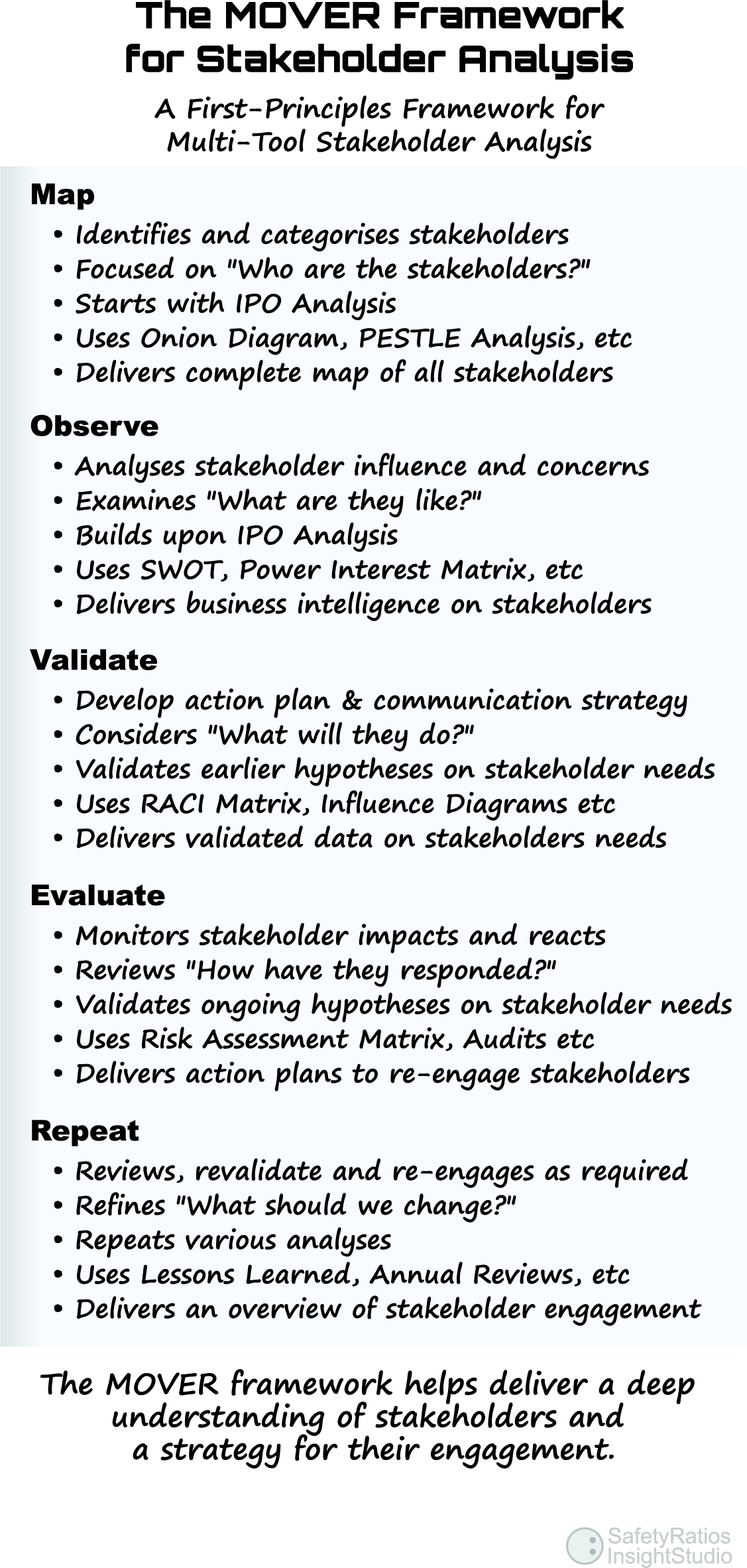
This article introduces a structured approach to stakeholder analysis using the MOVER framework, a method designed to guide organisations through the stages of identifying, analysing, engaging, and refining stakeholder relationships within ISO 45001 systems.
Step 1: Mapping Stakeholders
The first stage of stakeholder analysis involves identifying and categorising all stakeholders that may influence or be influenced by the organisation's OH&S objectives. A useful starting tool is an Input-Process-Output (IPO) analysis, which maps the organisation’s operations and helps identify who interacts with each stage.
Once identified, stakeholders can be visualised using tools such as stakeholder maps, onion diagrams, or PESTLE analysis to understand where they sit within the operational environment.
Step 2: Observing Stakeholder Characteristics
After mapping stakeholders, organisations must analyse their behaviour, expectations, motivations, and influence. This stage focuses on gathering insights into stakeholder interests and how their actions may affect OH&S performance.
Methods such as surveys, interviews, power-interest matrices, and SWOT analysis can be used to understand stakeholder priorities and potential conflicts.
Step 3: Validating and Engaging Stakeholders
The validation stage tests whether assumptions about stakeholders are accurate. Engagement activities such as consultations, meetings, and feedback mechanisms help confirm stakeholder expectations and identify gaps between assumptions and reality.
Tools such as RACI matrices, communication plans, and influence diagrams can support structured stakeholder engagement and clarify roles within the OH&S system.
Step 4: Evaluating Stakeholder Impact
Stakeholder influence changes over time. Organisations must therefore monitor how stakeholder behaviour affects safety performance and adjust strategies accordingly.
Regular reviews, audits, and SWOT assessments can help evaluate how stakeholder relationships evolve and how those changes affect risk management strategies.
Step 5: Repeating the Stakeholder Analysis Cycle
The final stage of the MOVER framework emphasises continuous improvement. Stakeholder relationships must be periodically reassessed to reflect organisational growth, regulatory changes, or shifts in operational environments.
By repeating the analysis cycle, organisations ensure that their OH&S systems remain responsive to stakeholder expectations and capable of adapting to new risks and opportunities.
When implemented effectively, stakeholder analysis strengthens ISO 45001 compliance while improving collaboration, transparency, and long-term safety performance.
Frequently Asked Questions
Why is stakeholder analysis required in ISO 45001?
ISO 45001 requires organisations to understand the needs and expectations of workers and other interested parties because these stakeholders influence the organisation’s ability to achieve OH&S objectives.
What is the purpose of the MOVER framework?
The MOVER framework provides a structured method for stakeholder analysis by guiding organisations through five stages: Map stakeholders, Observe their characteristics, Validate engagement assumptions, Evaluate their influence, and Repeat the process for continuous improvement.
Which tools are commonly used for stakeholder analysis?
Common tools include stakeholder mapping, power-interest matrices, SWOT analysis, surveys, interviews, communication plans, and influence diagrams.
How does stakeholder analysis improve safety management?
By understanding stakeholder expectations and influence, organisations can design safety systems that align with real operational conditions, regulatory expectations, and workforce needs.
How often should stakeholder analysis be reviewed?
Stakeholder analysis should be reviewed regularly and whenever significant changes occur, such as organisational restructuring, regulatory changes, or new operational environments.