Command Brief on ISO 45001:2018 Clause 6.1.4
Turning identified risks, opportunities, and obligations into coordinated action
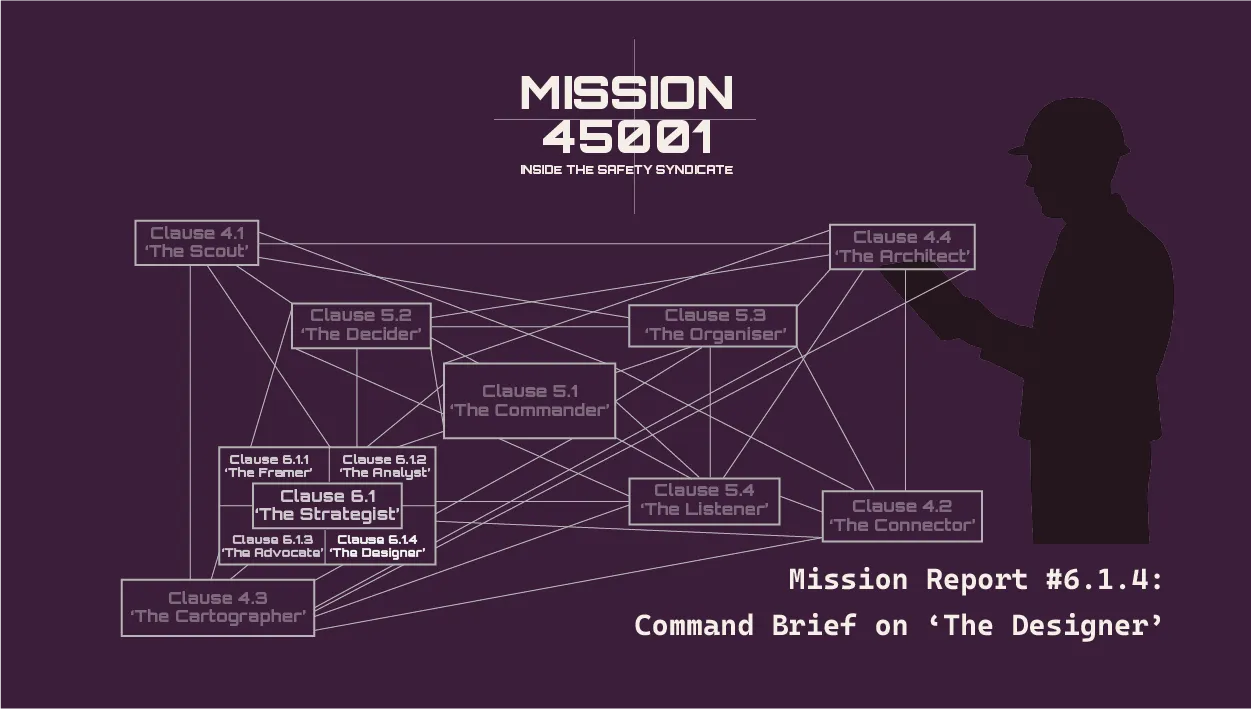
Mission 45001 is our deep dive into ISO 45001:2018, a network of clauses working together to help organisations run safe, resilient operations. Our mission is to show how that network works from the inside. This is our command brief on 'The Designer' of the safety syndicate.
This command brief examines ISO 45001:2018 Clause 6.1.4 and how organisations translate identified risks, opportunities, and compliance obligations into structured actions that are resourced, integrated, and evaluated.
Within the LDP framework, Clause 6.1.4 spans the living-driving and proving layers. planning builds on the controls identified in the assessment of OH&S risk, and continued assurance feeds the changing operational environment back into revised plans.
Clause 6.1.4 Requirements
Planning Action
- The organisation shall plan:
- a) actions to:
- 1) address these risks and opportunities enumerated in 6.1.2.2 and 6.1.2.3;
- 2) address legal requirements and other requirements enumerated in 6.1.3
- 3) prepare for and respond to emergency situations
- a) how to:
- 1) integrate and implement the actions into its OH&S management system processes or other business processes;
- 2) evaluate the effectiveness of these actions
- Documentation: There is no specific need for documentation in relation this specific clause, but its implementation requires the generation of documentation related to other clauses referenced in it.
Clause 6.1.4 In the LDP Framework
Planning action kick-starts safety implementation
- Living-Driving: Planning builds on the controls identified in the assessment of OH&S risk. Plans based on strategic direction and field inputs have better chances of being successful at implementation.
- Proving: Continued assurance process ensures that the changing operational environment is fed into revised plans.
What Effective Planning of OH&S Actions Mean
Turning identified risks, opportunities and obligations into coordinated implementation
- Prioritise actions systematically: Select actions based on risk significance, opportunities for improvement and compliance obligations
- Integrate actions into business processes: Embed planned activities within operational controls, projects, procurement and organisational planning
- Assign accountability and resources: Define responsibilities, authorities and the resources needed for successful implementation
- Plan for effectiveness: Establish how actions will be implemented, monitored, evaluated and adjusted where necessary
- Coordinate across the organisation: Align functions, leaders and operational teams so actions are delivered consistently
- Link planning to continual improvement: Use implementation outcomes to refine future planning, strengthen controls and improve OH&S performance
Why Effective Planning of OH&S Actions Matters
Ensuring intent becomes coordinated and measurable improvement
- Converts analysis into action: Ensures identified risks, opportunities and obligations lead to practical implementation
- Improves organisational resilience: Anticipates issues before they escalate, reducing disruption and strengthening operational continuity
- Optimises resources: Directs people, time and investment towards actions that deliver the greatest OH&S benefit
- Creates implementation confidence: Provides a structured pathway from planning through execution and review
- Strengthens organisational alignment: Ensures leaders, managers and workers pursue common OH&S priorities
- Demonstrates due diligence: Shows that decisions are planned, justified and supported by a systematic process
Systemic Impact of Effective Planning of OH&S Actions
Integrating planned actions throughout the OH&S management system
- Aligns strategic intent with operations: Planning connects organisational objectives with day-to-day implementation
- Coordinates management system processes: Objectives, operational controls, change management and performance evaluation work together
- Strengthens governance and assurance: Planned actions provide clear inputs for monitoring, audits and management reviews
- Improves organisational adaptability: The system responds consistently to changing risks, opportunities and compliance obligations
- Reinforces accountability across functions: Responsibilities remain coordinated throughout planning, implementation and review
- Sustains continual improvement: Planned actions create measurable outcomes that drive ongoing enhancement of OH&S performance
Systemic Indicators of Strong Planning of OH&S Actions
How effective organisations translate plans into sustained performance
- Risk-informed priorities: Planned actions reflect the organisation's highest OH&S risks, opportunities and compliance obligations
- Integrated business planning: OH&S actions are incorporated into operational, financial and strategic planning processes
- Coordinated implementation: Functions, sites and teams work to common priorities using agreed timelines and responsibilities
- Adaptive planning: Actions are revised as conditions, risks, legal requirements or organisational priorities change
- Performance visibility: Progress is monitored through meaningful measures that inform leadership decisions
- Verified outcomes: Reviews confirm that planned actions achieve their intended OH&S objectives and benefits
Systemic Indicators of Weak Planning of OH&S Actions
Where planning fails to produce effective organisational outcomes
- Planning disconnected from reality: Actions are developed without sufficient understanding of operational conditions or business constraints
- Unbalanced decision-making: Short-term pressures consistently outweigh OH&S priorities when selecting or implementing actions
- Implementation uncertainty: Plans exist but lack practical sequencing, coordination or achievable milestones
- Weak organisational commitment: Resources, competence or leadership support are insufficient to sustain planned actions
- Limited organisational learning: Planning rarely incorporates lessons from incidents, audits, worker feedback or previous initiatives
- Inconsistent follow-through: Completed activities are recorded, but their contribution to OH&S performance is seldom evaluated
Embedding Effective Planning of OH&S Actions
Making planned actions a consistent organisational capability
- Integrate planning into business processes: Build OH&S actions into operational planning, project delivery, procurement and organisational change
- Prioritise using risk intelligence: Base decisions on assessed risks, opportunities, compliance obligations and organisational objectives
- Assign clear ownership: Define responsibilities, authorities and resources so planned actions are delivered as intended
- Coordinate implementation: Align leaders, managers and operational teams to execute actions consistently across the organisation
- Monitor and adapt execution: Track progress, evaluate effectiveness and adjust actions as conditions or priorities change
- Reinforce continual improvement: Use implementation outcomes, audits and performance reviews to strengthen future planning and system effectiveness
Inside the Extended Edition
Ten Further Sections Available to Subscribers
- Policy implications: Ensuring organisational commitments translate into planned action
- Leadership implications: Ensuring leaders turn OH&S priorities into coordinated action
- Planning implications: Turning identified needs into structured and achievable action
- Support implications: Providing the capability and resources to deliver planned OH&S actions
- Operational control implications: Ensuring planned OH&S actions become effective work practices
- Performance evaluation implications: Confirming that planned OH&S actions achieve intended outcomes
- Improvement implications: Using planned actions to strengthen OH&S performance over time
- Cultural implications: Building a culture where planned OH&S actions become shared commitments
- System integration implications: Embedding OH&S action planning throughout the management system
- Next steps: Confirming effective planning and implementation of OH&S actions
Subscribers gain access to the complete presentation, while higher-tier members can download the full .pptx version for use in their own training programmes.
Background Data on 'The Designer', Clause 6.1.4
Focus: Planning Action on Risks and Opportunities
- Codename: The Designer (Element of The Strategist — Clause 6.1)
- Function: Translates identified risks, opportunities, and obligations into structured actions — ensures responses are defined, resourced, and integrated into operations
- System Role: Converts insight into execution design — bridges analysis and action by embedding controls, improvements, and safeguards into the system
- Syndicate Caucus: Element of The Strategist — Clause 6.1. Builds on The Framer (6.1.1), The Analyst (6.1.2), and The Advocate (6.1.3), and hands over to The Planner (6.2) and The Operator (8.1) for delivery
- Modus Operandi: Translational and structured — turns intent into practical measures, ensuring responses are proportionate, integrated, and effective
- Activation Threshold: Completion of risk and opportunity identification, legal review updates, change management, or when new controls or improvements are required
- Known For: Making plans real — ensuring that identified issues result in tangible, trackable actions within the system
- Field Signals: Documented controls, updated procedures, implemented safeguards, and visible changes in how work is performed
- Boardroom Signals: Approved action plans, resourcing decisions tied to risk, integration of actions into business processes and performance tracking
- Audit Signals: Defined actions linked to identified risks and obligations, evidence of implementation, and integration of controls into operational practice
- PDCA Coordinates: Lives in Plan and Do — designs the response and ensures it is embedded into execution
Frequently Asked Questions
What does ISO 45001 Clause 6.1.4 require?
The organisation shall plan actions to address the risks and opportunities enumerated in 6.1.2.2 and 6.1.2.3, address legal requirements and other requirements enumerated in 6.1.3, and prepare for and respond to emergency situations, and plan how to integrate and implement those actions into its OH&S management system or other business processes, and how to evaluate their effectiveness.
Does ISO 45001 Clause 6.1.4 require documented information?
There is no specific need for documentation in relation to this clause itself, but its implementation requires the generation of documentation related to the other clauses referenced in it.
How should OH&S actions be prioritised under Clause 6.1.4?
Actions are selected on risk significance, opportunities for improvement, and compliance obligations, with people, time, and investment directed to the actions delivering the greatest OH&S benefit.
What does strong planning of OH&S actions look like?
Risk-informed priorities, OH&S actions incorporated into operational, financial, and strategic planning, coordinated implementation on agreed timelines and responsibilities, adaptive revision as conditions change, progress visible through meaningful measures, and reviews that verify intended outcomes were achieved.
What are the signs of weak planning of OH&S actions?
Planning disconnected from operational reality, short-term pressures outweighing OH&S priorities, plans without practical sequencing or achievable milestones, insufficient resources or leadership support, little learning from incidents and audits, and completed activities whose contribution is seldom evaluated.