Field Brief on ISO 45001:2018 Clause 4.4
Living the management system as the way work actually runs
Mission 45001 is our deep dive into ISO 45001:2018, a network of clauses working together to help organisations run safe, resilient operations. Our mission is to show how that network works from the inside. This is our field brief on 'The Architect' of the safety syndicate.
This field brief examines ISO 45001:2018 Clause 4.4 and how operational teams live the OH&S management system as the way work actually runs: processes and their interactions carrying the day's tasks, rather than a manual describing them from a shelf.
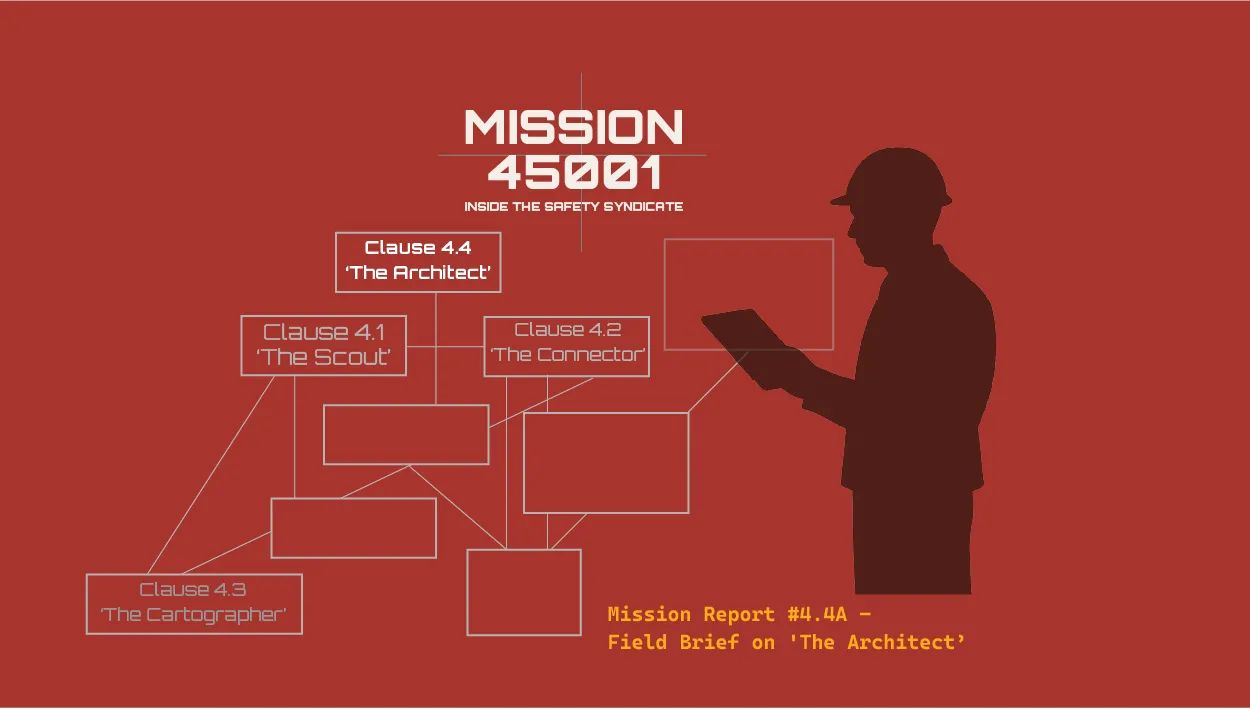
Within the LDP framework, Clause 4.4 turns the scouting layer's findings into standing structure. The Scout, The Connector and The Cartographer establish what the system must face and how far it reaches; The Architect builds the system that faces it, and keeps building for as long as the organisation works.
ISO 45001 Clause 4.4 Requirements
The OH&S management system
- Establish: The organization shall establish an OH&S management system in accordance with the requirements of ISO 45001:2018
- Implement and maintain: The system shall be implemented and maintained, run in practice and kept current, rather than documented once
- Continually improve: The organization shall continually improve the OH&S management system
- Processes and interactions: The system includes the processes needed and their interactions, the connections through which one process's output becomes another's input
- Documentation: Clause 4.4 sets no documentation requirement of its own; the system's documented information is governed by the clauses that compose it
What the System Means in the Field
The way work runs, not the manual that describes it
- The system is the routine: Permits, briefings, inspections, reporting loops and reviews are the system, experienced daily by people who may never read its manual
- Processes carry the work: Each process turns inputs into outputs someone else relies on, and the crew's day is a chain of them
- Interactions are the joints: Handovers between processes, report to investigation, finding to action, change to reassessment, are where the system holds or drops the load
- Built to the standard's spec: Establishing the system 'in accordance with ISO 45001' means every clause of the standard has machinery somewhere in the routine, from context to improvement
- Maintained means current: The system tracks the operation it serves, absorbing new work and shedding dead procedure
- Improving means moving: A system meeting Clause 4.4 is visibly different this year from last, in ways the field can name
Why the System Matters
Structure is what survives the week
- One structure holds every clause: Context, leadership, planning, support, operation, evaluation and improvement only function as parts of the system 4.4 establishes
- Joints fail before parts: Most system failures are interaction failures, the report that reached no investigation, the finding that reached no action, which is why interactions are named in the requirement
- Implemented beats documented: A modest system genuinely run outperforms an elaborate one genuinely shelved, in outcomes and in audit
- Unmaintained systems decay: Procedures age away from practice silently, and the gap becomes the workforce's real operating manual
- The system is the memory: What the organisation has learned about its hazards lives in the system's processes, or it lives nowhere
Impact On Daily Work
How the structure carries the day
- The day moves through processes: From pre-start to close-out, the crew operates the system's processes in sequence, whether or not anyone calls them that
- What crews record travels: Logs, reports and handovers become other processes' inputs, investigation, action, reassessment, and arrive there carrying the crew's words
- The system's returns land in the routine: Fixes, findings and revised procedures come back to the crew as briefings and changed documents, at whatever pace the system runs
- Unfamiliar tasks get routed: New work passes through assessment, method and briefing before it starts, which adds lead time to anything the system has not seen before
- Workarounds appear at the gaps: Where a process no longer fits the work, crews adapt on the spot, and what happens to that adaptation depends on the system
Key Factors to Watch
Signals that the structure and the work are parting company
- Manual and practice diverging: Documented processes describing a workplace that no longer exists, kept alive for audit week
- Processes without owners: Routines running on habit with nobody accountable for keeping them current or connected
- Outputs without consumers: Records produced that no process reads, the surest sign an interaction has quietly died
- Improvement outside the system: Fixes and initiatives run as side projects that never change the standing processes
- A system frozen at certification: Revision histories clustering around audit dates rather than operational change
Risks of a Weak System
Paper Structure = Weaker Safety
- The gap becomes the manual: Where documented process diverges from practice, the workforce runs its own unwritten system, unassessed and unimproved
- Interactions drop the load: Reports, findings and changes fall between processes, and each dropped handover is invisible until an incident finds it
- Incidents discover the gaps: Missing or dead processes are found by the event they failed to prevent, the most expensive audit available
- Certification becomes theatre: A system performed for auditors consumes real effort in producing appearance, effort the actual work never receives
- Change outruns the structure: New work, new plant and new contracts arrive faster than a stale system absorbs them, widening the uncovered ground
- Learning has nowhere to live: Without living processes to bank them, lessons from incidents and improvements evaporate with the people who learned them
Inside the Extended Edition
Fifteen Further Sections Available to Subscribers
- Benefits of a strong system: Living structure: fast induction, turnover resilience and evidence that makes itself
- How the system responds: Processes reviewed in place, traced interactions and change through the front door
- Role of operations team: Running processes as built, reporting friction and feeding the interactions
- Making the system operational: The FRAME discipline, from functions to evaluation
- Documentation requirements: What Clause 4.4 leaves unwritten, and what it implies for every other document
- Policy implications: Receiving the policy as working processes, and reporting the shortfall
- Leadership implications: Reading leadership in whether the machinery is resourced, current and used
- Planning implications: Risk work arriving as standing machinery rather than annual events
- Support implications: Training, information and tools delivered by process, not memory
- Operational control implications: The system under load at permits, isolations and handovers
- Performance evaluation implications: Honest records as the system's eyesight, graded daily by the crew
- Improvement implications: Fixes that change standing processes, and outcomes that return to the reporter
- Cultural implications: What a responsive or paper system teaches the workforce
- System integration implications: One routine discharging many duties across the business
- Next steps: Establish Fully. Run Daily. Improve Continually
Subscribers gain access to the complete presentation, while higher-tier members can download the full .pptx version for use in their own training programmes.
Background Data on 'The Architect', Clause 4.4
Focus: The OH&S Management System
- Codename: The Architect
- Function: System Framework — designs, builds, and maintains structural integrity
- System Role: Establishes the processes and interactions that carry every other clause, and keeps the structure matched to the operation
- Syndicate Caucus: Works with The Cartographer (4.3), The Commander (5.1), The Operator (8.1), and The Interrogator (9.2)
- Modus Operandi: Structural, connective, and intolerant of outputs without destinations
- Activation Threshold: Any new process need, broken interaction, aged procedure, or business change touching the frame
- Known For: Joints that hold, manuals that match practice, and structures that outlive their builders
- Field Signals: Workarounds hardening into custom, records nobody reads, processes running on habit without owners
- Boardroom Signals: Systems frozen since certification, improvement projects that never change standing process, safety structure funded as discretionary spend
- Audit Signals: Practice diverging from documented process, interactions that drop the load when traced end to end, revision histories clustered on audit dates
- PDCA Coordinates: Spans the whole cycle — the frame inside which Plan, Do, Check and Act all run
Frequently Asked Questions
What does ISO 45001 Clause 4.4 require?
Clause 4.4 requires the organization to establish, implement, maintain and continually improve an OH&S management system, including the processes needed and their interactions, in accordance with the requirements of ISO 45001:2018. It is the structural clause: every other requirement operates as part of the system it establishes.
Is the OH&S management system the same as the safety manual?
No. The system is the working structure of processes and interactions, the permits, briefings, reporting loops, reviews and the connections between them, as actually run. The manual documents parts of it. A modest system genuinely operated outperforms an elaborate one genuinely shelved, in outcomes and in audit.
What are the interactions Clause 4.4 refers to?
The connections through which one process's output becomes another's input: a report feeding an investigation, a finding feeding a corrective action, a change feeding a reassessment. Most system failures are interaction failures, loads dropped between processes, which is why the clause names interactions alongside the processes themselves.
What does maintaining the system mean in practice?
Keeping the structure matched to the operation it serves: processes reviewed by their owners against current work, dead procedure retired, new activities absorbed, and the documented way of working revised whenever it diverges from the real one. A revision history that clusters around audit dates rather than operational change is the classic sign of a system maintained for show.
How do Clause 4.3 and Clause 4.4 work together?
Clause 4.3 draws the boundary; Clause 4.4 builds the system inside it. The Cartographer determines the territory the system must cover, and The Architect establishes the processes and interactions that cover it, so scope changes are system changes and the two clauses move together.