The Five Pillars: A Special Report on ISO 45001:2018 Clause 5
Presence, direction, order, listening, and the culture they hold up
Mission 45001 is our deep dive into ISO 45001:2018, a network of clauses working together to help organisations run safe, resilient operations. Our mission is to show how that network works from the inside. This is the second of our special reports, after The Four Amigos on Clause 4. Here we take on 'The Five Pillars' of the safety syndicate, and learn the five pillars behind the codename.
ISO 45001 exists to prevent work-related injury and ill health. Clause 5 is where that purpose acquires an owner. This special report sets out the five pillars that carry it.
It also treats the clause as the answer to the oldest failure in safety management: the system that exists only on paper. A management system cannot want anything; people do. The standard could have settled for a nominated representative and a signed policy. It asked for leadership and a heard workforce instead.
Clause 5 sits between understanding and planning. Clause 4 establishes what the organisation is and what surrounds it; Clause 6.1 turns knowledge into committed action; between them the standard placed will. Four requirements each raise a pillar: presence at 5.1, direction at 5.2, order at 5.3, and listening at 5.4. The fifth pillar, culture, is the one they exist to hold up, and this report takes the five one by one.
The Outcome Clause 5 Exists to Produce
A System That Is Led, Owned, Organised, and Heard
- The headline advance: Leadership and worker participation were the defining step from OHSAS 18001 to ISO 45001, and Clause 5 carries both in its title
- Systems do not commit: Every requirement in the standard is executed by people, and Clause 5 is where the standard secures the people
- Will before plan: Clause 5 supplies the will and Clause 6.1 supplies the plan. A plan without will is a register; will without a plan is a speech
- Culture is the output: The clause's product is not documents but behaviour: what is tolerated, resourced, escalated, and heard
- Integration is the instruction: OH&S is embedded into business processes rather than run beside them, and only top management can order that
- The test: A system strong at Clauses 4, 6, and 8 while weak at 5 produces excellent paperwork about an organisation that does not exist
The Load-Bearing Frame of ISO 45001:2018
What Feeds In, What Flows Out, and What It Powers
- It inherits understanding: Context (4.1), interested parties (4.2), and scope (4.3) tell leadership what the organisation is before Clause 5 decides what it stands for
- It issues the mandate: The determination at 6.1 runs on leadership commitment, and its depth is set by the resourcing 5.1 chooses to put behind it
- It funds what follows: Clause 7's resources, competence, and communication are Clause 5 commitments made concrete
- It gives the system its senses: Worker voice at 5.4 feeds hazard identification at 6.1.2.1 with intelligence no audit produces
- It underwrites assurance: Accountability at 5.3 is what makes Clause 9's findings land on someone who must answer
- It never hands over: Unlike the planning clauses, Clause 5 does not complete and pass on; it holds the load continuously, or the structure sags
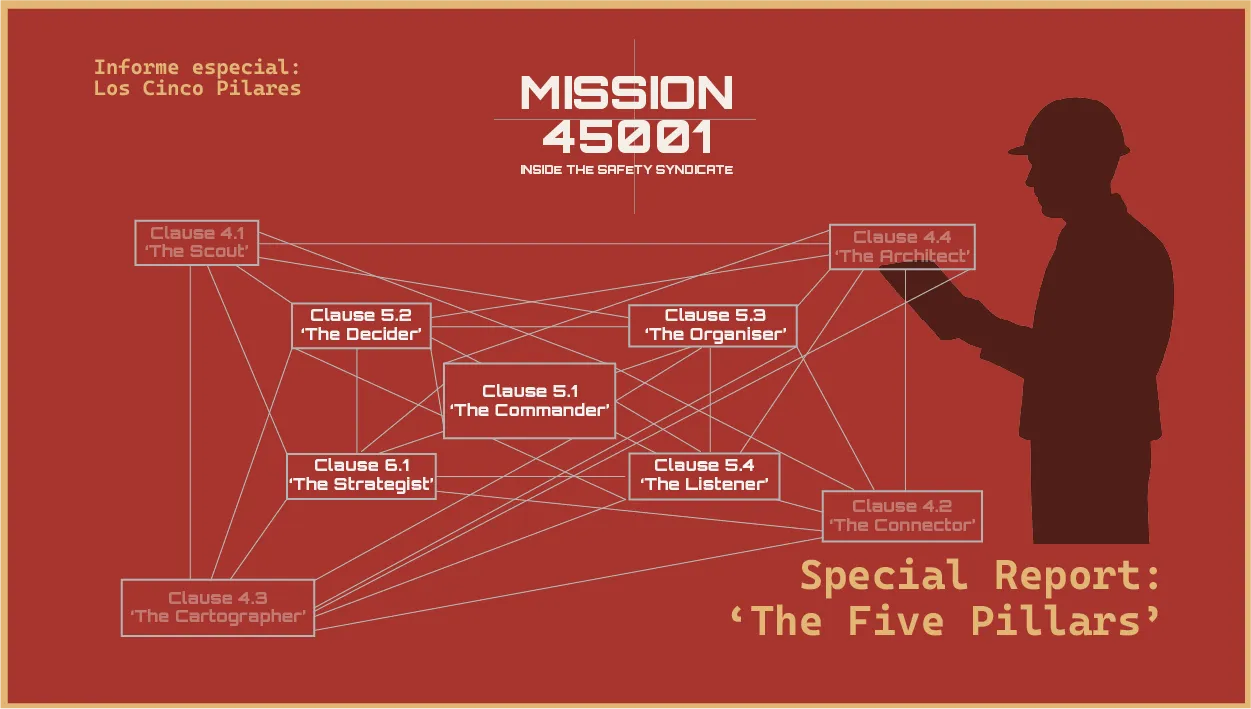
The Five Pillars of Clause 5
Four Requirements + One Outcome = Five Pillars
- Presence (5.1): Raised by The Commander: leadership and commitment kept where the risk and the pressure are. No other pillar can stand in for it
- Direction (5.2): Raised by The Decider: the policy as a promise made in public, framing objectives and surviving organisational change
- Order (5.3): Raised by The Organiser: responsibility and authority assigned, communicated, and documented so outcomes are owned rather than assumed
- Listening (5.4): Raised by The Listener: the workforce consulted before decisions and participating in them, with the barriers to speaking removed
- Culture (the fifth): Raised by all four together: the lived culture they hold up, and the outcome the clause exists to produce
Clause 5.1 Command · The Pillar of Presence
The Commander, Leading From Where the Risk Is
Clause 5.1 Leadership and commitment, in brief: top management takes overall responsibility and accountability for preventing work-related injury and ill health, ensures the policy and objectives fit the strategic direction, integrates OH&S into business processes, protects workers who report, and supports health and safety committees
- The pillar is presence: Leadership and commitment cannot be delegated; accountability for prevention stays with top management wherever the tasks are assigned
- Decisions are the real policy: What leaders decide under production pressure teaches the organisation what is actually tolerated, whatever the documents say
- Presence over pronouncement: Walk-throughs, interventions, and visible engagement carry more instruction than any communication campaign
- Tone sets the boundary: Leadership behaviour defines acceptable risk, and the field calibrates to what leaders challenge or let pass
- Commitment priced in resource: Funding, capability, and time assigned to OH&S are the observable measure of strategic intent
- The field mirrors the boardroom: Tolerance of shortcuts on site is the exact reflection of what leadership rewards and ignores above it
Clause 5.2 Policy · The Pillar of Direction
The Decider, Making a Promise in Public
Clause 5.2 OH&S policy, in brief: establish, implement and maintain a policy committing to safe and healthy working conditions, appropriate to the organisation's purpose, size, context and risks, providing a framework for objectives and committing to legal and other requirements, elimination of hazards, continual improvement, and worker consultation and participation, available as documented information
- The pillar is direction: The policy converts leadership intent into a stated commitment the whole organisation can navigate by
- A promise made in public: Once documented and communicated, the policy is a standing claim against which every decision can be judged
- Framework, not wallpaper: The policy exists to frame the OH&S objectives; a policy that no objective traces back to directs nothing
- Fitted to the organisation: Appropriate to purpose, size, context, and the specific nature of its risks and opportunities — or it is someone else's policy
- A stable reference in change: When structures, contracts, and priorities move, the policy is the directional anchor that persists
- Recalled or irrelevant: A policy the workforce cannot recognise in practical terms has already stopped governing
Clause 5.3 Structure · The Pillar of Order
The Organiser, Making Accountability Survive the Org Chart
Clause 5.3 Organisational roles, responsibilities and authorities, in brief: top management ensures responsibilities and authorities for relevant roles are assigned, communicated, and maintained as documented information, including responsibility for the system conforming to the standard and for reporting its performance back to top management
- The pillar is order: Responsibility and authority are assigned deliberately, so safety outcomes are owned rather than assumed
- Ownership, not oversight: Roles are defined so that individuals answer for outcomes, not merely observe them
- Authority matched to risk: Higher-risk activities carry decision-making authority equal to their consequence
- Empowerment made explicit: Clear roles let stop-work decisions happen without hesitation, fear, or a meeting
- Documented against turnover: Maintained documented information keeps accountability standing when the people move
- Blur is the failure mode: Breakdowns in performance trace to overlapping, informal, or assumed responsibilities more often than to missing procedures
Clause 5.4 Voice · The Pillar of Listening
The Listener, Turning the Workforce Into Intelligence
Clause 5.4 Consultation and participation of workers, in brief: maintain processes for consultation and participation of workers at all applicable levels and functions in developing, planning, implementing, evaluating and improving the system, providing mechanisms, time, training and resources, removing barriers, and emphasising the voice of non-managerial workers
- The pillar is listening: Consultation seeks views before decisions; participation brings workers inside them; the clause requires both
- Voice is intelligence: Workers identify hazards and control weaknesses before they reach any report, which makes 5.4 the system's forward sensor
- Barriers removed, not endured: The organisation determines and removes obstacles to participation, and minimises those that cannot be removed
- The non-managerial emphasis: The standard names non-managerial workers deliberately, because theirs is the voice hierarchies lose first
- Heard and answered: Listening completes only when concerns raised are addressed, tracked, and communicated back
- Fear is the counter-signal: Where speaking up carries personal risk, the system's most valuable intelligence channel is already closed
The Fifth Pillar · Culture
What the Other Four Hold Up
No clause to quote, in brief: culture is nowhere required and everywhere intended — the standard writes requirements for leadership, policy, structure, and voice, and culture is what their practice precipitates
- The pillar with no clause number: Culture appears in no requirement heading, yet it is the outcome the whole clause exists to produce
- It cannot be built directly: No requirement can order a culture into existence; it precipitates from presence, direction, order, and listening practised together
- It bears the daily load: Most safety-critical decisions are made under pressure, away from any document. Culture is what decides them
- It is the first to move: When any pillar beneath it weakens, culture shifts before the paperwork does, which is why field signals appear before audit findings
- It returns the load it carries: A strong culture makes presence cheaper, direction credible, order self-enforcing, and listening honest
- The test of the group: When the Five Pillars stand firm, safety is led, owned, organised, and heard; when they weaken, the system exists only on paper
How the Pillars Bear Load Together
Why Four Separate Efforts Hold Nothing Up
- Presence gives direction weight: A policy signed by absent leadership reads as decoration; the same words behind visible commitment read as instruction
- Direction gives order purpose: Roles and authorities exist to deliver the policy's commitments, not to complete an organisational chart
- Order gives listening a route: Consultation without assigned authority collects concerns that nobody is obliged to answer
- Listening gives presence its eyes: Leadership decisions are only as good as the field intelligence that reaches them
- Four raise the fifth: The dossier records it directly: decisions, policies, structure, and consultation operate as a single authority loop, and culture stands on the loop, not on any one pillar
- The weakest pillar sets the ceiling: Culture rises no higher than the least practised of the four beneath it, however strong the other three
The Contest Inside the Organisation
The Pillars Under Competing Priorities
- Pressure is the activation: Operational pressure, incident escalation, organisational change, and conflicting priorities are precisely when the Pillars engage
- Presence is tested at the margin: Commitment measured in the easy quarter is decoration; the pillar exists for the week the schedule slips
- Direction holds the line: Commitments made in public are hard to trade quietly, which is exactly their value under commercial pressure
- Order pre-decides the argument: Authority assigned in advance means the stop-work call does not wait for a meeting that production can postpone
- Listening counters the pressure narrative: Field voice is the standing correction to reports that improve as they travel upward
- Alignment beats decree: Leadership wins the contest by folding safety into how the business already runs, not by winning each collision as it comes
Where the Pillars Crack
The Failure Patterns That Recur Across Clause 5
- The delegated leader: OH&S is handed to a manager and accountability is assumed to travel with it; the standard says it does not. The counter: assign the tasks wherever they fit, and keep accountability where the clause left it, with top management
- The imported policy: A document appropriate to some other organisation's purpose, size, and risks, signed and forgotten. The counter: draft against the organisation's own purpose, size, context, and risks, and let the objectives trace back to it
- The unread commitment: A policy nobody in the field can recognise in practical terms, however carefully it was worded. The counter: translate each commitment into what it means at the task, and test recall in the field rather than distribution
- The assumed role: Responsibility inferred from job titles rather than assigned, communicated, and documented. The counter: assign each responsibility by name, communicate it, and maintain it as documented information so it survives turnover
- The token forum: Consultation staged after decisions are made, collecting agreement rather than intelligence. The counter: consult before the decision is made, and let the outcome show what the consultation changed
- The silenced channel: Reporting that carries personal risk, so the system hears only what is safe to say. The counter: protect workers who report, remove the barriers to speaking, and answer every concern back
- The paper system: All four pillars performed as documentation while the field runs on informal rules, and the fifth quietly falls. The counter: practise the four pillars where the work is, and let the documents record what already happens
What the Evidence Trail Looks Like
Where the Five Pillars Leave Their Marks
- Presence: In leadership diaries, walk-through records, and decisions under pressure that resolved for safety
- Direction: In the policy's currency, its recall in the field, and objectives that trace back to it
- Order: In documented responsibilities and authorities, and in role clarity when workers are asked who decides
- Listening: In issues raised, tracked, and answered back, and in participation that reaches beyond representatives
- Culture: In the gap, or its absence, between stated commitment and behaviour observed in the field
The Five Pillars in the LDP Framework
Where Clause 5 Is Lived, Driven, and Proven
- Living: Listening is where the clause is experienced, and culture is where the experience shows, exactly where the risk exists
- Driving: Presence and direction give the system its will, its priorities, and its resources
- Proving: Order leaves the documented trail of ownership, and direction the policy record, that hold up under scrutiny
Inside the Extended Edition
Ten Further Sections Available to Subscribers
- Policy implications: Employing the five pillars for better policy making
- Leadership implications: Employing the five pillars for better safety leadership
- Planning implications: Carrying the will into the Clause 6.1 determination and its design
- Support implications: Directing Clause 7's resources, competence, and communication to where they count
- Operational control implications: Turning leadership intent into controlled work under Clause 8
- Performance evaluation implications: Shaping what Clause 9 measures and what management review asks
- Improvement implications: Turning worker voice and findings into Clause 10 action
- Cultural implications: How raising the four pillars together builds the fifth
- System integration implications: How the pillars hold the management system together
- Next steps for Clause 5: Where the Pillars' trail usually runs, with a step-by-step audit walkthrough from preparation to reporting
Subscribers gain access to the complete presentation, while higher-tier members can download the full .pptx version for use in their own training programmes.
Background Data on 'The Five Pillars', Clause 5
Focus: Establishing Leadership, Accountability, and Workforce Ownership of the OH&S System
- Group Codename: The Five Pillars
- Group Members: The Commander (5.1), The Decider (5.2), The Organiser (5.3), and The Listener (5.4)
- Function: Operate as the system's cultural and authority core — converting structure and intent into leadership behaviour, clear accountability, and active workforce involvement
- System Role: Define who leads the system, how direction is set, where accountability sits, and how voices are heard — the structure upon which planning, operational control, and assurance is built
- Syndicate Caucus: Led by The Commander (5.1) — all pillars align under visible leadership, ensuring decisions, policies, structure, and consultation operate as a single authority loop
- Modus Operandi: Directive, visible, and influential — first to respond under pressure, constant in presence, and decisive in moments of conflict between safety and competing priorities
- Activation Threshold: Operational pressure, incident escalation, organisational change, conflicting priorities, workforce concern, or leadership challenge
- Known For: Preventing paper systems, eliminating accountability gaps, amplifying worker voice, and embedding safety as a lived organisational value
- Field Signals: Leadership absence, inconsistent enforcement, unclear authority, disengaged workers, or unreported risk
- Boardroom Signals: Competing priorities overriding safety, unclear ownership of outcomes, weak policy influence, or decisions disconnected from operational reality
- Audit Signals: Delegated leadership, policy irrelevance, blurred responsibilities, token consultation, or evidence of suppressed worker input
- PDCA Coordinates: Lives across Plan and Do — anchoring intent in action and reinforcing Check and Act through accountability and engagement
- System Insight Cue: When the Five Pillars stand firm, safety is led, owned, organised, and heard — when they weaken, the system exists only on paper
Frequently Asked Questions
What are the Five Pillars of ISO 45001 Clause 5?
Presence, raised by The Commander (5.1, leadership and commitment); direction, raised by The Decider (5.2, the OH&S policy); order, raised by The Organiser (5.3, roles, responsibilities and authorities); listening, raised by The Listener (5.4, consultation and participation of workers); and culture, the fifth pillar the other four hold up.
Which sub-clause covers the fifth pillar, culture?
None, and that is the point. Culture appears in no requirement heading because no requirement can order it into existence. It is the outcome Clause 5 exists to produce, precipitating from presence, direction, order, and listening practised together, and it is the first thing to fall when any of them weakens.
Can leadership responsibility under Clause 5.1 be delegated?
Tasks can be assigned, but overall responsibility and accountability for the prevention of work-related injury and ill health stay with top management. A system where OH&S has been handed to a manager and forgotten fails the clause's first requirement.
What is the difference between consultation and participation in Clause 5.4?
Consultation seeks workers' views before decisions are made; participation involves workers in making them. The clause requires both, with mechanisms, time, training and resources provided, barriers removed, and particular emphasis on non-managerial workers.
How does Clause 5 connect to Clause 6.1?
Clause 5 supplies the will — commitment, policy direction, accountability, and worker voice — and Clause 6.1 turns it into the plan. The determination of risks and opportunities runs on the mandate and resourcing that leadership provides, and worker consultation feeds hazard identification directly.