The Six Arts of the Strategist: A Special Report on ISO 45001:2018 Clause 6.1
Actions to address risks and opportunities, and the six arts that deliver them
Mission 45001 is our deep dive into ISO 45001:2018, a network of clauses working together to help organisations run safe, resilient operations. Our mission is to show how that network works from the inside. This is the third of our special reports, after The Four Amigos on Clause 4 and The Five Pillars on Clause 5. Here we take on 'The Strategist' of the safety syndicate, and learn the six arts behind the codename.
ISO 45001 exists to prevent work-related injury and ill health. Clause 6.1 is where that purpose becomes a requirement to act. This special report sets out the six arts that deliver it.
It also treats the clause as the fundamental basis of any successful safety strategy: deciding what to act on when everything cannot be, with resource that is never enough, on terrain that shifts before the plan reaches it. The standard could have settled for a risk register. It asked for actions instead.
Clause 6.1 sits at the hinge of the standard. Clauses 4 and 5 supply everything it consumes; Clauses 7 through 10 deliver whatever it planned. Within the clause, six requirements share the work: the determination of risks and opportunities at 6.1.1, hazard identification at 6.1.2.1, the assessment of risks at 6.1.2.2 and of opportunities at 6.1.2.3, legal and other requirements at 6.1.3, and planning action at 6.1.4. Each asks for a distinct discipline, and this report takes the six one by one.
The Outcome ISO 45001:2018 Exists to Produce
Actions to Address Risks and Opportunities
- The stated purpose: ISO 45001 exists to prevent work-related injury and ill health and to provide safe and healthy workplaces. Clause 6.1 is where that purpose becomes an instruction
- The operative word: The clause is titled actions to address risks and opportunities, and every requirement inside it drives toward the first of those words
- What precedes it prepares: Clauses 4 and 5 establish who the organisation is, what surrounds it, who holds a stake, and who carries accountability
- What follows it delivers: Clauses 7 through 10 resource, operate, measure, and improve the actions this clause defines
- The pivot point: Clause 6.1 is the only place in the standard where understanding becomes intent, and intent becomes something that can be scheduled and owned
- The test: A system strong at 4, 5, 7, and 8 while weak at 6.1 is an organisation busy in every direction that leaves harm where it found it
The Strategic Core of ISO 45001:2018
What Feeds In, What Flows Out, and the Terrain in Between
- It inherits everything upstream: Context (4.1), interested parties (4.2), and scope (4.3) supply the issues, the expectations, and the boundary the determination works within
- It turns will into plan: Clause 5 supplies leadership commitment, the OH&S policy, and worker consultation. That is the will; Clause 6.1 is the plan
- It works on moving terrain: New contracts, technology, people, and regulation re-deal the hazards, so the clause activates on change rather than on the calendar
- It chooses under scarcity: Not everything found can be addressed. What acts first and what waits is decided while production, cost, and quality claim the same budget
- It re-ranks as priority perishes: What ranked first at determination may rank third by delivery; a system with no way to re-rank executes last year's strategy
- It governs everything downstream: Clauses 6.2 to 8 deliver what it planned, and Clauses 9 and 10 test the effect and feed it back in
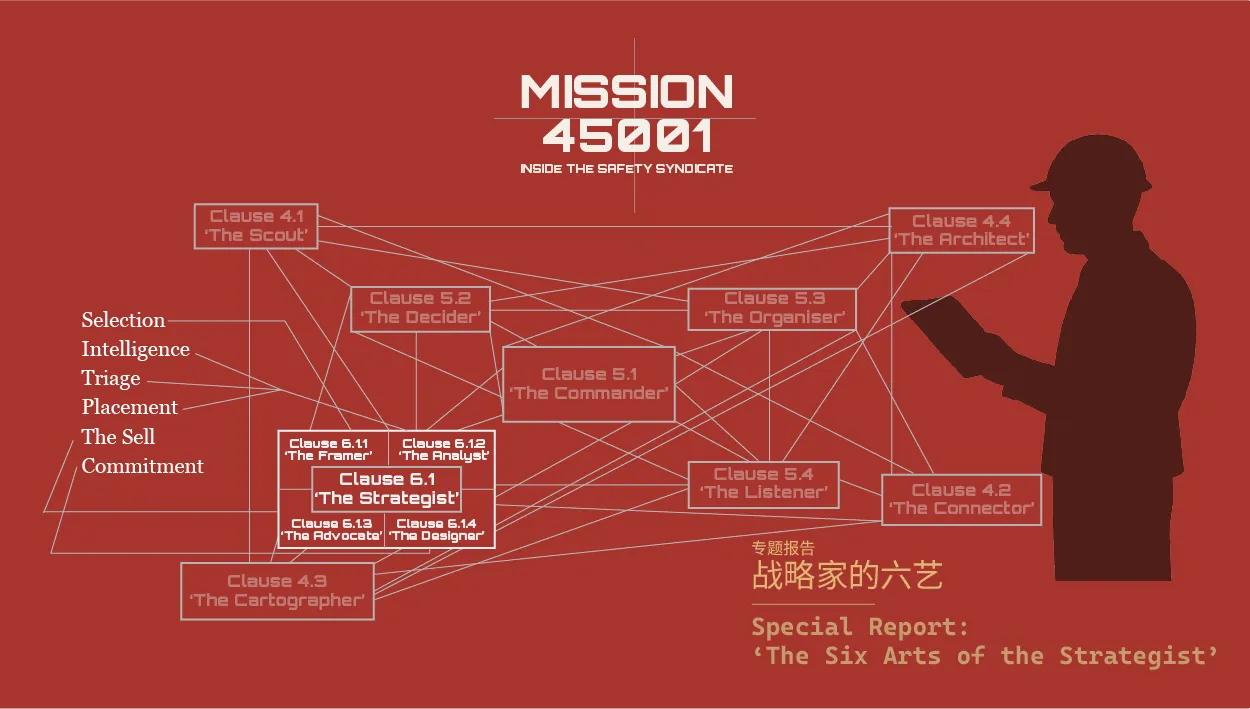
The Six Arts of Clause 6.1
A Roll-Call Repeated as the Operating Environment Evolves
- Selection (6.1.1): Concentrates scarce effort and resource on what is worth pursuing under current capability. No action can reach what the determination left out
- Intelligence (6.1.2.1): Surveys the nature of the hazards, risks and opportunities an action will be written against. The only art the workforce shares directly
- Triage (6.1.2.2): Sizes what was found, risks to people and to the system alike, so effort and sequence follow consequence rather than availability
- Placement (6.1.2.3): Assesses where scarce effort would gain the most, from removing a hazard outright to improving the system itself
- The Sell (6.1.3): Establishes the requirements action has to satisfy, and wins the buy-in that returns as resource
- Commitment (6.1.4): Converts all of it into planned action inside the business. Until commitment is made, nothing the other five arts produced exists on site
6.1.1 Framing · The Art of Selection
The Framer, Drawing the Boundary Around What Is Worth Addressing
Clause 6.1.1 General, in brief: considering context, interested parties, scope and planned change, determine the risks and opportunities that must be addressed to assure intended outcomes, prevent undesired effects and achieve continual improvement, and keep documented information on them
- The art is selection: Framing begins with choosing the ground worth contesting and declining the rest
- Not everything deserves pursuit: Framing settles which kinds of risk and opportunity must be addressed for the system to achieve its intended outcomes, avoid undesired effects, and keep improving
- Framing is built on context: Context (4.1), interested parties (4.2), and scope (4.3) determine which hazards, risks and opportunities to pursue
- Depth is integral to framing: Shallow framing stops at statutory duty; deeper framing, in the context of better resourcing, reaches into optimisation and even innovation
- Framing dictates downstream effort: Detection cannot find what the frame excluded, and weighting cannot size what was missed
- The same hazard, framed differently: Chemical handling is central to a coatings plant, marginal to the architect specifying the coating
6.1.2.1 Detection · The Art of Intelligence
The Analyst's First Reading, Surfacing What Any Action Will Have to Address
Clause 6.1.2.1 Hazard identification, in brief: maintain ongoing and proactive processes to identify hazards, covering how work is organised, social factors, routine and non-routine activity, past incidents, potential emergencies, and the people in and around the workplace
- The art is intelligence: Detection is the first part of the analysis, turning the generalities of the frame into specific areas of interest
- Detection turns kinds into findings: It surfaces the actual hazards, emerging risks and openings for gain inside the kinds the frame admitted, one by one
- Detection covers the frame: Work organisation, social factors, contractors, visitors, past incidents, potential emergencies, and changes in knowledge all sit inside its sweep
- Depth is integral to detection: Shallow detection records what is sensed; deeper detection records what is expected from systematic analysis of the operating environment
- Detection dictates what can be sized: Weighting ranks only what detection produced, so an absent hazard scores zero and an unseen opportunity is never taken
- Detection is strongest when targeted: Hazard reporting dominated by opportunistic observation is weaker than that from targeted inspections such as planned task observations
6.1.2.2 Weighting · The Art of Triage
The Analyst's Second Reading, Sizing Hazard, Risk and Opportunity So Action Follows Consequence
Clause 6.1.2.2 Assessment of OH&S risks and other risks, in brief: maintain processes to assess OH&S risks from the identified hazards against the effectiveness of existing controls, and to assess other risks to the management system itself, with methodologies and criteria defined before use
- The art is triage: Weighting is the second part of the analysis, placing the risks and opportunities detected in the context of the resources available
- Weighting is context-aware: The same forklift crossing weighs one way at ten movements a day behind a barrier, and another at a hundred behind a painted line
- Weighting is built on criteria: Methodology is defined before scoring for scope, nature and timing, and judged against the guard as fitted rather than the guard as specified
- Weighting prices every choice: Acting carries a cost and so does not acting; the burden includes the best option forgone, so what is set aside is weighed, not ignored
- Depth is integral to weighting: Shallow weighting accepts whatever a scorer feels; deeper weighting tests whether two assessors reach the same number
- Weighting contributes to sequencing and leverage: The running order it sets decides what is pursued first and what waits, and its sizing of gains hands leverage its targets
6.1.2.3 Leverage · The Art of Placement
The Analyst's Third Reading, Choosing the Points Where Effort Multiplies
Clause 6.1.2.3 Assessment of OH&S opportunities and other opportunities, in brief: maintain processes to assess opportunities to eliminate hazards and reduce OH&S risks, to adapt work, work organisation and the working environment to workers, and other opportunities to improve the management system
- The art is placement: Leverage picks its point before events force it: the place where modest effort moves the most, so scarce resource reaches further toward the goals
- Leverage earns its name: A lever multiplies force. Placed well, a small effort moves what direct push cannot, and placement is the whole of the skill
- Leverage is what 6.1.2.3 assesses: Opportunities to eliminate hazards and reduce risks, to adapt work, its organisation and environment to workers, and to improve the management system itself
- The highest points sit upstream: Eliminating a hazard at design outranks managing it in operation, and changing the system outranks patching the symptom
- Depth is integral to leverage: Shallow leverage logs improvements that surface anyway; deeper leverage searches the system for the points where least effort yields most effect
- The emptiest page of all: Most opportunity registers hold nothing, and the blank itself is the finding worth reporting
6.1.3 Advocacy · The Art of the Sell
The Advocate, Making What Binds Argue for the Plan
Clause 6.1.3 Determination of legal requirements and other requirements, in brief: maintain processes to determine and have access to the legal and other requirements that apply, work out how they apply and what needs communicating, keep them current, and maintain documented information
- The art is the sell: Advocacy determines what binds and makes it argue for the plan. Requirements carried into the business win the buy-in that returns as backing and resource
- Advocacy sets the floor: Determined requirements fix a minimum that no surrounding judgement is free to argue below
- Advocacy raises the ceiling: Beyond the floor, voluntary pledges and adopted standards set aspiration, and leadership turns them into a collective sense of achieving more together
- Advocacy is determined, applied, and kept current: What binds is established, how it applies is worked out, and changes are tracked
- Depth is integral to advocacy: Shallow advocacy captures statute alone; deeper advocacy binds contracts, client standards and voluntary pledges, which frequently demand rather more
- A filed requirement governs nobody: Procedures that cite the duty change behaviour; a register holding it alone does not
6.1.4 Design · The Art of Commitment
The Designer, Turning What Was Determined Into Action That Holds
Clause 6.1.4 Planning action, in brief: plan actions to address the determined risks, opportunities and requirements and to respond to emergencies, integrate them into the management system or wider business processes, plan how their effectiveness will be evaluated, and consider the hierarchy of controls when doing so
- The art is commitment: Design begins where strategy stops being a preference. Owners, dates, and a measure of effect are how intent survives contact with competing priorities
- Design brings action into existence: Every determination upstream becomes action with an owner, a date and a measure
- Design answers three duties at once: Risks and opportunities, legal and other requirements, and emergency preparedness all become planned action
- Depth is integral to design: Shallow design leaves actions in a safety spreadsheet beside the business; deeper design folds them into the permits, procurement and maintenance schedules
- Design is where the clause hands over: Objectives at 6.2, control at 8.1 and evaluation at 9.1 take what was produced
- Hierarchy respected, or quietly skipped: Elimination costs influence, a procedure costs a morning, and the record rarely says which
How the Arts Compound
Why Six Separate Exercises Produce No Strategy
- Framing sets the field: Everything downstream works only on what the frame admitted; hazards outside it are never found, however good the detection
- Weighting inherits detection: The risk register carries the hazard register's blind spots forward, scored and formalised
- One analysis, both directions: Risk and opportunity come out of the same assessment. Splitting them into separate exercises loses both
- Advocacy sets the floor and the sky: Legal and other requirements fix the minimum any designed action must clear; voluntary aspiration sets how high the plan reaches
- Design makes it observable: Until design moves, nothing the other five arts produced is visible in the workplace
- The cycle never closes: Every shift in terrain, priority, or resource reopens the frame. The six arts are a standing discipline, not an annual event survived in one sitting
The Contest Inside the Organisation
The Art of Handling Competing Priorities
- Weighting arms the argument: A defensible ranking is what wins the budget conversation, because production and cost arrive at that table with numbers of their own
- Advocacy takes ground off the table: The determined floor is not available for negotiation, and its value shows precisely in the quarter when everything negotiable is being traded
- Opportunity changes the register: An opportunity speaks the business's own language of gain, and recruits allies that a cost of prevention never will
- Design ends the contest by ending the separation: An action living inside the maintenance schedule no longer competes with the maintenance schedule
- Framing keeps the fight winnable: A frame sized to actual resource means every admitted risk can be defended; a frame sized to aspiration guarantees quiet defeats
- The art in one line: The Strategist does not beat competing priorities but aligns with them until safety is indistinguishable from the way the business already runs
Where the Strategy Breaks
The Failure Patterns That Recur Across Clause 6.1
- The unused frame: A risk procedure exists but never references context, interested parties, or scope
- The calendar register: Hazard identification runs on schedule rather than on change, so new work stays unassessed
- The undefended matrix: Scoring runs without documented criteria, so ratings collapse under challenge
- The missing art of placement: Opportunity assessment is absent entirely, the single most common gap in the clause
- The orphan register: Legal and other requirements are listed but never reach planning or the workforce
- The parallel plan: Actions live in a spreadsheet beside the business rather than inside it
- The completed action: Actions close on delivery rather than on evaluated effectiveness, so a control that failed is retired from attention while the risk stands
What the Evidence Trail Looks Like
Where the Six Arts Leave Their Marks
- Framing: In the scope section of the risk procedure, and in management review inputs
- Detection: In hazard register revision dates clustered around change, not around audits
- Weighting: In the methodology document, and in whether two assessors reach the same score
- Leverage: In the improvement register, where opportunity entries either exist or conspicuously do not
- Advocacy: In the legal register's update history and in operational procedures that cite it
- Design: In action owners, dates, and the business processes the actions were folded into
The Six Arts in the CHART Framework
Which Art Answers Which Step, and Where the Clause Hands Over
- Context: Framing works here, reading issues, interested parties, and scope forward into the cycle about to start
- Hazards: Detection works here, surfacing what is present rather than what the last register recorded
- Assess: Weighting and Leverage share this step, sizing risk and opportunity against one another
- Requirements: Advocacy works here, fixing the floor beneath anything the other steps propose and the sky above it
- Translate: Design works here, and the clause ends. What it produces passes to Clause 6.2, Clause 8.1, and back through Clause 9.1
- Two tools, two moments: CHART builds the action while it is still a decision. LDP, below, tests the system once it is running
The Six Arts in the LDP Framework
Where Clause 6.1 Is Lived, Driven, and Proven
- Living: Detection is where the clause is experienced, in hazards surfaced by the people doing the work
- Driving: Framing, Weighting, and Leverage give leadership the basis for direction and resourcing
- Proving: Advocacy and Design leave the trail that holds up under scrutiny
Inside the Extended Edition
Ten Further Sections Available to Subscribers
- Policy implications: Employing the six arts for better policy making
- Leadership implications: Employing the six arts for better safety leadership
- Planning implications: Employing the six arts for better safety management planning
- Support implications: Directing Clause 7 and others to where they count
- Operational control implications: Turning determined risk into controlled work
- Performance evaluation implications: Shaping what Clause 9 on performance evaluation measures
- Improvement implications: Turning findings into the next determination
- Cultural implications: How practising the arts together changes the organisation
- System integration implications: How the arts hold the management system together
- Next steps for Clause 6.1: Where the Strategist's trail usually runs, with a step-by-step audit walkthrough from preparation to reporting
Subscribers gain access to the complete presentation, while higher-tier members can download the full .pptx version for use in their own training programmes.
Background Data on 'The Strategist', Clause 6.1
Focus: Actions to Address Risks and Opportunities
- Codename: The Strategist. Clause 6.1, comprising The Framer (6.1.1), The Analyst (6.1.2), The Advocate (6.1.3), and The Designer (6.1.4)
- Function: Converts what the organisation knows about itself into action it can be held to. Commands four elements rather than operating a single process
- System Role: The hinge of the standard. Consumes context, interested parties, and scope, then sets the terms every downstream clause delivers against
- Syndicate Caucus: Commands The Framer (6.1.1), The Analyst (6.1.2), The Advocate (6.1.3), and The Designer (6.1.4). Draws from The Scout (4.1), The Connector (4.2), and The Cartographer (4.3). Hands over to The Planner (6.2) and The Operator (8.1)
- Modus Operandi: Sequential and cumulative. Each element depends on the one before it, so a weak link degrades everything downstream of it rather than only itself
- Activation Threshold: Any change in context, stakeholder expectation, scope, legal duty, workplace hazard, or planned organisational change
- Known For: Turning understanding into obligation. The clause where a system either commits to something or reveals that it has not
- Field Signals: Hazard reports that produce no change, risk assessments that outlive the work they describe, controls with no traceable origin
- Boardroom Signals: Risk registers presented without action status, opportunity absent from improvement papers, resourcing decided outside the determination
- Audit Signals: Undefined risk criteria, empty opportunity assessment, legal registers disconnected from planning, actions with no effectiveness measure
- PDCA Coordinates: Lives in Plan and reaches into Do. Designs the response and specifies how its effect will be measured
Frequently Asked Questions
What are the Strategist's six arts in ISO 45001 Clause 6.1?
Selection at 6.1.1 (The Framer), intelligence at 6.1.2.1, triage at 6.1.2.2, and placement at 6.1.2.3 (The Analyst's three readings), the sell at 6.1.3 (The Advocate), and commitment at 6.1.4 (The Designer). Together they turn determined risks and opportunities into planned action.
Which part of Clause 6.1 is most often missed?
Clause 6.1.2.3, the assessment of OH&S opportunities. Most systems assess risk thoroughly and opportunity not at all, even though assessing opportunities is a requirement rather than an optional extra.
How does Clause 4.2 connect to Clause 6.1?
Expectations that Clause 4.2 (c) classifies as being, or potentially becoming, legal requirements and other requirements flow directly into Clause 6.1.3.
Does Clause 6.1 require documented information?
Yes. The organisation must maintain documented information on risks and opportunities, and on the processes and actions needed to determine and address them.
What makes planned action under 6.1.4 compliant?
Actions must address risks, opportunities, legal and other requirements, and emergency preparedness; they must be integrated into the OH&S management system or other business processes; and the method for evaluating their effectiveness must be planned.