Summary Report on ISO 45001:2018 Clause 5: The Five Pillars
Safety actively led, clearly directed, properly organised, and genuinely heard
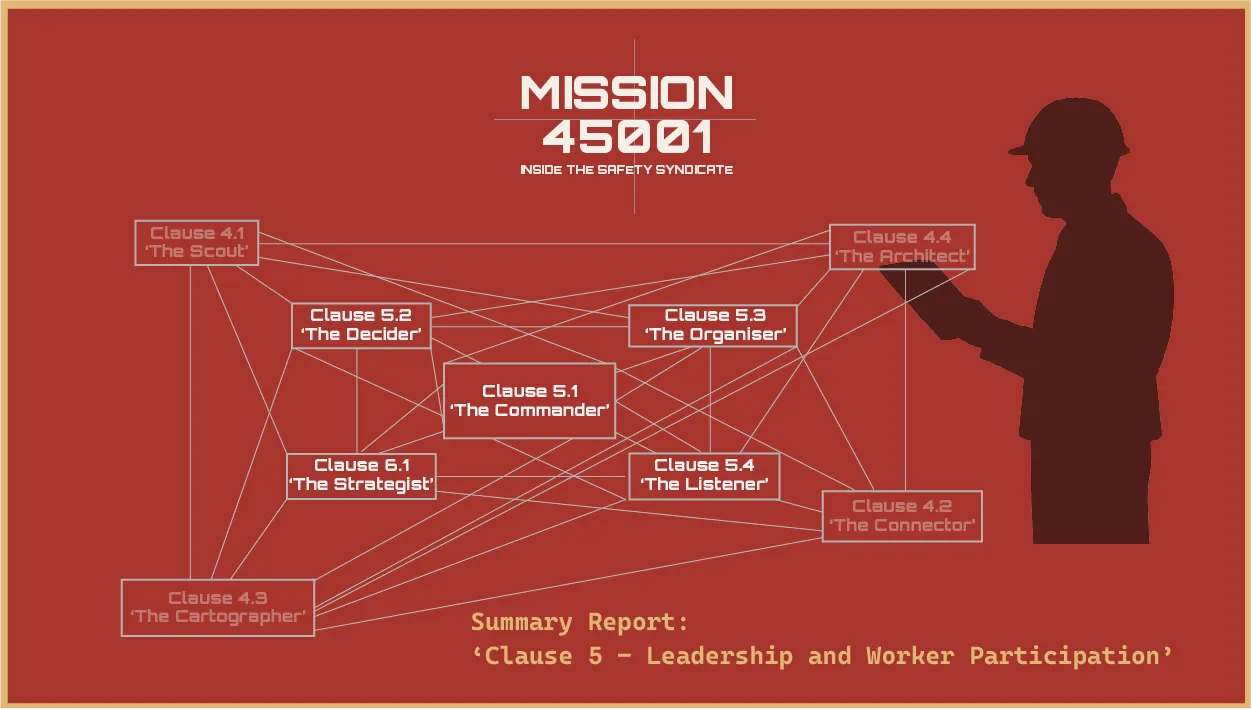
Mission 45001 is our deep dive into ISO 45001:2018, a network of clauses working together to help organisations run safe, resilient operations. Our mission is to show how that network works from the inside. This is our summary report on 'The Five Pillars' of the safety syndicate, marking the completion of the Clause 5 review and looking back across its four members.
This is a summary report marking the completion of the review of Clause 5. It looks back at the critical elements of the group codenamed the Five Pillars, comprising The Commander (5.1), The Decider (5.2), The Organiser (5.3), and The Listener (5.4). This group forms the leadership and cultural engine of the OH&S management system, ensuring that safety is actively led, clearly directed, properly organised, and genuinely heard.
Clause 5 is a pivotal element of ISO 45001, converting contextual understanding into consistent leadership behaviour and workforce engagement. Together, Clauses 5.1 through 5.4 operate as the system's cultural drivers, embedding authority, intent, accountability, and dialogue before planning, operational control, and performance assurance take over.
The Five Pillars at a Glance
Four Members, One Authority Loop
- The Commander (5.1): Leadership and commitment. Safety actively led, with top management taking overall responsibility and accountability for prevention
- The Decider (5.2): The OH&S policy. Direction clearly set, providing the framework for objectives and the commitments the system answers to
- The Organiser (5.3): Organisational roles, responsibilities and authorities. Accountability properly organised, so outcomes are owned rather than assumed
- The Listener (5.4): Consultation and participation of workers. The workforce genuinely heard, at all applicable levels and functions
- The group in one line: The leadership and cultural engine of the OH&S management system, embedding authority, intent, accountability, and dialogue before planning, operational control, and assurance take over
ISO 45001:2018 Clause 5.1 Requirements
Leadership and commitment
Clause 5.1: Top management shall demonstrate leadership and commitment with respect to the OH&S management system by:
- a) taking overall responsibility and accountability for the prevention of work-related injury and ill health, as well as the provision of safe and healthy workplaces and activities
- b) ensuring that the OH&S policy and related OH&S objectives are established and are compatible with the strategic direction of the organisation
- . . .
- m) supporting the establishment and functioning of health and safety committees
- Documentation: There is no requirement to generate specific documents demonstrating compliance with Clause 5.1
ISO 45001:2018 Clause 5.1 in the Field
Leadership visible in action
- Drives field behaviour: Day-to-day safety behaviours in the field reflect what leaders actively demonstrate, reinforce, and challenge
- Shapes field decisions: Supervisors and workers take cues from leadership responses to production pressure, unsafe conditions, and rule deviations
- Relies on leadership presence: Walk-throughs, site engagement, and real-time interventions signal that OH&S is a leadership priority
- Influences field culture: Tolerance or intolerance of shortcuts in the field directly mirrors leadership commitment
- Dominated by leadership impact: With most safety-critical decisions made under pressure in the field, leadership behaviour strongly influences injury and compliance outcomes
ISO 45001:2018 Clause 5.1 in Strategy
Leadership commitment drives direction and priorities
- Establishes safety as a core value: Requires top management to integrate OH&S into overall business strategy and decision-making
- Sets organisational tone: Leadership behaviour defines acceptable risk, performance expectations, and accountability standards
- Directs resource allocation: Strategic commitment is demonstrated through funding, capability, and time assigned to OH&S
- Aligns business objectives: OH&S considerations are embedded alongside commercial, operational, and reputational goals
- Demands visible accountability: Leaders are required to take ownership of system effectiveness and outcomes, not just oversight
ISO 45001:2018 Clause 5.1 in Evidence
Proving leadership commitment is real and effective
- Verify leadership involvement: Confirm that top management is visibly engaged in OH&S activities, not only through delegation
- Test decision consistency: Review whether leadership decisions under pressure consistently support OH&S over competing priorities
- Trace actions to commitment: Identify examples where leaders have intervened, resourced, or changed direction due to OH&S considerations
- Confirm accountability mechanisms: Check that OH&S responsibilities are owned, monitored, and reviewed at leadership level
- Assess cultural signals: Look for alignment between stated leadership commitment and actual behaviours observed in the field
ISO 45001:2018 Clause 5.2 Requirements
OH&S Policy
Clause 5.2: Top management shall establish, implement and maintain an OH&S policy that:
- a) Includes a commitment to provide safe and healthy working conditions for the prevention of work-related injury and ill health and is appropriate to the purpose, size and context of the organisation and to the specific nature of its OH&S risks and OH&S opportunities
- b) provides a framework for setting the OH&S objectives
- . . .
- f) includes a commitment to consultation and participation of workers and, where they exist, workers' representatives
- Documentation: The OH&S policy shall be available as documented information
ISO 45001:2018 Clause 5.2 in the Field
Policy translated into everyday direction
- Guides field expectations: The OH&S policy sets clear boundaries for acceptable behaviour and decision-making in the field
- Shapes on-the-spot decisions: Workers and supervisors use the policy as a reference when balancing safety, time, and production pressures
- Visible through practice: Policy commitments are reflected in how rules are enforced, incidents are handled, and risks are escalated
- Reinforced by leadership messaging: Toolbox talks, briefings, and interventions echo policy intent rather than contradict it
- Measured by field consistency: Gaps between stated policy and field behaviour quickly expose weak or misunderstood policy direction
ISO 45001:2018 Clause 5.2 in Strategy
Policy sets direction and organisational intent
- Defines organisational commitment: Articulates leadership's intent regarding safe and healthy working conditions and continual improvement
- Anchors strategic decisions: Provides a reference point for setting objectives, priorities, and performance expectations
- Aligns legal and other requirements: Commits the organisation to compliance and shapes how obligations are interpreted strategically
- Integrates with business direction: Ensures OH&S intent supports, rather than competes with, organisational purpose and strategy
- Provides a stable reference: Acts as a consistent directional anchor during organisational or operational change
ISO 45001:2018 Clause 5.2 in Evidence
Proving the policy is alive and effective
- Check policy awareness: Verify that workers and supervisors can recognise and explain the policy's intent in practical terms
- Test policy application: Review real decisions and actions to confirm they align with policy commitments
- Confirm relevance and currency: Ensure the policy reflects current risks, context, and organisational direction
- Trace policy to objectives: Verify that OH&S objectives and programs clearly flow from policy commitments
- Assess communication effectiveness: Confirm the policy is accessible, communicated, and reinforced across all relevant levels
ISO 45001:2018 Clause 5.3 Requirements
Organisational roles, responsibilities and authorities
Clause 5.3: Top management shall assign the responsibility and authority for:
- a) ensuring that the OH&S management system conforms to the requirements of this document
- b) reporting on the performance of the OH&S management system to top management
- Documentation: Responsibilities and authorities for relevant roles within the OH&S management system are maintained as documented information
ISO 45001:2018 Clause 5.3 in the Field
Clear ownership where work happens
- Defines who acts: Field responses to hazards, incidents, and unsafe conditions depend on clearly assigned authority
- Reduces hesitation and gaps: Workers know who is responsible for decisions, escalation, and control in real time
- Enables consistent supervision: Supervisors apply controls and enforce standards within clearly defined authority
- Supports effective intervention: Clear roles empower timely stop-work decisions without fear or confusion
- Reflected in field outcomes: Breakdowns in safety performance often trace back to unclear or overlapping responsibilities
ISO 45001:2018 Clause 5.3 in Strategy
Accountability structured into the system
- Allocates responsibility deliberately: Leadership assigns OH&S roles to ensure coverage across all functions and levels
- Embeds accountability: Responsibilities and authorities are defined so safety outcomes can be owned and measured
- Supports governance and assurance: Clear structure enables effective oversight, review, and corrective action
- Aligns authority with risk: Higher-risk activities are matched with appropriate decision-making authority
- Enables system effectiveness: A well-defined organisational structure prevents reliance on informal or assumed roles
ISO 45001:2018 Clause 5.3 in Evidence
Proving roles and authorities are clear and effective
- Verify role clarity: Confirm workers and leaders can identify who is responsible for key OH&S decisions
- Test authority in practice: Review whether individuals are empowered to act within their assigned authority, especially under pressure
- Trace accountability for outcomes: Check that incidents, actions, and improvements are clearly owned and followed through
- Confirm communication of roles: Ensure responsibilities and authorities are communicated and understood across the organisation
- Assess structural alignment: Look for consistency between organisational charts, role descriptions, and actual safety practice
ISO 45001:2018 Clause 5.4 Requirements
Consultation and participation of workers
Clause 5.4: The organisation shall establish, implement and maintain a process(es) for consultation and participation of workers at all applicable levels and functions, and, where they exist, workers' representatives, in the development, planning, implementation, performance evaluation and actions for improvement of the OH&S management system. The organisation shall:
- a) provide mechanisms, time, training and resources necessary for consultation and participation
- b) provide timely access to clear, understandable and relevant information about the OH&S management system
- c) determine and remove obstacles or barriers to participation and minimize those that cannot be removed
- d) emphasize the consultation of non-managerial workers on the following: ...policy, roles, objectives, audits and more
- e) emphasize the participation of non-managerial workers in the following: ...consultation process, hazard identification, controls, communication and more
- Documentation: Consultation and participation of workers extend across the entire management system and do not entail any specific requirements for documented information
ISO 45001:2018 Clause 5.4 in the Field
The workforce heard where risk exists
- Captures real risk insight: Workers identify hazards and control weaknesses before they appear in reports or statistics
- Shapes safer work methods: Field input directly influences how tasks are planned, controlled, and adapted
- Enables early intervention: Consultation allows issues to be raised and addressed before harm occurs
- Builds trust and engagement: Visible listening encourages reporting, challenge, and participation without fear
- Reflected in field resilience: Strong consultation and participation improve adaptability during non-routine and emergency situations
ISO 45001:2018 Clause 5.4 in Strategy
Worker voice informs decisions
- Integrates operational reality: Leadership decisions are grounded in first-hand experience from the field
- Strengthens risk identification: Strategic risk assessments benefit from worker knowledge of actual work conditions
- Improves decision quality: Consultation reduces blind spots in planning, change management, and control design
- Supports continual improvement: Participation feeds practical insight into system review and improvement activities
- Aligns culture with intent: Strategy reflects shared ownership of OH&S rather than top-down instruction
ISO 45001:2018 Clause 5.4 in Evidence
Proving workers are consulted and involved
- Verify consultation mechanisms: Confirm workers have genuine, accessible ways to raise OH&S matters
- Test influence on decisions: Review whether worker input has shaped controls, procedures, or changes
- Confirm participation breadth: Ensure involvement extends beyond representatives to the wider workforce
- Trace issues to outcomes: Check that concerns raised are addressed, tracked, and communicated back
- Assess psychological safety: Look for evidence that workers can speak up without retaliation or suppression
In Summary
Clause 5 of ISO 45001:2018 provides the leadership and cultural backbone of an effective OH&S management system. By addressing leadership and commitment (5.1), policy direction (5.2), organisational roles and accountability (5.3), and worker consultation and participation (5.4), it ensures safety is actively led, clearly directed, properly owned, and genuinely shared.
Together the Five Pillars comprising The Commander (5.1), The Decider (5.2), The Organiser (5.3), and The Listener (5.4) serve as the system's driving force within the wider Safety Syndicate, embedding authority, intent, structure, and voice so the system is lived in practice as planning, operations, and assurance unfold.
Background Data on 'The Five Pillars', Clause 5
Focus: Establishing Leadership, Accountability, and Workforce Ownership of the OH&S System
- Group Codename: The Five Pillars
- Group Members: The Commander (5.1), The Decider (5.2), The Organiser (5.3), and The Listener (5.4)
- Function: Operate as the system's cultural and authority core — converting structure and intent into leadership behaviour, clear accountability, and active workforce involvement
- System Role: Define who leads the system, how direction is set, where accountability sits, and how voices are heard — the structure upon which planning, operational control, and assurance is built
- Syndicate Caucus: Led by The Commander (5.1) — all pillars align under visible leadership, ensuring decisions, policies, structure, and consultation operate as a single authority loop
- Modus Operandi: Directive, visible, and influential — first to respond under pressure, constant in presence, and decisive in moments of conflict between safety and competing priorities
- Activation Threshold: Operational pressure, incident escalation, organisational change, conflicting priorities, workforce concern, or leadership challenge
- Known For: Preventing paper systems, eliminating accountability gaps, amplifying worker voice, and embedding safety as a lived organisational value
- Field Signals: Leadership absence, inconsistent enforcement, unclear authority, disengaged workers, or unreported risk
- Boardroom Signals: Competing priorities overriding safety, unclear ownership of outcomes, weak policy influence, or decisions disconnected from operational reality
- Audit Signals: Delegated leadership, policy irrelevance, blurred responsibilities, token consultation, or evidence of suppressed worker input
- PDCA Coordinates: Lives across Plan and Do — anchoring intent in action and reinforcing Check and Act through accountability and engagement
- System Insight Cue: When the Five Pillars stand firm, safety is led, owned, organised, and heard — when they weaken, the system exists only on paper
Frequently Asked Questions
What are the Five Pillars of ISO 45001 Clause 5?
The Commander (5.1, leadership and commitment), The Decider (5.2, the OH&S policy), The Organiser (5.3, organisational roles, responsibilities and authorities), and The Listener (5.4, consultation and participation of workers). The group takes its name from Clause 5 and forms the leadership and cultural engine of the OH&S management system.
What does Clause 5.1 require of top management?
Top management must demonstrate leadership and commitment by taking overall responsibility and accountability for the prevention of work-related injury and ill health and the provision of safe and healthy workplaces, ensuring the OH&S policy and objectives are compatible with the organisation's strategic direction, and supporting health and safety committees, among further duties.
Does Clause 5 require documented information?
Twice. The OH&S policy under Clause 5.2 must be available as documented information, and responsibilities and authorities under Clause 5.3 must be maintained as documented information. Clauses 5.1 and 5.4 carry no specific documentation requirements of their own.
Why does Clause 5.4 single out non-managerial workers?
The clause emphasises the consultation of non-managerial workers on matters such as policy, roles, objectives and audits, and their participation in hazard identification, controls and communication, because worker voice matters most where the risk actually exists and is weakest in systems run top-down.
Where does Clause 5 sit in the PDCA cycle?
The Five Pillars live across Plan and Do, anchoring intent in action, and they reinforce Check and Act through accountability and engagement. When they weaken, the system exists only on paper.