Stakeholder Analysis for ISO 45001 Clause 4.2: The MOVER Framework
A Step-by-Step Approach to Stakeholder Engagement in ISO 45001 OH&S Systems
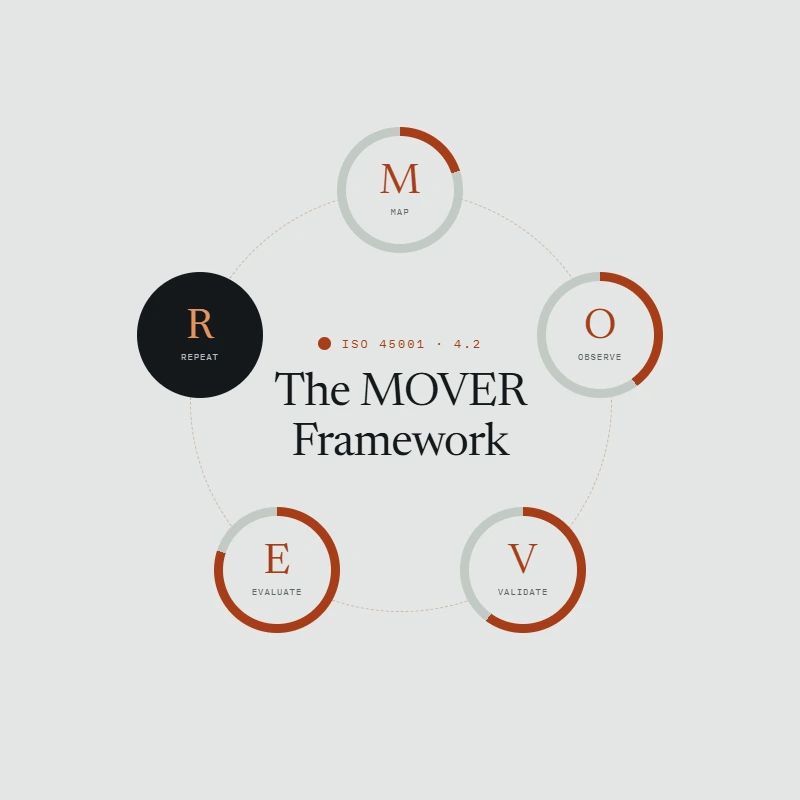
The MOVER Framework is a stakeholder-analysis model for ISO 45001 Clause 4.2, Understanding the needs and expectations of workers and other interested parties. Clause 4.2 asks an organisation to determine who holds a stake in the safety system, what those parties need and expect, and which of those expectations it will bind itself to. It says little about the order, and stakeholder analysis done out of order produces a register nobody plans from. MOVER supplies the order: Map, Observe, Validate, Evaluate, Repeat. Each step produces something the next one needs, so a gap becomes visible as a gap rather than surfacing later as an expectation nobody caught.
Definition and Core Purpose
The MOVER Framework treats stakeholder analysis as a cycle to be run rather than a register to be produced. It shifts the question from "have we listed our interested parties?" to "at which step did engagement lose its connection to the expectation it was meant to meet?"
MOVER works through five steps, each with its own output:
- Map – establish who holds a stake, upstream and downstream of the operation, before deciding who matters most
- Observe – read what each party is like: needs, expectations, influence, and direction of travel
- Validate – test that reading with the stakeholder, and settle which expectations the organisation binds itself to
- Evaluate – measure the stakeholder's response, rather than the organisation's activity
- Repeat – reopen the analysis when the stakeholders move, rather than when the calendar does
The value is in the order, and the order is the clause's own. Map answers 4.2 (a), Observe answers 4.2 (b), Validate carries 4.2 (c) together with the consultation duties of Clause 5.4, Evaluate reports through Clause 9.1, and Repeat is Clause 10.3 applied to the stakeholder register. Analysis that begins at Observe studies a cast nobody has confirmed. Analysis that stops before Validate hands planning a list of guesses.
How MOVER Maps to ISO 45001
Each step corresponds to a specific requirement, in the order the system consumes them. The mapping is what makes the framework auditable rather than merely memorable.
| Step | Clause | What it produces |
|---|---|---|
| Map | 4.2 (a) | A register of who holds a stake, workers first among them |
| Observe | 4.2 (b) | Needs and expectations as they are, with source and weight |
| Validate | 4.2 (c), with 5.4 | The expectations the organisation binds itself to: the minimum requirements and stretch goals handed to planning |
| Evaluate | 9.1, feeding 9.3 | Evidence of how stakeholders actually responded |
| Repeat | 10.3 | A register that moves when the stakeholders do |
How MOVER Relates to CHART
MOVER runs upstream of the CHART Framework. What MOVER determines under Clause 4.2 is what CHART's Context step reads forward into Clause 6.1 planning, and what Validate adopts under 4.2 (c) arrives at CHART's Requirements step as the minimum the plan must clear and the stretch goals beyond it. The two frameworks meet at a hand-off, and hand-offs are where frameworks fail: a stakeholder register that stops moving feeds a Context that reads a situation which no longer exists.
Inside the Extended Edition
The complete MOVER Framework, together with a full worked example, is available free to all subscribers. Nine further sections sit in the extended edition:
- Map: Establishing who holds a stake, with the signs mapping is being done well
- Observe: Reading what each party is like, including the quiet parties silence has hidden
- Validate: Settling what the organisation binds itself to, the minimum requirements and stretch goals handed to planning
- Evaluate: Measuring the stakeholder's response rather than the organisation's activity
- Repeat: Keeping the register current, triggered by change rather than the calendar
- How MOVER relates to LDP: Where the register is lived, driven and proven, and which dimension fails first
- Where MOVER breaks: Five failure signatures, each with the counter built into the process
- Origins and use cases: Where the framework earns its keep, and how it pairs with the Clause 4.2 briefs
- The MOVER Framework in Practice: A full worked example, one shift change taken from Map to Repeat, tested with the CHART and LDP overlays
Subscribers gain access to the complete documents, while higher-tier members can download them for use in their own training programmes.
Frequently Asked Questions
What does ISO 45001 Clause 4.2 require?
Clause 4.2 requires an organisation to determine, in addition to its workers, the other interested parties relevant to the OH&S management system; to determine the relevant needs and expectations of those workers and parties; and to determine which of those needs and expectations are, or could become, legal requirements and other requirements. The MOVER Framework works through those duties in order, then adds evaluation and repetition to keep the stakeholder register current.
What is the MOVER Framework used for?
MOVER works through ISO 45001 Clause 4.2 in the order the clause itself sets: map who holds a stake, observe their needs and expectations, validate the reading and settle what binds, evaluate the response, and repeat on change. It gives stakeholder analysis a sequence, so an organisation can see which step it skipped when an expectation surfaces as a surprise.
Why is it called MOVER?
Because stakeholders move. The five letters are Map, Observe, Validate, Evaluate and Repeat, and the final letter is the point: a stakeholder register is only as good as its last revision, and the framework is built to be re-run rather than filed.
How is MOVER different from CHART?
MOVER is a stakeholder-analysis framework and CHART is a planning one. MOVER determines who holds a stake and what the organisation binds itself to under Clause 4.2; CHART consumes that output at Clause 6.1, reading it forward as Context and receiving the adopted expectations at Requirements as minimum requirements and stretch goals. MOVER runs upstream; CHART runs downstream.
What tools can be used with the MOVER Framework?
IPO Analysis suits Map, reading inputs, processes and outputs to surface upstream and downstream parties. SWOT Analysis and the Power-Interest Matrix suit Observe. Consultation records, surveys and feedback loops carry Validate and Evaluate. MOVER is tool-neutral: the sequence is fixed, the instruments are not.
Where does MOVER most often fail in practice?
At Map's edges and at Validate's second half. The parties an operation touches without contracting, agency workers, second-tier suppliers, neighbours, never reach the register, and the needs that are recorded are never sorted into which become requirements, so nothing arrives at Clause 6.1.3. Both failures are invisible in an audit of the register itself.