The PAPA Model in Practice: Anatomy of a Safety Transformation
Consultant-Led Versus Practitioner-Led Transformation, Read Through the Layers
The most common way organisations attempt culture change is the transformation programme: branded, cascaded, measured, and declared a success. This worked example reads one such programme, as commonly applied, through the PAPA Model, at a single operation, from before the kickoff to the years after the banners came down.
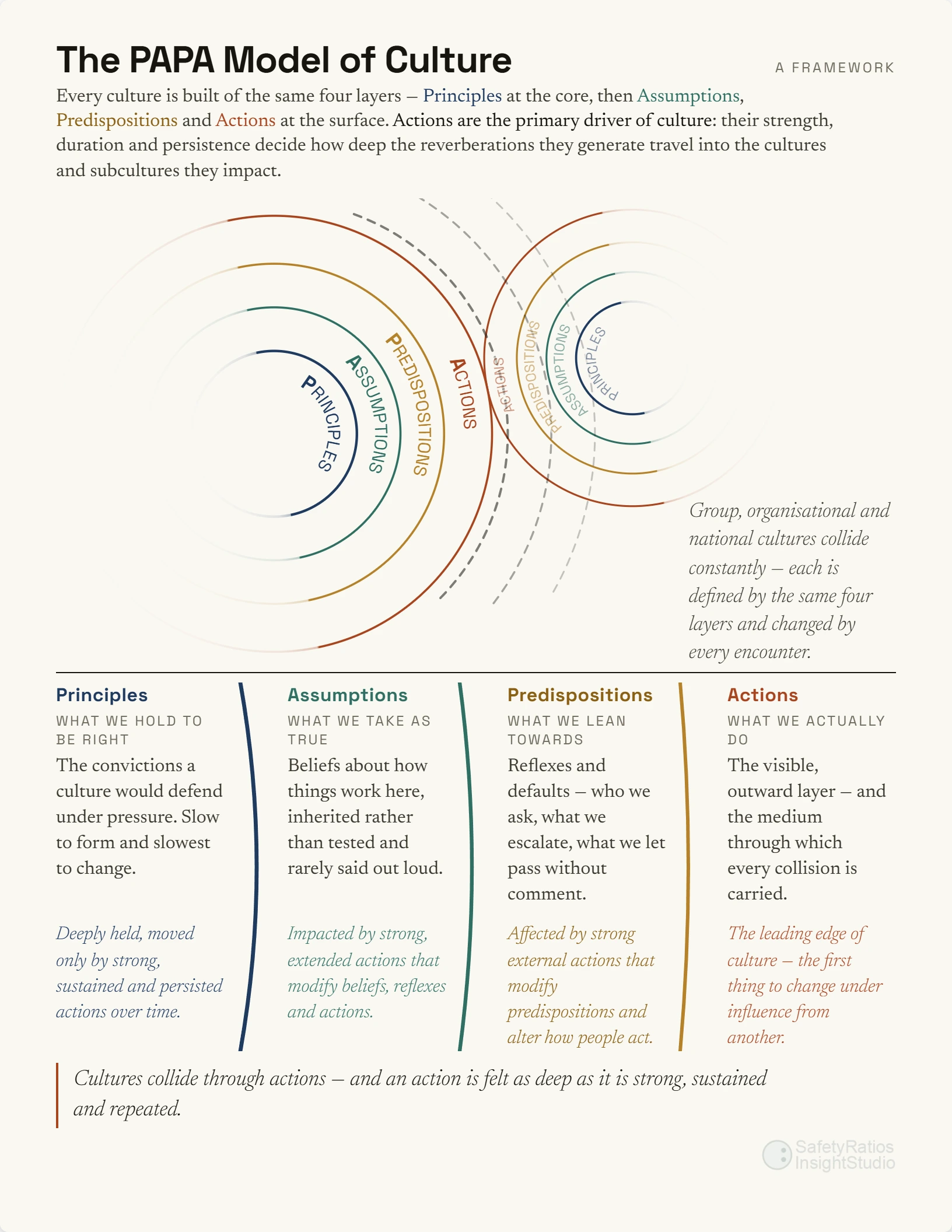
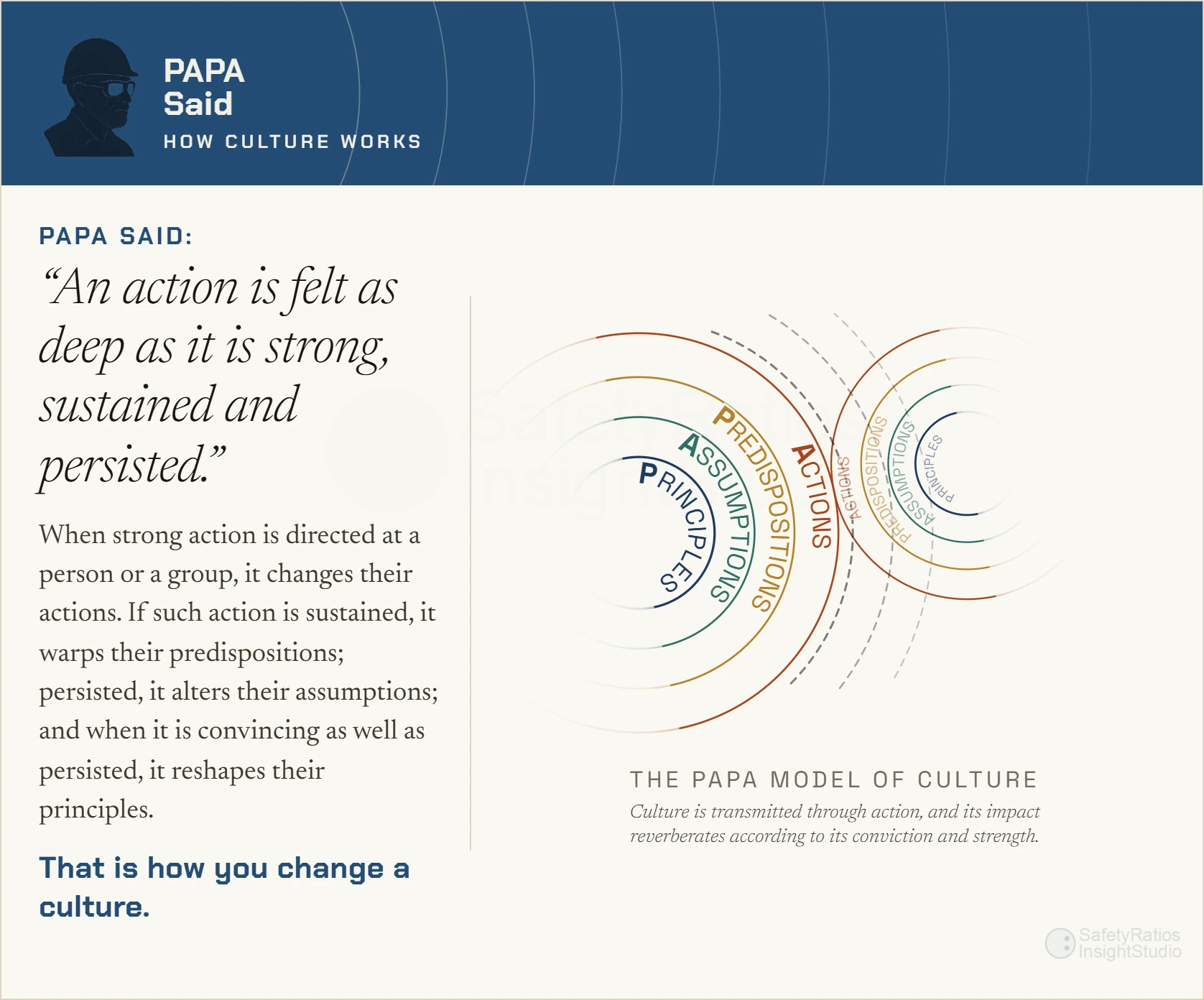
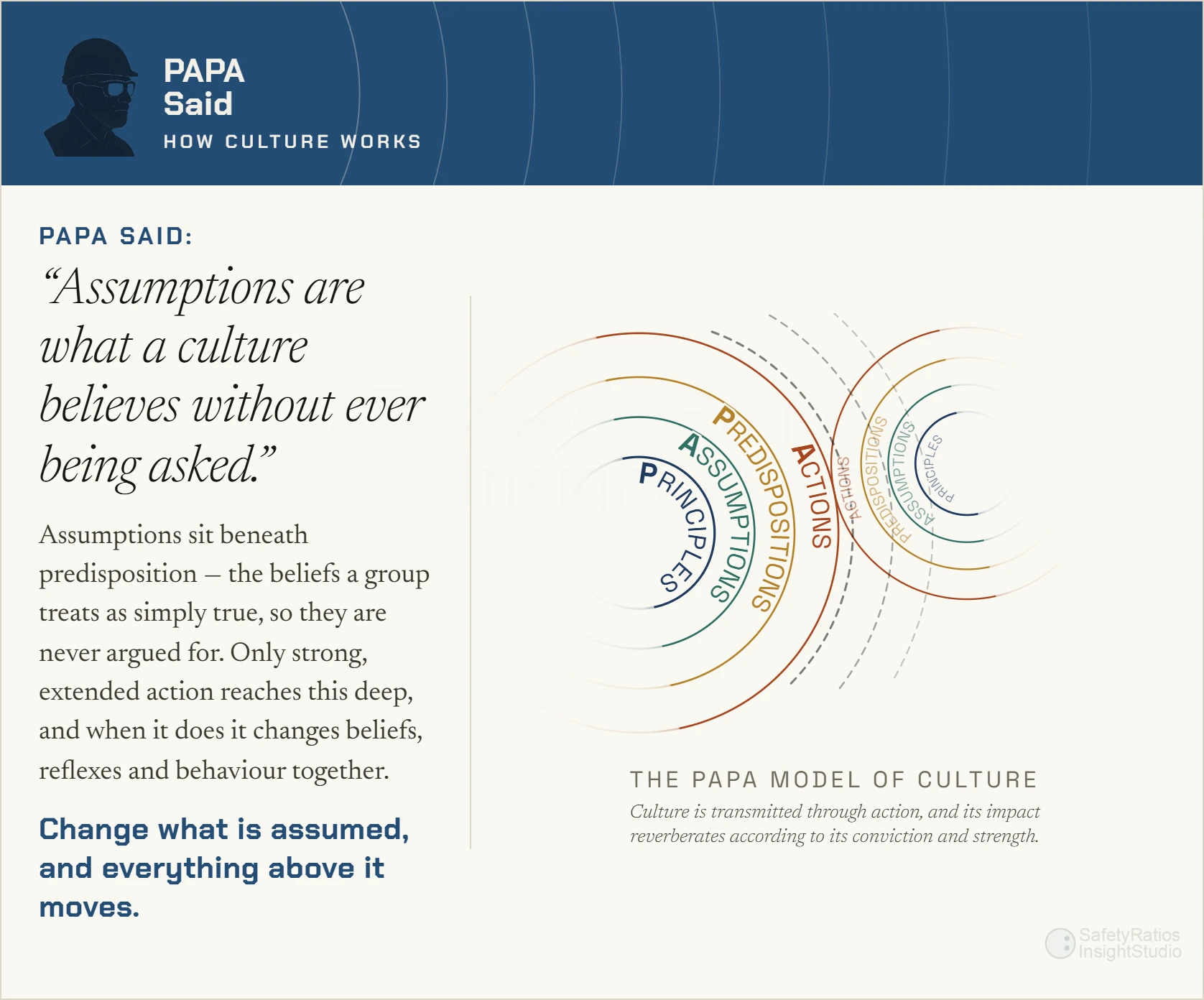
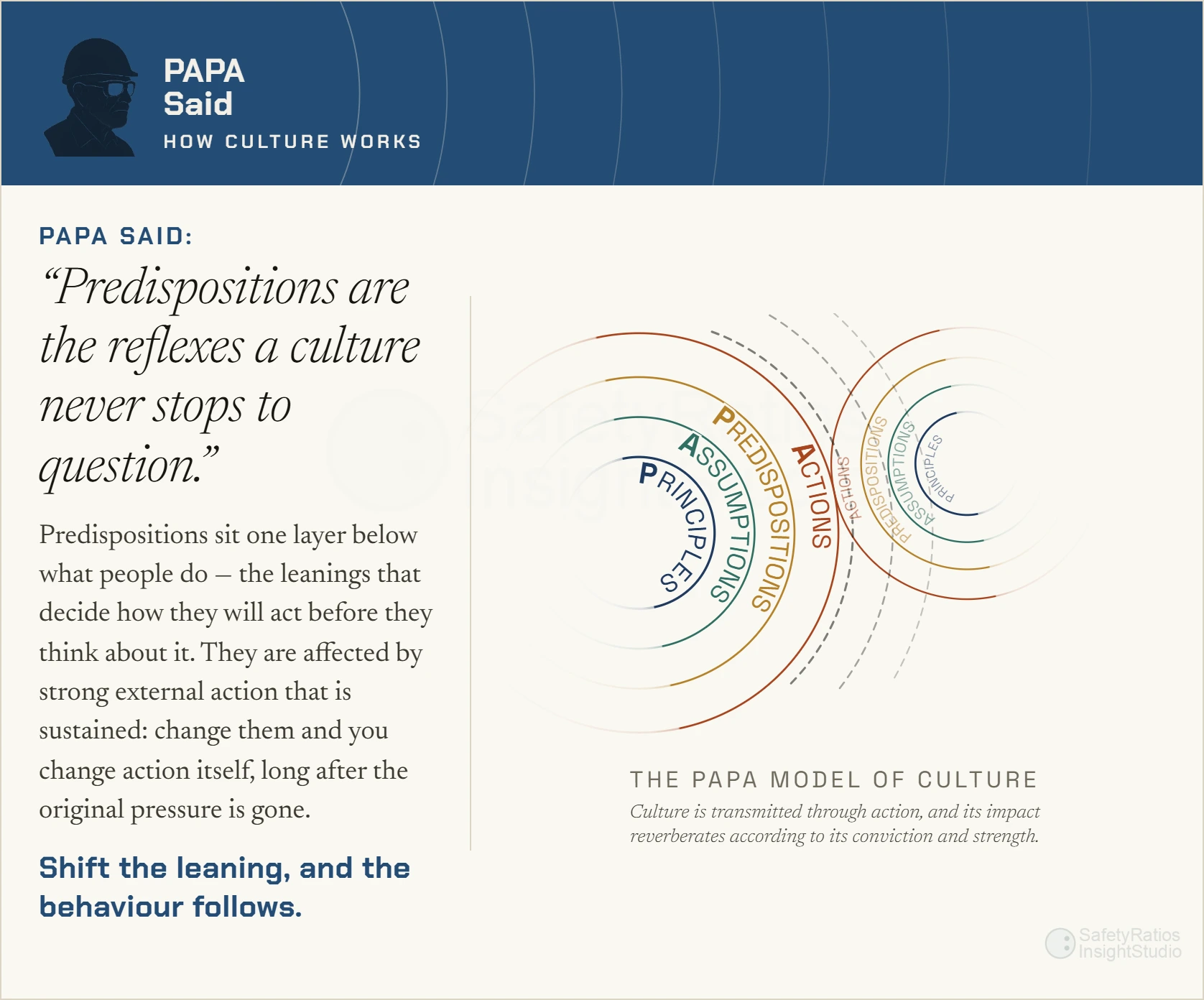
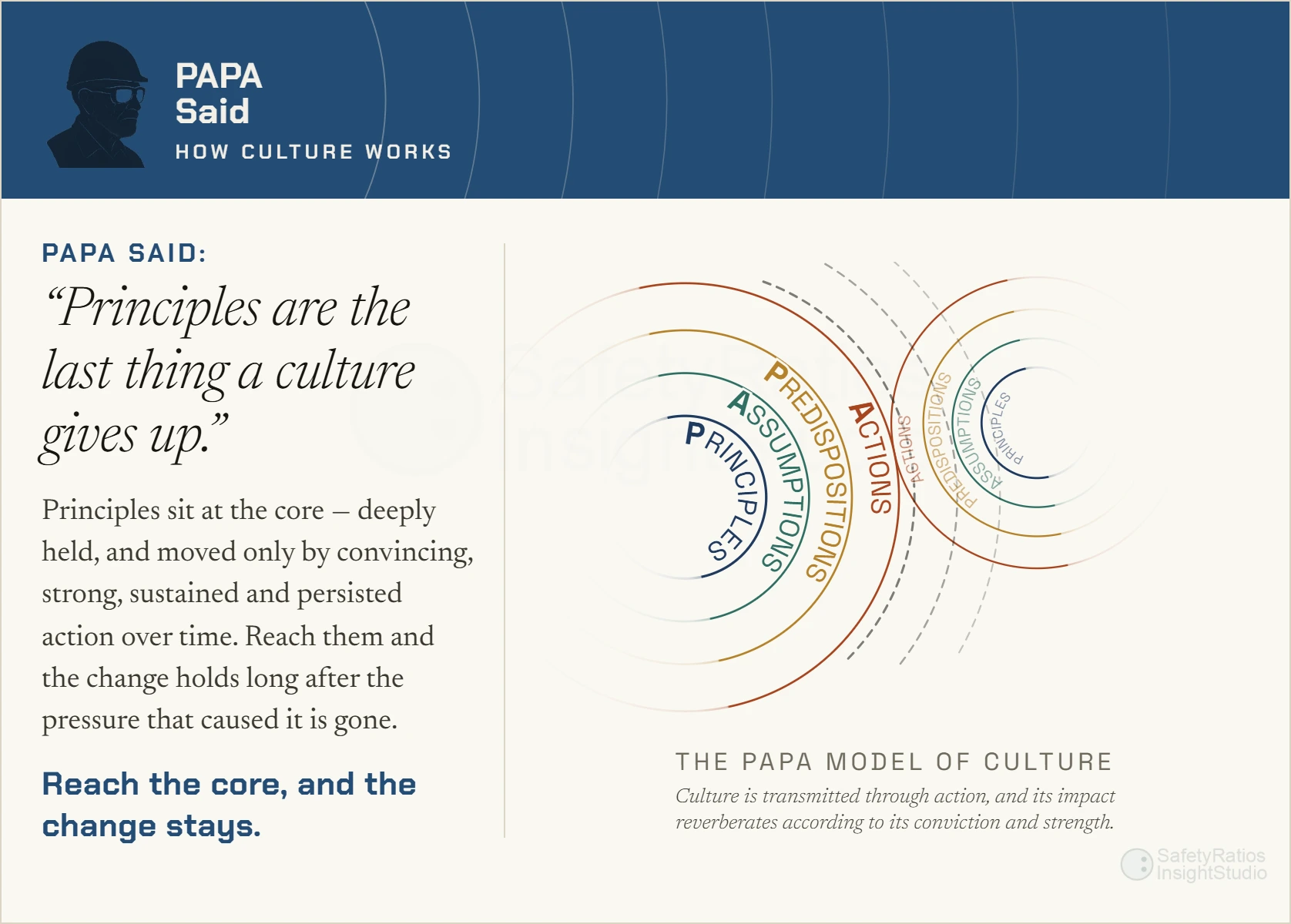
The PAPA model reads culture as layers. Principles sit at the core: the convictions people privately hold. Around them, assumptions: the beliefs a group holds about how its world really works. Around those, predispositions: the reflexes and defaults the beliefs set. And at the surface, action: the expression of all of those, the leading edge where a culture meets every other culture.
An external action strikes that edge and reverberates through the layers in waves, and how deep a wave travels is a contest: the strength, duration, conviction, and persistence of the action on one side, and the resisting strength of each layer on the other.
In plain terms: people watch what is done, and what they watch changes what they believe. The harder, longer and more sincerely something is done, the deeper the change goes.
In this worked example we analyse three phases: the operation as a decade of evidence built it; the leader-led transformation and its claims; and the practitioner-led alternative.
The Operation, Before
A mid-sized processing site inside a larger group. Its injury rate has been flat for a decade, above the sector benchmark. Audits pass and certifications renew. Past initiatives, a poster campaign, a near-miss drive, a behavioural pilot, each bought a dip and a reversion.
Read before any intervention, the layers hold a coherent story. At the surface: workarounds at night, cosmetic pre-starts, hazards walked past, reports filed thin. The reflexes beneath: quiet compliance while watched, private shortcuts while not, challenge reserved for the safety rep, and a We Don't Have Time for That approach.
The beliefs beneath those, each well taught: "schedule wins when it matters", taught by years of decisions under pressure; "reporting brings paperwork, not fixes", taught by a backlog of unanswered reports; "the rules flex at night", taught by what supervision tolerated on the shifts nobody senior attends.
And the actions that taught those beliefs came from everywhere: the budget that deferred the crane refurbishment, the promotion of a supervisor famous for hitting dates, the maintenance requests that died in the system. The actual problem is a belief structure, taught by the whole organisation, expressed at the surface as behaviour.
Then the leadership changes. A new managing director arrives from outside, reads the decade of flat numbers, and makes safety transformation the signature commitment of their tenure: stated to the board, funded for three years, led in person. It is leader-led.
The site is about to receive the strongest push for change it has felt in years, and the conviction behind it is genuine. The next sections audit what the machinery of a typical transformation does with that conviction, because conviction reaches the layers only as what the leader visibly does when it costs.
The Transformation, As Implemented
The managing director launches it personally, area by area. The group engages a specialist consultancy and funds a multi-year roadmap with ongoing support built in: annual re-surveys, refresher training, sustainment visits from the programme team.
The package covers the familiar ground:
- Measurement. A baseline safety climate survey benchmarked against an industry index and repeated annually, plus a culture maturity assessment placing the site on a five-step ladder
- Leadership. Safety leadership training for every manager and supervisor, scheduled site tours, and a visible-commitment standard for the top team
- Behaviour. A behavioural observation programme with conversation cards and participation targets, and a set of golden rules for the highest-risk activities
- Engagement. Refreshed safety committees, a champions network, and workforce representation in the programme's governance
- Competence. A training cascade in behavioural safety and human factors: error types, fatigue, the limits of procedures
- Reporting and learning. A just-culture policy, a rebuilt incident reporting system, and a commitment to investigate for learning rather than blame
- Contractors. The rules, inductions and observation programme extended to everyone inside the gate
- Communication. The brand, the town halls, safety moments opening every meeting, a recognition scheme, and the pledge wall
The claims are the standard ones, and the programme's own dashboard exists to prove them: hearts and minds won, behaviours changed, leadership visibly committed, the workforce engaged, a just culture embedded, reporting healthy, and the culture measurably matured, all sustained by the annual cycle.
Within eighteen months the dashboard delivers: training completion near total, observation cards above target, tours on schedule, survey scores up against the index, the maturity ladder climbed a level, and the injury rate finally off its decade-long plateau. The transformation is declared a success.
What the Intervention Jump-Started
Before auditing the claims, credit the ignition. A leader-led programme is a jolt of attention: safety becomes speakable, and hazards walked past for years get raised in the town halls.
The reporting channel re-opens, part quota noise, part real: people testing whether the new listening is genuine. The near-misses appearing in the system are a healthy signal, the crews resuming telling the truth about the job.
Programmes unlock money. The crane refurbishment that three annual budgets had deferred is approved in the first quarter, because a transformation with the managing director's name on it cannot afford its own contradiction standing in the yard.
The golden rules hand the workforce a vocabulary that outranks rank: the newest labourer can say "that's a golden rule" to a supervisor, and while the programme's authority stands behind the phrase, the words carry.
Together this opens a window: a period in which the layers beneath are unusually reachable, because the daily evidence really has changed. Motivation, funding and participation are all up, and the behavioural changes are significant, potentially backed by new beliefs and reflexes.
The PAPA Layer Audit: Claimed Against Actual
Now run each claim to the PAPA layer it says it fixed, and read what that layer actually held.
| The claim | The layer it points at | What the layer actually held | What never changed |
|---|---|---|---|
| "Hearts and minds won" — survey scores up | Convictions and beliefs | Survey answers are performances at the surface; no watched decision changed, so the beliefs stood. Cores were hardly modified by any programme | Decisions under pressure still resolved in favour of schedule requirements more than safety demands |
| "Behaviours changed" — observations above target | Action, via reflexes | The surface held its shape while watched; card quotas produced volume without substance, thin observations that carried no real information | Supervision on nights unchanged; the private shortcut survived |
| "Visible leadership commitment" — tours complete | Beliefs, via leadership action | Scripted tours are low-cost acts, and the workforce see them as such. The costly decisions, budget, schedule, promotion criteria, pointed the old way throughout | The date-hitting supervisor kept rising |
| "Workforce engaged" — committees and champions active | Beliefs, via participation | The same few volunteers filled every seat; attendance was measured, influence was not. | The decisions that mattered were taken in rooms the committee never entered |
| "Just culture embedded" — policy published | Beliefs, via the response to error | A policy is an announcement. The belief waited for the first test case, and the disciplinary matrix that would decide it was never amended | The response to the next honest error, still unwritten |
| "Reporting culture improved" — counts up | Beliefs, via the reporting loop | Counts rose to meet the target; content thinned. The belief "reporting brings paperwork, not fixes" was confirmed. | The maintenance backlog kept swallowing reports |
| "Culture matured a level" — ladder climbed | The whole structure | The ladder measured the programme's artefacts, training, cards, tours, rather than the layers. It certified activity and said little about belief | All of the above |
And the injury rate? It showed improvement, in part from the watching effect created by the heightened focus of the programme environment, and in part because the programme was led from the very top. What was real and traceable in that improvement is the next section.
What Was Actually Fixed
The final analysis of the programme is that what worked and what was claimed were two different lists. The hazard reviews bought real engineering: the lifting plan rewritten, the exclusion zones rebuilt, the crane refurbished. Costly standing actions, and the beliefs around lifting genuinely moved.
One area manager used the programme as cover to make extensive changes with the influx of funds and attention. His area's beliefs moved, measurably, and stayed moved after the programme ended.
A clear image of the mechanics emerged, in two patterns:
- Wherever the programme coincided with a costly, standing, watched act, the layer beneath shifted
- Wherever it was communication, cascade and cards alone, the layer held
The programme succeeded exactly where it stopped being a programme and became action.
The Reversion to Baseline
Programmes crest, and the attention moves on. The team and the budget move to the next division, and the weekly drumbeat thins to a schedule. The sustainment package, an annual re-survey, a refresher week, a quarterly visit, is still episodic attention: wider-spaced jolts slow the settling, they do not hold the shape.
First the artefacts decay: cards drift to quota-filling, then the quota lapses; tours slip from monthly to none.
Then the surface relaxes: the watching effect fades with the watching and beliefs that were never rewritten resume driving the old reflexes.
The annual re-survey loses its relevance, as do the other threads of the programme, including the visible leadership of its original sponsors.
As if to add dark humour to a sorry story of decline, financial decisions taken far from the safety department, and without its knowledge, remake the culture into one of financial survival, just as the safety team completes its reports on the most recent safety climate: a climate that will not survive the new financial realities of the operation.
By the third year the curve is drifting back toward its old plateau. The layers settled back toward the shape the daily evidence supports.
Reversion speed is a depth gauge: what was held by attention alone snaps back fast, the cards, the tours, the survey scores; where a belief was actually rewritten, practice persists. Here the lifting regime holds, the area manager's patch holds, and everything else settles back within eighteen months.
The few elements of the programme that survive are those held together by processes integrated into everyday workflows and supported by the right financial and human resources: standing constants that keep making the point on their own.
| What the jolt started | The constant that would keep it | What happened without one |
|---|---|---|
| Reporting re-opened; counts and substance up | Every report answered inside a fixed window, permanently | Counts decayed to quota-filling; the channel went quiet again |
| Challenge cheap; the golden-rule vocabulary carried | Stop-work authority devolved, published, backed at each use | Challenge retreated to the safety rep within a year |
| Leadership visible; mixed messages briefly discussable | Bonus metric amended; backlog reported beside injuries | Tours lapsed; budget and schedule pressures resumed unopposed |
| Surface compliance held under the attention | Standing verification at the start of every job, never skipped | The watching effect faded; the workaround returned at night |
| Just-culture policy published and welcomed | The disciplinary matrix amended before the first test case | The first punished self-report re-taught the old belief in a day |
| Deferred engineering funded and done | None needed: changes built into the plant are their own constant | Held. The one line on the dashboard that never reverted |
The Practitioner's Alternative: Working the Layers in Real Time
The PAPA model predicts this outcome before the kickoff: a transformation as commonly applied is a series of short-lived, low-cost gestures aimed at the surface. The workforce prices each one by what it costs, and its message is cancelled by the louder, costlier messages still arriving from budget, schedule and promotion, the mixed messages the programme never went looking for.
The alternative lives in-house: a practitioner, a safety manager, an operations lead, sometimes the leader themselves, who understands the layers and works them in real time, using the leader's conviction as capital. The practice has a rhythm.
The practitioner reads before writing, and never stops reading: first responses when no manager is present, what reports say rather than how many arrive, who challenges whom and what it costs them. The output is a live belief register, each operative belief, the evidence teaching it, its direction of travel, rewritten constantly, because by the time any survey has measured the culture, it has already changed.
The decisive move: sit where the waves are made, the meetings that set schedules, budgets, contracts and promotions, and say out loud what each decision will teach before it is taken: this cut will teach the night shift that the rules flex. This is where the leader's conviction is converted into decisions people can believe.
Then write, slowly, one belief at a time. Pick the belief doing the most damage, land one costly, visible, standing act against it, freeze it into structure, and check it held by watching what happens when nobody is enforcing it. Three or four beliefs a year: slower than a launch, yet capable of more enduring results.
The rhythm, in practice, runs from daily to annual:
| Rhythm | The practice | What it reads or writes |
|---|---|---|
| Daily | Answer reports as they arrive; watch one job start to finish | Reads the reflexes; writes "reporting brings fixes" |
| Weekly | Walk the pressure points, nights, handovers; hold one unscripted conversation at the workface | Reads first responses; updates the belief register |
| Monthly | Sit in the schedule and budget meetings; say what each decision will teach before it lands | Catches mixed messages at the source |
| Quarterly | Review the target belief; establish one costly standing act; freeze it into structure | Writes one belief at a time |
| Annually | Audit the standing changes: which still make the point on their own; watch what holds when enforcement pauses | Verifies depth rather than artefacts |
The pressures never stop arriving. A new contract lands with an impossible date; a downturn puts finance back in charge; a new supervisor imports old reflexes. Each will teach the workforce something, whether or not anyone is watching what it teaches.
Resilience, in this model, is exactly two things: the standing changes accumulated, structures that keep making the right point on their own, and the speed at which the operation notices and answers each new pressure. Both are built over years, neither is ever finished, and that is the main lesson of this case.
A transformation is a drive; culture is a struggle. The drive's attention is external and episodic, even when a sustainment package keeps it coming; the practitioner's attention is internal and continuous. What the operation needs is an understanding of the layers, held by people who stay, applied to every decision the workforce watches.
The site's beliefs were a fair reading of what the organisation had been doing for a decade. Only changing what it does, and keeping it changed, was ever going to re-write them.
Frequently Asked Questions
Is this a real case?
It is a typical composite: an operation, a programme and a multi-year arc assembled from patterns that recur across plants, projects and networks, written so a safety professional recognises their own ground. The package is drawn from the typical coverage of real transformation practice, measurement and benchmarking, leadership standards, behavioural observation, engagement, competence, just culture, communication, without depicting any provider or methodology.
Is this an argument against safety transformation programmes?
Against a common shape of them: episodic, announcement-heavy, measured by their own artefacts, and aimed at the surface. The case deliberately gives the programme its best shot, leader-led, genuinely resourced, with ongoing support, and credits what the jolt starts: attention, re-opened channels, unlocked money, a language for challenge. The finding is that even the best-supported drive is episodic attention, and episodic attention cannot hold the change in place; only standing changes built into the operation can.
What counts as a constant?
A standing action that keeps making the point after the programme's attention has gone: an amended bonus metric, a backlog reported beside the injury numbers, an answered-report window, a devolved and published stop-work authority, a verification built into the start of every job. The test is whether it still works when nobody remembers the programme. A person can serve as a constant for a while; structure outlives the person.
What does the PAPA-literate practitioner actually do?
Reads the operation continuously, first responses, report substance, the canteen, and keeps a live register of the operative beliefs and what is teaching them. Sits in the meetings where costly decisions are made and names what each will teach before it lands. Then writes one belief at a time: a costly standing act a quarter, built into structure, checked by what still holds when nobody is enforcing it. The job is a rhythm rather than a launch, and it is never finished, which is the point.