What Is the PAPA Model of Culture
How Culture Actually Works, from Conviction to Action
Most descriptions of organisational culture describe an atmosphere: something an organisation has, measured by survey, improved by campaign. Within the safety management space, safety culture is rightly defined by its narrow focus on safety, but wrongly limited to it, with minimal acknowledgement of the adjoining subcultures that influence it.
Safety culture is in fact one of many subcultures inside an organisation, all competing for leadership and resource attention, and understanding it requires the broader understanding of how culture itself works. The PAPA Model supplies that: it explains culture as structure in perpetual evolution, morphed by the actions of every other culture it encounters.
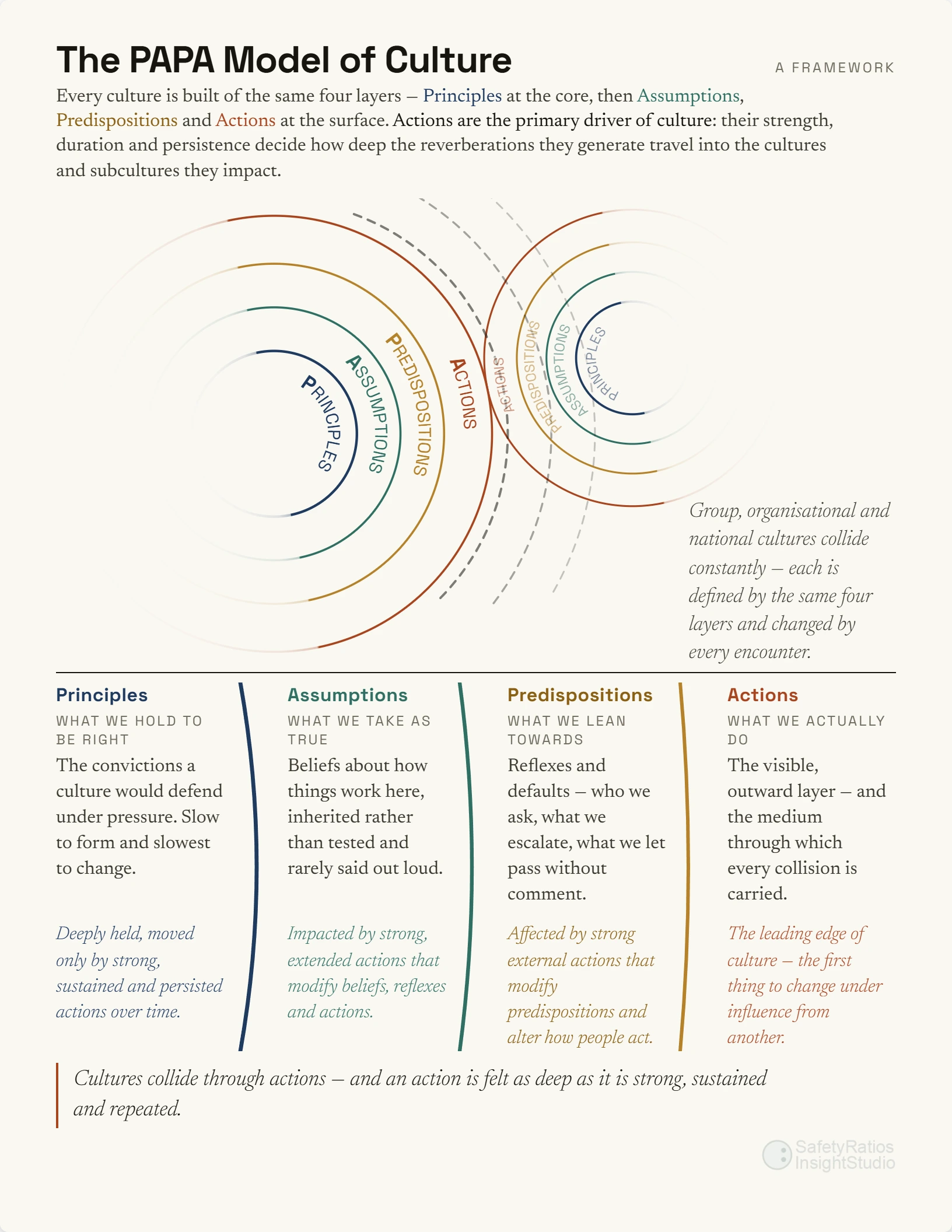
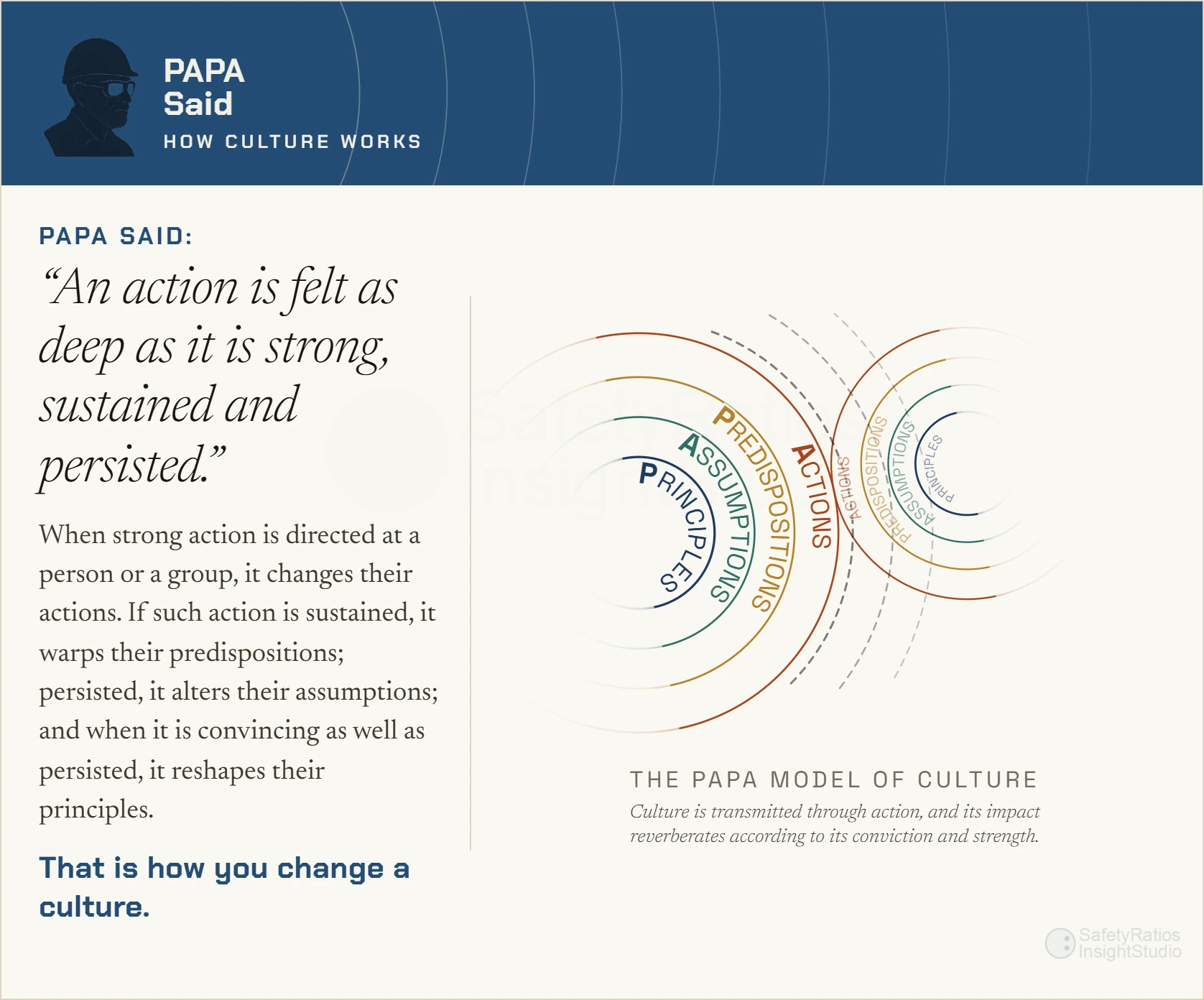
Culture is built on principles at its core. Those principles underpin the assumptions of the people who hold to that culture, inform their predispositions, and power every action they take: Principle, Assumption, Predisposition, Action. So every action is powered, ultimately, by conviction.
Actions powered by convictions out of one group is received by another group - the object of that action. As they land on other groups, and on the people who make those groups up, their effects ripple through the receivers' own PAPA layers: they impact their actions, may alter their predispositions, change their assumptions, and, seldomly, even the principles they hold dear.
Each response is then informed by the changed state of the responder's own PAPA, and their resulting actions land on others in turn, ripple after ripple, on and on. Heard from any distance, the entire system generates a cacophony of actions and re-actions, ripples tangling and colliding, and that is the point the model exists to make: culture is a system in perpetual evolution.
Definition and Core Purpose
The PAPA Model reads culture as four elements, layered from the core to the surface:
- Principle – a conviction: the ethical or organisational anchor a healthy culture would hold: respect, integrity, accountability, trust, courage, humility
- Assumption – a belief: the quiet mental conclusion that undermines the conviction, rarely articulated aloud: "Safety is management's job." "A quiet dashboard means a safe operation." "The documents describe the work."
- Predisposition – the reflexes and defaults the belief sets: passivity, defensiveness, cynicism, individualism, short-term thinking
- Action – the expression of all of those: the observable behaviour the reflexes drive: silence about hazards, corners cut on the floor, prevention shaved from the budget, findings closed on paper rather than in the plant
The structure is the diagnostic tool. It shifts the question from "how do we stop this behaviour?" to "which belief makes this behaviour reasonable to the person holding it?" A behaviour that looks like carelessness from outside is usually a sound decision inside the assumption that produced it, and the PAPA model exists to name that assumption.
Principle: The Conviction
A principle is a conviction: what the organisation would stand for at almost any cost: the value its decisions under pressure would confirm, whatever the wall slogans say.
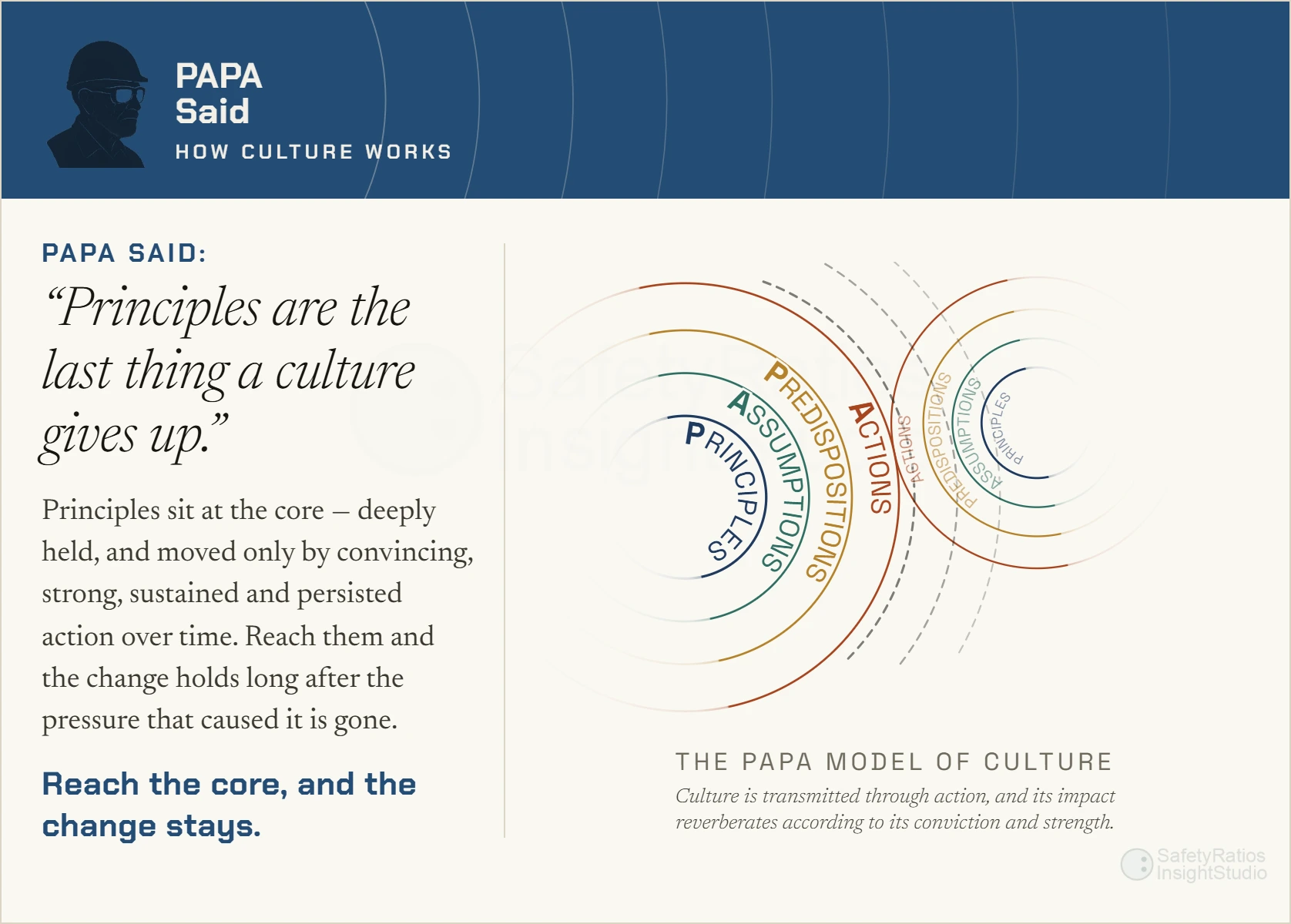
Convictions are also personal. They belong to the individual members of the group that shares the culture, and from respect to integrity to empathy, it is these personal convictions that ultimately drive the actions of that culture.
Convictions are deeply held and enduring, and they drive in both directions: the ultimate driver of action in the primary sense, initiating what a person does unprompted. And it is also the ultimate arbiter of re-action in the secondary sense, governing the response to actions thrust upon the individual or the group.
Each conviction works both ways. Below is a list of some of the most commonly held principles and examples how they relate to initiating action and generating re-actions:
- Respect – initiates actions that treat every person's safety equally; informs reactions that defend whoever is being excluded or diminished
- Integrity – initiates actions that surface problems; informs reactions that refuse to bury what arrives buried
- Accountability – initiates ownership of any hazard in view; informs reactions that answer for outcomes rather than deflect them
- Trust – initiates speaking up in the expectation of protection; informs reactions that extend good faith when the organisation stumbles
- Courage – initiates the call when you see it; informs reactions that hold the line when the call is unwelcome
- Learning – initiates questions and experiments; informs reactions that mine failure for information rather than for blame
The principle is the reference point for the whole structure. Culture erodes one principle at a time rather than failing wholesale, and naming which principle is under attack is what makes the rest of the diagnosis possible.
Assumption: The Belief
Between conviction and reflex sits the assumption: the belief a person holds about how their world actually works, formed from what they have watched happen more often than what they have been told. Where a conviction says what should matter, the assumption says what is true here, and the two do not always agree.
Assumptions are at the core of the common description of safety culture as "the way things are done here".
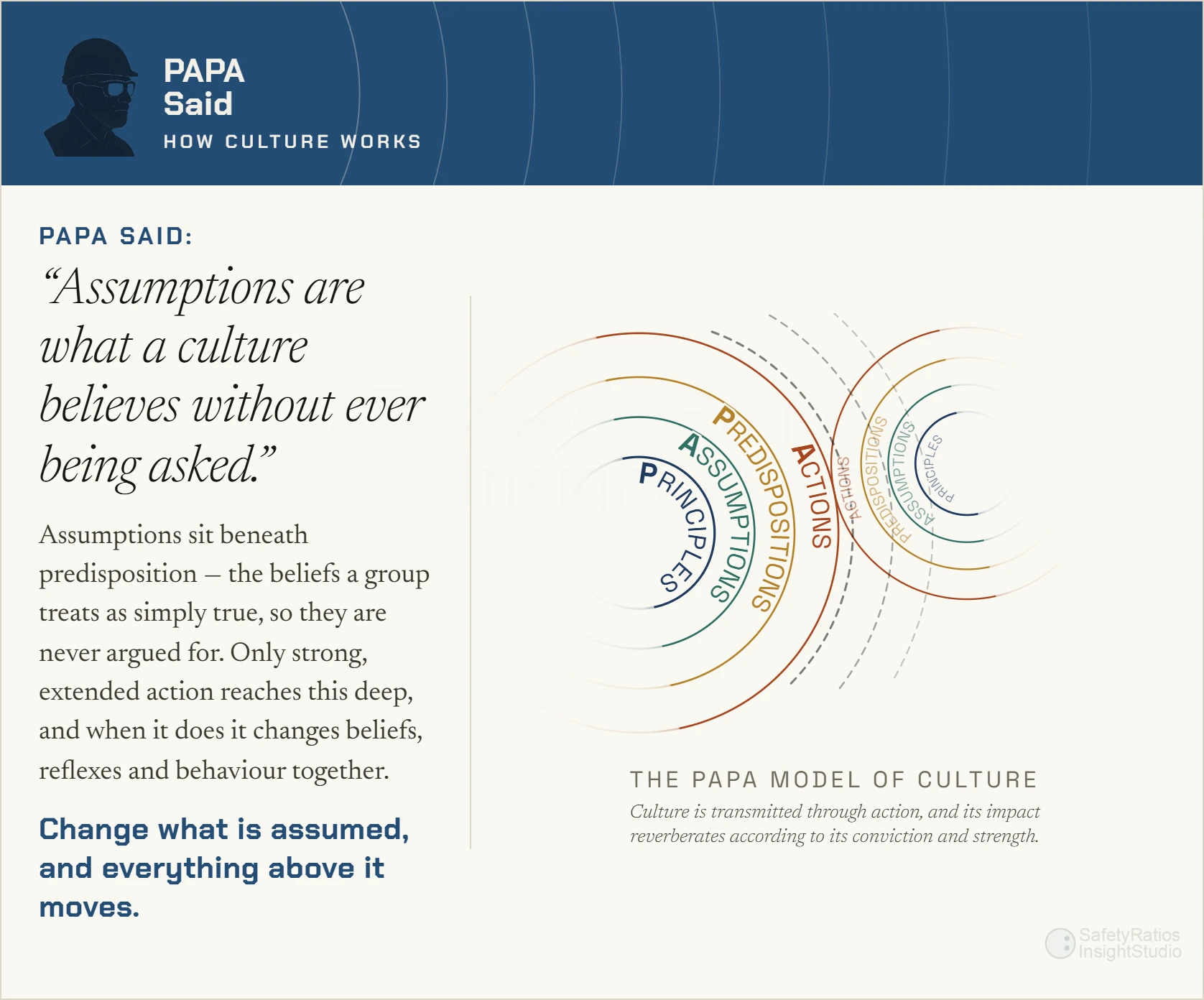
Assumptions are held quietly, almost never said aloud in front of management, and they are usually reasonable: someone was punished after reporting, so "people get punished for reporting errors"
And they form at every level. Years of green dashboards teach an executive "a quiet site is a safe site"; years of tidy files teach an auditor "the documents describe the work." Each is reasonable, learned from the evidence supplied, and wrong in exactly the way that matters.
In action, (the primary sense), the assumption layer is the gatekeeper between conviction and deed. A conviction initiates; the assumption clears or blocks the launch. The worker who holds respect and believes reporting is punished files no report: the conviction supplied the drive, the belief withheld the permission. Result = no action.
The gate operates at every level. The director who holds care but believes candour spooks the market clears no disclosure; the auditor who holds integrity but believes challenge sours the client raises no finding.
In re-action, (the secondary sense), the assumption is the first interpreter of every action that lands. It reads the incoming act for meaning, what does this decision say about how things really work here, and it is the layer most revised by what arrives: beliefs persist exactly until stronger evidence replaces them.
That is also how personal layers become shared culture. Individuals watching the same evidence converge on the same beliefs, which makes assumptions collective in practice, and the load-bearing layer of the PAPA model. Surfacing them takes listening structured for the purpose: ask "what happens here to the person who reports?" rather than "do you feel safe?"
Predisposition: The Reflexes and Defaults
Between assumption and action sit the predispositions: the reflexes and defaults, the posture people fall back on ahead of any particular decision. Beliefs set them, and each is the rational reflex for the belief beneath it.
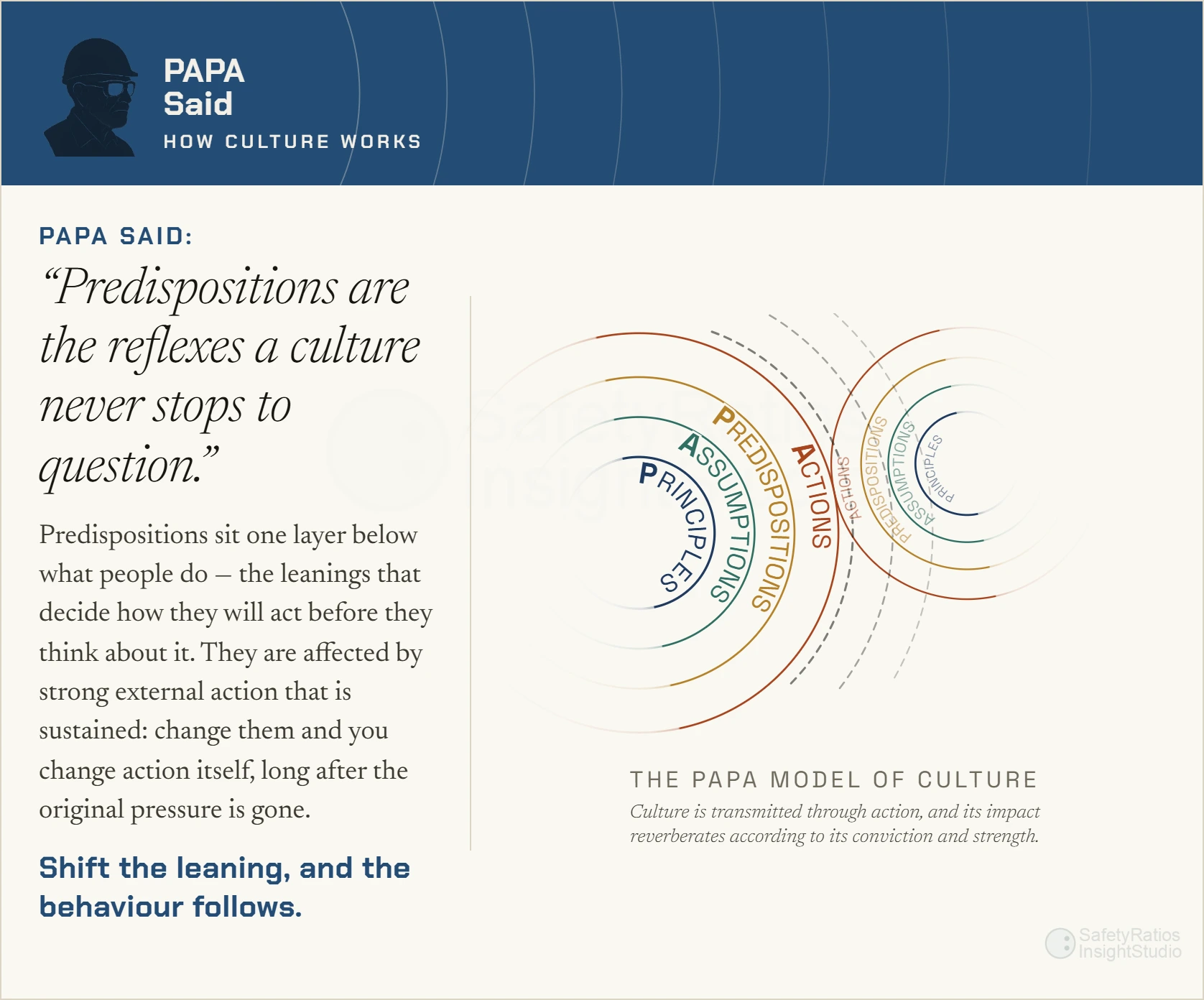
A workforce that believes reporting is punished defaults to defensiveness; one that believes safety belongs to management defaults to passivity. A board that believes candour spooks markets defaults to secrecy; an audit team that believes the paperwork is the work defaults to the checklist. Cynicism, individualism and short-term thinking recur everywhere.
In action, the primary sense, the predisposition is the accelerator. Conviction initiates, the assumption clears the launch, and the reflex executes, without deliberation, at habit speed. Most of what a culture does in a day is launched by its defaults rather than its decisions, which is why the defaults are where a culture's real priorities show.
In re-action, the secondary sense, the predisposition is the first responder, and the damper. It answers incoming actions before thought arrives, the flinch, the silence, the instant pushback, and it absorbs what the belief layer has not yet endorsed: when an episodic wave (like most cultural transformation programmes) fades, it is the reflexes that push the old behaviour back out.
The predisposition is why culture change feels slow. Behaviour can be corrected in a toolbox talk; a reflex re-produces the behaviour the following week, because the reflex was never addressed, and the defaults travel with the people rather than the task.
Two are common enough that the series names them outright: We Don't Have Time for That, the reflex of defeated prudence, and Comfort in Familiar Risk, the reflex of defeated learning. Most sites will recognise both without an introduction.
Action: The Expression
At the surface sits action: the expression of conviction, belief and reflex together, and the only layer anyone else can see. This is the leading edge, where subcultures project influence on others subcultures, groups and individuals.
The near miss not reported, the pre-start checklist auto-filled, the prevention budget quietly shaved, the finding closed on paper rather than in the plant.
Every audience meets the culture here: the line manager in the observation round and the state of the walkway, leadership in the decisions minuted and unminuted, the auditor in the record and in its gaps.
In action, the primary sense, the edge publishes the completed outward journey: the conviction initiated, the belief cleared, the reflex executed. A culture cannot help publishing itself; its actions are the publication, the whole interior made visible.
In re-action, the secondary sense, the edge is both the landing ground and the reply desk. Every incoming action lands here, and the answer the inner layers assemble leaves from here, and a re-action is an action to everyone watching it, carrying the same evidential weight as anything initiated.
Contact between cultures is therefore always edge against edge, never interior to interior. Everything a culture will ever learn about another arrives through this outermost surface: what a night shift knows of the boardroom is the boardroom's actions, and what the boardroom knows of the night shift is the same in reverse.
The model's warning is that the action is evidence of the culture rather than its cause. Discipline the action and the assumption beneath it remains, ready to produce the next action, often better hidden than the last. The visible behaviour is where diagnosis starts, and where intervention should not stop.
The Cacophony of Actions and Re-actions That Drives Culture
Because contact is edge against edge, every action is a transmission. When an action is taken it travels outward from the actionee and lands on the leading edge of every culture and subculture it touches, a crew, a department, a workforce, and of every person within them, and from there it reverberates inward through the layers of the impacted.
But no wave travels alone. Every culture in the system is acting and answering at once, and the ripples cross each-other: actions collide with re-actions, reverberations tangle with reverberations, answers become new waves before the waves that caused them have faded. At any moment the system is a tangled mess of actions and re-actions, and it is the whole mass of acts, taken together, that drives culture.
Collisions decide as much as strength does. Waves pointing the same way reinforce: when the leadership decision, the budget line and the roster all teach the same lesson, it lands with their combined force.
Waves pointing opposite ways collide: the policy that says safety first meets the procurement wave that says cost first, and the belief layer goes to whichever wave is felt, longer-lived and more persistent, almost never to the weaker request-like announcements.
How deep any surviving wave then travels is a contest: on the action's side, its strength (what it visibly costs and changes), its duration (a moment, or a standing structure that keeps acting), and its persistence (whether the signal keeps arriving); on the culture's side, the resisting strength of each layer in turn.
- The action layer yields first: threats of sanctions and consequences trigger almost immediate compliance in most cases. For example the introduction of new regulations send organisations taking immediate actions to comply.
- The belief layer resists: assumptions give way only to sustained contradiction, evidence arriving again and again against them. For example the successful prosecution of just one organistion under new legislation makes clear the intention of the authorities to follow through.
- The reflexes re-set once beliefs move: defaults take their shape from the layer beneath them rather than from the instruction. Organisations tend to create new roles and resource capacity to ensure they are agile in face of new regulations.
- The core is absolute: convictions are seldom reached by actions unless they are themselves powered by strong convictions that align with those of the recipients of such actions. So organisations will comply with new goverment policies and targets but will continue to lobby for the replacement such administration and policy changges that align their own values
Subcultures: The Same Model at Every Scale
Culture occurs in nested subsets. Civilisational cultures sit above national ones, then sector, then organisation; inside the organisation, functional subcultures, safety, finance, production, quality, leadership among them, then the chartered and emergent groups within.
And at the smallest scale, the person: the same four layers in miniature. Culture itself is a property of groups; the person is the carrier through which every culture is expressed and answered.
Every subset is the same four layers, and they touch only through action, edge against edge. Context decides which subculture is energised at any moment, and safety culture, commanding few levers of its own, lives largely on the waves the others emit.
This is why many organisations inadvertently rewrite their own safety culture without ever taking a safety decision. See the worked example for how decisions taken far away from any safety consideration rewires the safety culture while the safety team were reviewing the findings of their latest (now unbeknownst to them) obsolete safety climate survey.
In Conclusion
Culture is architecture in motion: principles, assumptions, predispositions, and the actions that express them, layered from the core to the edge in every group, organisation and civilisation, and carried in every person who makes them up.
And it changes constantly. Every action triggers a re-action, which triggers action elsewhere, and a culture is often still absorbing one wave while sending out reverberations of its own. The cacophony of actions and re-actions is the core of the complex system that drives culture.
Great organisations can tell the difference between the noise the system generates and the signal they can harness, and they use it to find their point of maximum impact and leverage: where to act, when to act, for how long, and which levers to pull, buttons to push.
Organisations re-write their culture every day through what they do. The PAPA Model offers the tool to read what is being written, and to start writing it deliberately: aligning actions into the unison that gives them a collective, directed effect beyond the reach of any individual act.
Frequently Asked Questions
What is the PAPA Model used for?
Explaining and diagnosing culture as layered structure rather than atmosphere. PAPA traces an observable behaviour inward through the reflex that makes it habitual and the belief that makes it reasonable, to the conviction beneath, and aims any intervention at the belief layer, delivered through sustained action, because that is where culture actually resets.
What do the four letters stand for?
Principles, Assumptions, Predispositions, Action, layered from the core out, and each with a paired role in the traffic: the conviction drives action and arbitrates re-action; the assumption gates the launch and interprets what lands; the reflexes accelerate the deed and damp the impact; and action, at the leading edge, expresses everything in both directions.
What is the difference between an action and a re-action?
Provenance, and nothing else. An action begins inside, the conviction initiating, the belief clearing, the reflex executing; a re-action begins outside, as the answered form of something that landed. To everyone watching there is no difference at all: both cross the edge, both are evidence, and both drive the layers of whoever receives them.
How is PAPA different from behaviour-based safety?
Behaviour-based safety works on the surface layer: observing, correcting and reinforcing actions. PAPA holds that a behaviour corrected while its belief survives will be re-expressed, often better hidden. The model uses observed behaviour as evidence for diagnosis, and aims the intervention two layers deeper, at the belief, delivered as sustained action rather than episodic correction.
Is PAPA a management-system tool?
No. PAPA is a culture model: it works on beliefs, reflexes and behaviours, none of which a clause can require. A formal safety management system touches the layers at known points, the policy states the principles, leadership behaviour writes the beliefs, the consultation climate shows the reflexes, and the reporting and investigation machinery records the actions, but the system's evidence reads mostly the surface, which is why a clean record can coexist with a defeated principle.