SMV-DR: The Decreased Reliability Observation
The Most Serious Observation Class: Variations That Corrupt the Safety System Itself
An SMV-DR (Decreased Reliability) is a Safe Method Variation in which the method used both increases risk and undermines the reliability of the safety systems around it. It is the most serious class in the SMV taxonomy, and the one that demands more than a task-level fix.
An SMV is the difference between work-as-planned and work-as-done, classified by its effect, and the distinction between the two negative classes is reach and survival.
An SMV-IV creates localised risk: the task crew becomes vulnerable while the task runs, and the exposure largely dies at close-out. An SMV-DR outlives the task: it degrades the machinery of protection itself, the interlock, the check, the record, so that every other task relying on that machinery inherits the damage.
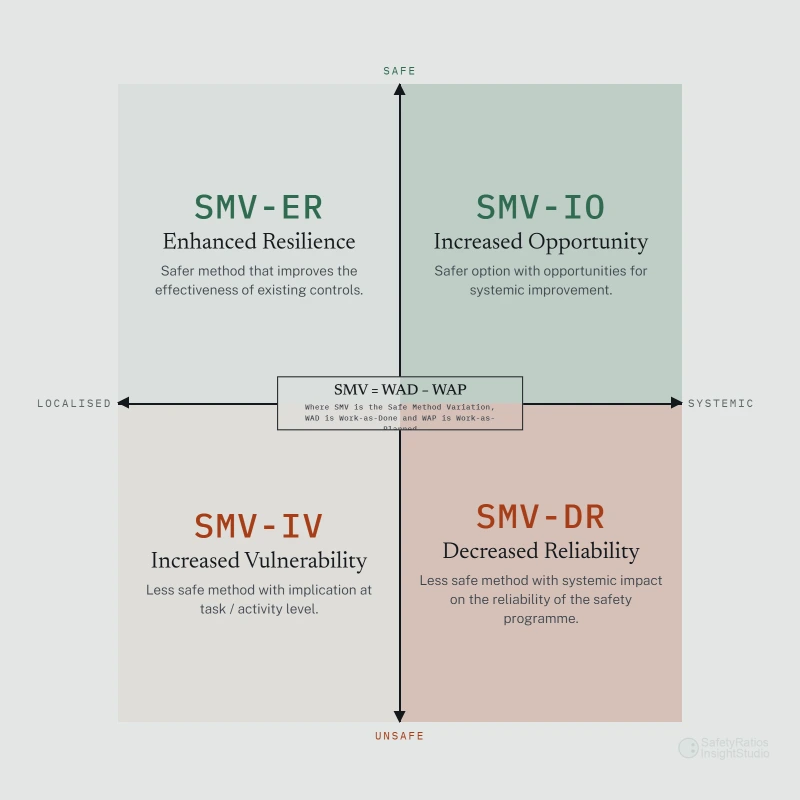
What Qualifies as an SMV-DR
The observed method must attack a safety system, not just spend a margin: a defence disabled, a verification performed on paper only, a record made untrue. The task at hand gets riskier, and the organisation's picture of its own safety gets falser at the same time.
Typical examples: an interlock bridged so the machine runs with the gate open; a pre-start check signed off unperformed; a gas monitor alarm muted for the shift; downtime logged against a different cause so the faulty equipment stays in service.
Each leaves an artefact that lies: a green record over a red condition. The documented information the management system runs on, in ISO 45001:2018 terms, stops telling the truth.
Why SMV-DRs Are Different in Kind
An SMV-DR propagates through two channels. The first is behavioural: a bridged interlock or skipped verification, seen to work and go unpunished, teaches the practice to everyone watching, and the risky behaviour walks off the task and into the next one.
The second is systemic knock-on: every safety system runs on the assumption that its own instruments tell the truth, that a signed check happened, a closed finding was fixed, a silent alarm found nothing. An SMV-DR breaks that assumption, and the break travels. One pencil-whipped inspection makes every inspection record less believable, and the tasks and decisions relying on those records inherit risk they cannot see.
That is the reliability in the name: the damage is not confined to the task where the variation happened. It survives the task, and it degrades the general controls the rest of the system depends on.
That is why an SMV-DR finding is never only about the task observed. It is evidence that somewhere, the cost of doing the check honestly has come to outweigh the perceived value of the check, and that trade will not be confined to one crew or one form.
What an SMV-DR Finding Demands
- Immediate restoration: the bridged, muted or falsified defence is returned to service before anything else
- A scope check, not just a spot fix: where one record lies, sample the neighbouring records; SMV-DRs are rarely solitary
- A pressure investigation: establish what made honest compliance expensive, an unworkable check, an impossible frequency, a metric that rewards green records
- A system-level response: redesign the check or the pressure so truth becomes cheaper than fiction, then verify the change held
- Careful people-handling: the recorded signature identifies who was cornered by the system, and only sometimes who deserves sanction
The Reading Beneath the Finding
An SMV-DR is the strongest cultural signal an observation can produce: it marks the point where a workforce stopped believing the safety system deserved honest inputs. That belief was taught, usually by checks that consume effort and produce nothing, findings that close on paper, and pressure that rewards the green dashboard over the true one.
A single incident investigation reaches this territory too late. A planned task observation that surfaces an SMV-DR while the record still looks clean is the early version of the same discovery, which is what makes the class worth its severity: it is the cheapest moment the organisation will ever get to repair both the defence and the belief.
Frequently Asked Questions
What does SMV-DR stand for?
Safe Method Variation, Decreased Reliability: the classification for an observed work method that both increases risk and undermines the reliability of the safety systems around it, such as a bridged interlock or a check signed off unperformed. It is the most serious of the four SMV classes.
What is the difference between an SMV-IV and an SMV-DR?
An Increased Vulnerability creates localised risk: the task crew becomes vulnerable to harm while the task runs, and the exposure largely ends at close-out. A Decreased Reliability survives the task and goes systemic: it degrades a general control or teaches a risky behaviour, so the damage extends to every task and decision that relies on that system, from normalised workarounds to knock-on risk elsewhere.
Why does one falsified check matter if the task went fine?
Because the safety system runs on its records being true. One pencil-whipped inspection makes every inspection record less believable, and audits, handovers and maintenance decisions all inherit the doubt. The harm is to the reliability of the system, and it persists long after the individual task is finished.
Should an SMV-DR finding always lead to discipline?
It should always lead to restoration, a scope check and a pressure investigation. Discipline depends on what those find: deliberate concealment for private convenience is different from a crew cornered by an unworkable check or a metric that rewards green records. Sanctioning the signature without fixing the pressure guarantees the next SMV-DR is hidden better.