SMV-IV: The Increased Vulnerability Observation
The Observation Class Everyone Records and Most Programmes Mishandle
An SMV-IV (Increased Vulnerability) is a Safe Method Variation in which the method actually used introduces additional risk or weakens existing controls compared with the approved method. It is the class observation programmes record most, and read least.
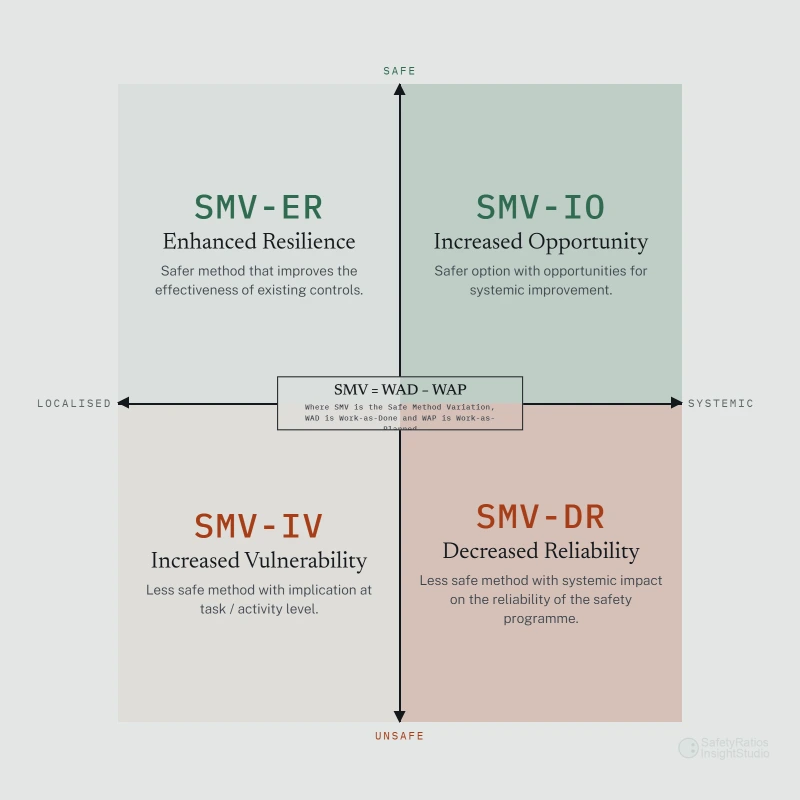
An SMV is the difference between work-as-planned and work-as-done, classified by effect in a four-class taxonomy. Within it, Increased Vulnerability is the localised negative class: the added risk lands on the worker or team performing the task, and it largely ends when the task ends. Its darker sibling, Decreased Reliability, is where the harm outlives the task and spreads into the system.
What Qualifies as an SMV-IV
The observed method must raise the risk of the task or thin its protections against the approved method: an exposure added, a control skipped, a protection removed. Whatever the variation gains in exchange, usually time, sometimes convenience, the classification follows the effect on risk, never the motive.
Typical examples: reinforcement bars manhandled up the shuttering to save rigging time, bypassing the lifting plan; a guard left off between cycles because refitting it is awkward; a gas test done at the start of the shift standing in for the continuous monitoring the permit requires.
The defining boundary is locality. An SMV-IV makes this task, this crew, this window more dangerous: the people doing the work become vulnerable to accident and harm while it runs. When the task closes out, the added risk largely closes with it, leaving the defences that other tasks rely on intact.
The Standard Response, and What It Misses
Most programmes respond with correction: stop the task, restate the rule, record the deviation, perhaps discipline the person. Correction is often necessary, and it is never sufficient, because it treats the variation as a choice made in a vacuum.
An SMV-IV is almost always an answer to something: a schedule that does not fit the method, tools that were not there, a method written for conditions the task no longer runs under, or years of watching shortcuts go unremarked until the audit week. Correct the person without reading the pressure, and the same variation returns with the next crew, better hidden.
The observation conversation is where the reading happens: ask what the shortcut buys, who else does it, and what would make the approved method the easier path. The answers usually name the real problem.
Why the Class Matters
SMV-IVs are the map of where the safety system is under pressure. Each one marks a point where the approved method lost a contest with production reality, and the pattern across many observations shows which pressures win most often, intelligence a single incident investigation reconstructs too late.
Handled as data, SMV-IVs also protect the positive classes. A programme that meets good-faith variation with assessment rather than reflex discipline keeps the disclosure channel open, and that channel is the same one that surfaces the improvements worth adopting.
How to Respond to an SMV-IV
- Make the task safe first: immediate exposure ends before any conversation starts
- Read before ruling: establish what the variation was answering, schedule, tools, method fit, before deciding what it was
- Fix the teacher, not just the taught: if pressure or a stale method produced the shortcut, correcting the crew alone changes nothing durable; corrective action in the ISO 45001:2018 Clause 10.2 sense addresses the cause, not the symptom
- Reserve discipline for the reckless minority: deliberate, informed disregard exists, and it is rarer than the record suggests
- Track the pattern: recurring SMV-IVs on one task or one pressure are a method or planning problem wearing a behaviour costume
The Classification Guard
The guard runs in both directions. A variation that looks efficient can hide a control being spent, which makes it an SMV-IV misfiled as an improvement; and a variation that breaks the written method while genuinely reducing risk is not an SMV-IV at all, but a positive class pointing at a method overdue for update.
Classification follows the risk assessment, not the rulebook alone: the question is what the change does to exposure and controls, not merely whether the text was followed.
Frequently Asked Questions
What does SMV-IV stand for?
Safe Method Variation, Increased Vulnerability: the classification for an observed work method that introduces additional risk or weakens existing controls compared with the approved method. It is the localised negative class: the risk lands on the task crew and largely ends when the task ends.
Is an SMV-IV the same as a violation?
Not automatically. An SMV-IV describes the effect of the variation on risk, not the intent behind it. Some SMV-IVs are deliberate disregard; most are adaptations to schedule pressure, missing tools or methods that no longer fit the work. The response should follow the cause, which is why the observation conversation matters more than the classification itself.
Why not simply discipline every observed shortcut?
Because most shortcuts are answers to pressures the organisation created, and punishing the answer leaves the pressure teaching the next crew the same lesson, better hidden. Reflex discipline also closes the disclosure channel that surfaces genuine improvements. Discipline has a place, for deliberate, informed disregard; reading the pressure comes first.
What does a recurring SMV-IV on the same task mean?
That the approved method is losing a repeated contest with reality: the schedule does not fit it, the tools are not there, or the method was written for different conditions. Treat recurrence as a method and planning review trigger rather than a behaviour problem.