SMV-ER: The Enhanced Resilience Observation
The Observation Class for Work Made Safer at the Same Cost
An SMV-ER (Enhanced Resilience) is a Safe Method Variation in which the method actually used is safer than the approved method, at the same cost. The task that took cost X under the approved method still takes cost X; the crew has found a way to spend the same time, effort and resource more safely.
An SMV is the difference between work-as-planned and work-as-done, classified by effect in a four-class taxonomy.
Enhanced Resilience sits beside Increased Opportunity as one of its two positive classes, and the pair divides by reach the same way the negative pair does: an SMV-IO reveals an opportunity for a better system, while an SMV-ER strengthens the system already in place, adding margin, capacity or an alternate path at the same cost.
The quieter win, and the easier one to miss.
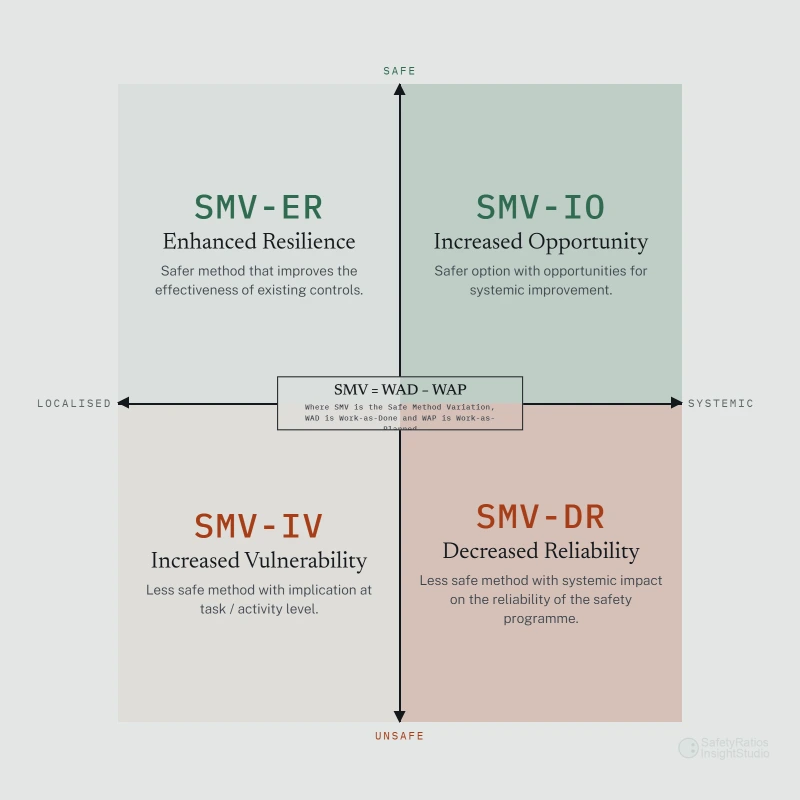
What Qualifies as an SMV-ER
The observed method must demonstrably reduce risk while consuming broadly the same time, effort and resource as the approved method, reinforcing how the task already works.
A variation that points beyond the task, to a better, faster or more cost-efficient way of working, belongs in Increased Opportunity; one that buys pace with exposure belongs in the negative classes.
Typical examples: a lift resequenced so the rigging is checked while the load is still grounded and nobody stands under a suspended path, taking no longer end to end; an inspection done from the permanent platform rather than a ladder that had to be fetched and footed; a handover reordered so the gas test lands before entry preparation rather than during it, inside the same window.
Each is the same job, at the same cost, arranged so less of it is exposed, usually in response to something the crew has seen or nearly seen.
Why the Class Goes Unrecorded
An SMV-ER is invisible to both of the filters observation programmes usually run. It carries no efficiency headline to catch management's eye, and no harm or breach to trigger the deviation form. Nothing appears to have happened, except that a risk quietly left the task.
Observers add a third filter: anything non-standard reads as deviation. A safer arrangement gets corrected back to the approved method simply for being different, and the crew learns to keep its improvements out of the record.
Why the Class Matters
SMV-ERs are the workforce's own risk assessment made visible. Where crews consistently rearrange a task for safety, they are showing the observer exactly where the approved method feels thin, which is intelligence no planned task observation checklist generates on its own.
Adopted, SMV-ERs are free safety: protection gained with nothing lost, which makes them the easiest adoption decision in the whole SMV taxonomy. The only work between finding one and standardising it is validation, and standardising it keeps operational control aligned with real work, as ISO 45001:2018 Clause 8.1 intends.
How to Handle an SMV-ER
- Record it as found: the observation captures the rearrangement and the crew's reason for it
- Validate the safety gain: confirm the reduced exposure is real against the risk assessment, rather than comfort ritual
- Check the reach: if the variation points beyond reinforcing this task, to a better way of working for the system, classify it as an SMV-IO; if it is quietly slower, have that conversation honestly rather than by drift
- Adopt and standardise: a validated SMV-ER should become the approved method as a matter of course, credited to the crew that found it
- Watch where SMV-ERs cluster: repeated safety rearrangements around one task are the workforce flagging a method that needs review
The Validation Guard
Not every altered step is resilience. Some are ritual: changes that consume attention without touching exposure. The test is the one every control faces: name the failure mode the new arrangement defends against, and show the defence is real under normal conditions.
Held to that standard, an SMV-ER on the record means something precise: the same work, at the same cost, made demonstrably safer, and adopted on those terms.
Frequently Asked Questions
What does SMV-ER stand for?
Safe Method Variation, Enhanced Resilience: the classification for an observed work method that is safer than the approved method at the same cost. The task still consumes the same time, effort and resource; the crew has arranged that spend more safely. It is one of the two positive SMV classes, alongside Increased Opportunity.
How is an SMV-ER different from an SMV-IO?
Both are safer than the approved method, and the pair divides by reach, the same way the negative pair does. An SMV-ER reinforces the current system: margin, capacity or an alternate path added at the same cost, cost X before and cost X after. An SMV-IO carries an opportunity beyond the task: a better, faster, more cost-efficient or more capable way of working that the wider system can adopt.
Should a validated SMV-ER be adopted into the procedure?
Once validated, adoption is close to automatic: the gain costs nothing extra, so the only questions are whether the reduced exposure is real and whether the arrangement holds under normal conditions. The variations needing a harder decision are the ones that turn out not to be cost-neutral after all.
What does it mean when crews keep adding margin to one task?
Clustered Enhanced Resilience variations are the workforce flagging that the approved method feels thin at that point. Treat the cluster as a signal to review the method and its risk assessment, and expect some of those reviews to surface Increased Opportunities as well.