SMV-IO: The Increased Opportunity Observation
The Observation Class We Rarely Use, for Work Done Safer and Better Than the Procedure
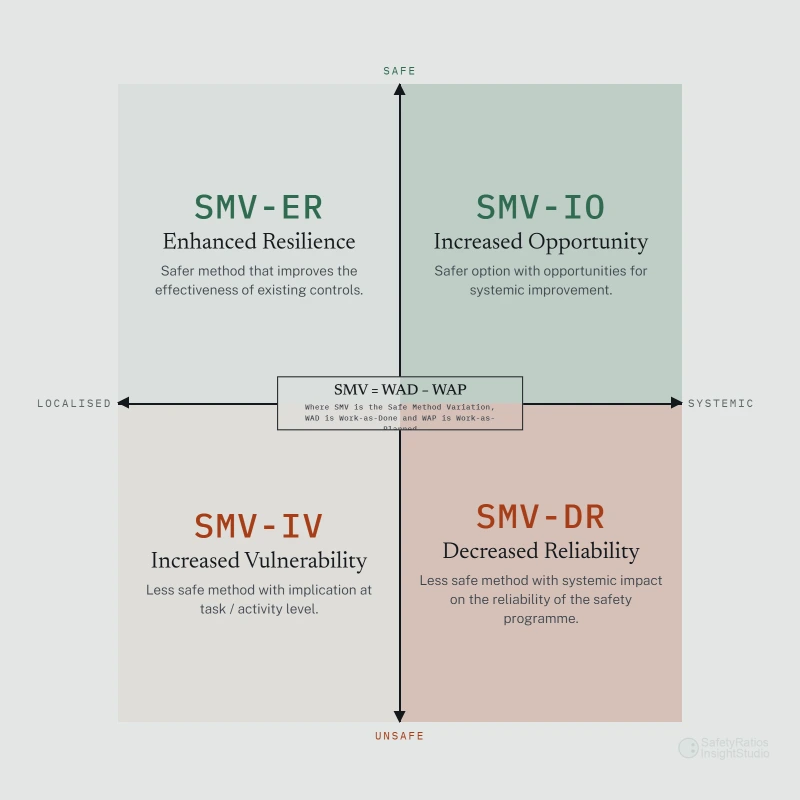
An SMV-IO (Increased Opportunity) is a Safe Method Variation in which the method actually used is safer than the approved method and carries an opportunity beyond it: a way of working that is faster, more cost-efficient, simpler, or capable of something the method was not, and that can improve the system beyond the task where it was found.
It is the highest-value finding an observation programme can make, and the one most programmes never record.
An SMV is the difference between the approved safe method (work-as-planned) and the method actually used (work-as-done), and the taxonomy classifies every such difference by its effect: Increased Opportunity, Enhanced Resilience, Increased Vulnerability, and Decreased Reliability.
Two of the four describe how work drifts or degrades; two describe work improving on its own procedure, and SMV-IO is the systemic one of that pair: the variation that points beyond its task to a better system.
What Qualifies as an SMV-IO
The bar is deliberately high: the observed method must improve safety and carry an opportunity beyond it, faster, more cost-efficient, simpler to run, or portable to other tasks and sites. A variation that reinforces the current way of working without pointing beyond it is Enhanced Resilience; one that buys its gains with exposure belongs in the negative classes.
SMV-IO is reserved for the variation that shows the system how to be better.
The classic sources are frontline improvisations that stuck: a jig a crew built that positions material faster and keeps fingers clear of pinch points; a staging sequence that removes double-handling and a manual-lifting exposure with it; a permit sequence reordered so isolation checks happen before crews are standing idle in the work area.
Each began life as a deviation. Classified properly, each is a system improvement waiting for adoption, here and everywhere the task runs.
Why We Rarely Record It
Observation programmes are tuned to find fault. Forms lead with unsafe acts and unsafe conditions, observer training centres on spotting deviation, and the reporting metrics count problems found. A finding with no negative to log has, in many systems, nowhere to go.
The workforce learns the tuning quickly. If every recorded deviation triggers correction or discipline, a crew with a better method keeps it out of sight, because disclosing it means admitting the procedure was not followed. The improvement survives, but underground, unassessed and unshared.
There is also a quieter institutional reason: recording an SMV-IO concedes that the approved method was imperfect, and programmes built around procedural authority find that concession uncomfortable. The result is an observation record that documents everything except the best work being done, the good observation problem in full.
Why the Class Matters
SMV-IOs are how procedures catch up with reality. Frontline crews run thousands of experiments a year under real conditions; the SMV-IO class is the mechanism that harvests the successful ones, assesses them properly, and turns them into the new approved method: continual improvement in the ISO 45001:2018 sense, sourced from the work itself.
It also changes what the observation programme teaches. A programme that only ever corrects tells crews that observation means scrutiny. A programme that adopts a crew's better method, and credits it, teaches that observation is how good ideas get promoted, and participation rises with that belief.
And the class is a culture indicator in its own right. The ratio of positive classifications (SMV-IO and Enhanced Resilience) to negative ones (Increased Vulnerability and Decreased Reliability) reads how the programme is tuned: a record with zero SMV-IOs is rarely describing a workforce with no good ideas.
How to Capture SMV-IOs
- Ask for it in the observation: a planned task observation that ends with "is there a better way to do this?" invites the disclosure the form alone never gets
- Give it a home on the form: if the observation record has no positive class, SMV-IOs will be logged as deviations or not at all
- Protect the discloser: a variation volunteered in good faith is assessed, never disciplined; one punished disclosure ends the pipeline for years
- Validate before adopting: risk-assess the variation formally; an efficiency gain with a hidden exposure is Increased Vulnerability wearing a disguise
- Update the procedure and credit the crew: adoption is the visible proof that the class is real, and the credit is what keeps disclosures coming
The Validation Guard
Not every popular shortcut is an SMV-IO, and the class must be earned through assessment rather than enthusiasm. The test is the same one the approved method passed: hazards identified, controls verified, and the gain confirmed under normal conditions rather than the best day anyone remembers.
Held to that standard, the class stays credible in audits and keeps its meaning: an SMV-IO on the record is a validated improvement, not a tolerated workaround.
Frequently Asked Questions
What does SMV-IO stand for?
Safe Method Variation, Increased Opportunity: the classification for an observed work method that is safer than the approved method and carries an opportunity beyond the task: faster, more cost-efficient, simpler, or portable to the wider system. It is one of four SMV classes, alongside Enhanced Resilience, Increased Vulnerability and Decreased Reliability.
How is an SMV-IO different from a tolerated shortcut?
An SMV-IO has been formally assessed: hazards identified, controls verified, and the safety and efficiency gains confirmed under normal conditions. A tolerated shortcut has simply not been challenged. The classification is earned through validation, and until then the variation is just a deviation awaiting assessment.
Why do observation programmes record so few SMV-IOs?
Most programmes are tuned to find fault: forms, training and metrics all centre on deviations and problems. Crews also learn to keep better methods out of sight when disclosure risks discipline for not following procedure. The class goes unrecorded because the system neither asks for it nor makes it safe to volunteer.
What happens after an SMV-IO is validated?
The approved method is updated so the improvement becomes the standard, the change is communicated through the same channels as any procedure revision, and the originating crew is credited. Visible adoption is what convinces the workforce the class is real and keeps future disclosures coming.