6 Audit Findings That Show Safety Objectives Exist Only on Paper
What auditors find when the objectives cycle is documented and not run
A compliant-looking list of safety objectives can be drafted in an afternoon. The trail behind it cannot. That is why auditors spend less time on the list than on the evidence that the objectives cycle actually runs.
The six findings below are the ones that show a cycle documented and not run. Each comes with what the record shows, how to test for it, and what good evidence looks like instead.
This piece is written for internal auditors, certification assessors and anyone preparing a system for audit.
It is a companion to our verification brief on Clause 6.2.1, which reads OH&S objectives as the record proves them. Subscribers to the SCAN Series have access to a fuller edition of the brief.
1. The register is a slide
The objectives exist in a presentation, with no maintained documented information behind them. Clause 6.2.1 requires documented information on the objectives, so this finding ends the audit question on its own.
Test: ask for the current register with owners, measures and dates, maintained through the cycle.
Good evidence: a live register where retired objectives are marked achieved or withdrawn, and each objective shows its policy link, measure or method, and monitoring rhythm.
2. Same list, new year
The targets have rolled forward unchanged, with fresh dates and no analysis of why the last cycle missed. It is the clearest single sign that the system has stopped improving, which Clause 10.3 requires it to keep doing.
Test: lay successive registers side by side.
Good evidence: missed objectives carry a recorded cause, met ones are banked into changed standards, and each cycle starts from a better baseline than the last.
3. Readings cluster before audits
Indicator data arrives in batches dated just ahead of assessments, with long gaps between. The monitoring the organisation claims is being reconstructed for the visit.
Test: count the entries against the claimed rhythm. A monthly reading should show as twelve dated entries a year.
Good evidence: readings taken at meetings that already happen, at the claimed rhythm, with the minutes to match.
4. Consultation that changed nothing
There is no record of worker input, or there is a record showing input that changed nothing.
Either way the objectives were shown to workers rather than set with them, and the gap touches Clause 5.4 as well as Clause 6.2.1, so one weakness raises two findings.
Test: check the date order. Consultation records must predate the objectives that claim to result from them, and reversed dates are a finding in themselves.
Good evidence: minutes showing what workers said and what it changed.
5. Progress without numbers
Review minutes assert that objectives are advancing while the indicators are flat, stale or absent. Progress claims of this kind collapse under audit, and they mislead the board before they mislead the auditor.
Test: trace dashboard figures back to their source records; untraceable numbers are findings.
Good evidence: one indicator movement that provably caused a review decision. That single trail proves the cycle turns.
6. Objectives nobody can say
Briefing packs and noticeboards carry the objectives, but sampled workers cannot state them. Distribution lists show that communication was sent, and only interviews show whether it arrived.
Test: sample workers and supervisors and ask what the site is trying to improve.
Good evidence: answers in the workers' own words. Word-perfect poster quotes evidence compliance; own words evidence ownership.
The six findings at a glance
Each finding has a single test, and several pull in a second clause, which is where one gap turns into two findings.
| Finding | Test | Also touches |
|---|---|---|
| The register is a slide | Ask for the maintained register | Clause 7.5 |
| Same list, new year | Compare successive registers | Clause 10.3 |
| Readings cluster before audits | Count entries against the rhythm | Clause 9.1 |
| Consultation that changed nothing | Check the date order | Clause 5.4 |
| Progress without numbers | Trace figures to source | Clause 9.3 |
| Objectives nobody can say | Interview sample | Clause 7.4 |
Conclusion
All six findings share one cause: the objectives exist, and the cycle behind them does not run.
The register, the readings, the consultation record, the minutes and the interviews are where a running cycle leaves its trail, and where an idle one leaves silence.
Read the audit view in our verification brief on Clause 6.2.1. Subscribers to the SCAN Series have access to a fuller edition of the brief.
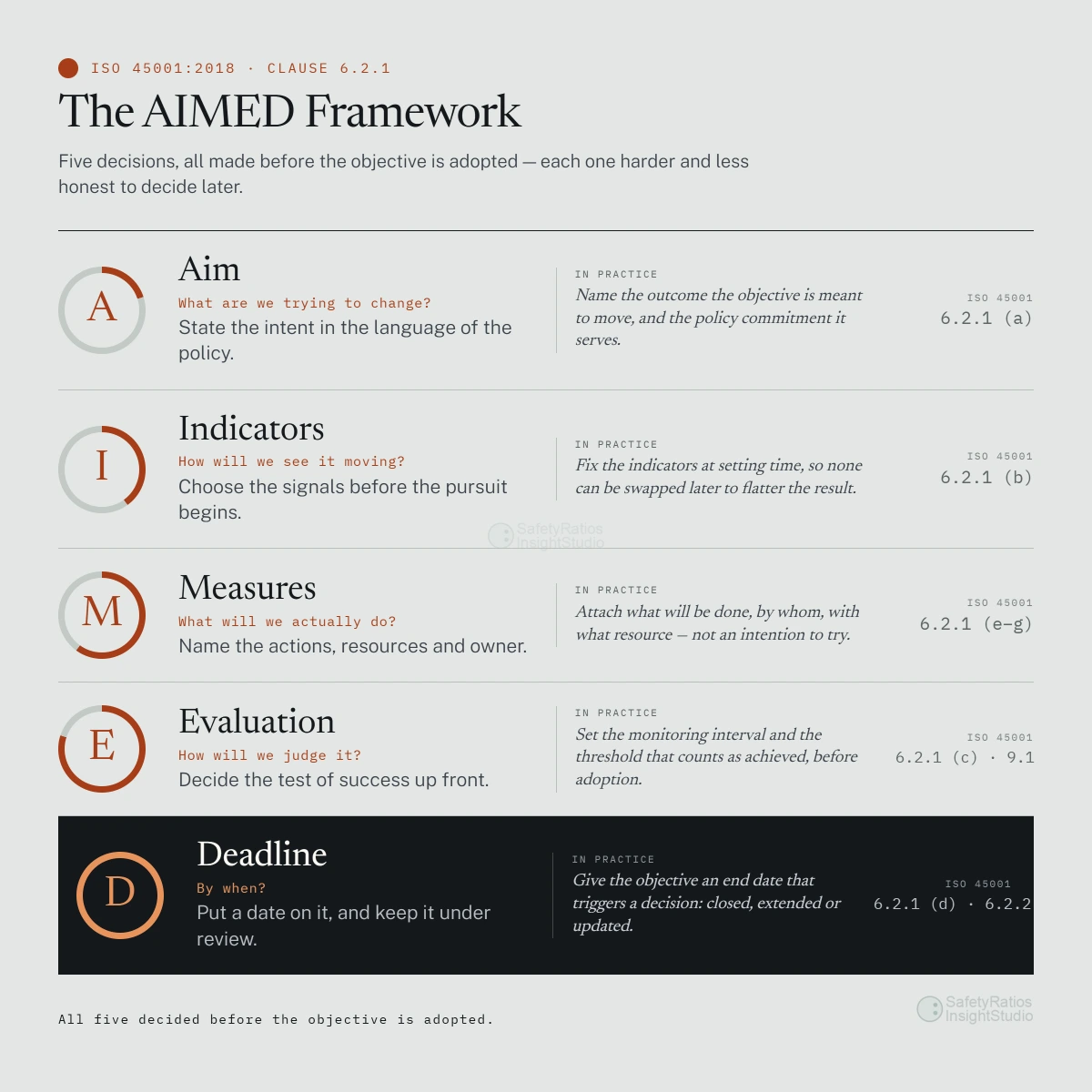
The list proves little, the trail proves all: see AIMED in Evidence make the call.
The AIMED Framework in Evidence follows an internal audit team setting an objective for its own audits and reviews, with the evidence each element leaves. It is part of the Mission 45001 subscriber edition, with the full briefs and all four worked examples.
Subscribe for full access →Frequently asked questions
What is the most common audit finding on safety objectives?
Objectives that cannot be evaluated, closely followed by targets rolled forward unchanged from the previous year with no analysis of why the last cycle missed.
How do auditors test whether safety objectives are monitored?
They count dated readings against the claimed rhythm and trace dashboard figures back to source records. Readings clustered just before audits show monitoring reconstructed for the visit.
What single piece of evidence best proves the objectives cycle works?
One indicator movement that provably caused a review decision. That trail shows readings reach reviews and reviews change something.