Verification Brief on ISO 45001:2018 Clause 6.2.1
Confirming the declared objectives are set, monitored and updated as claimed
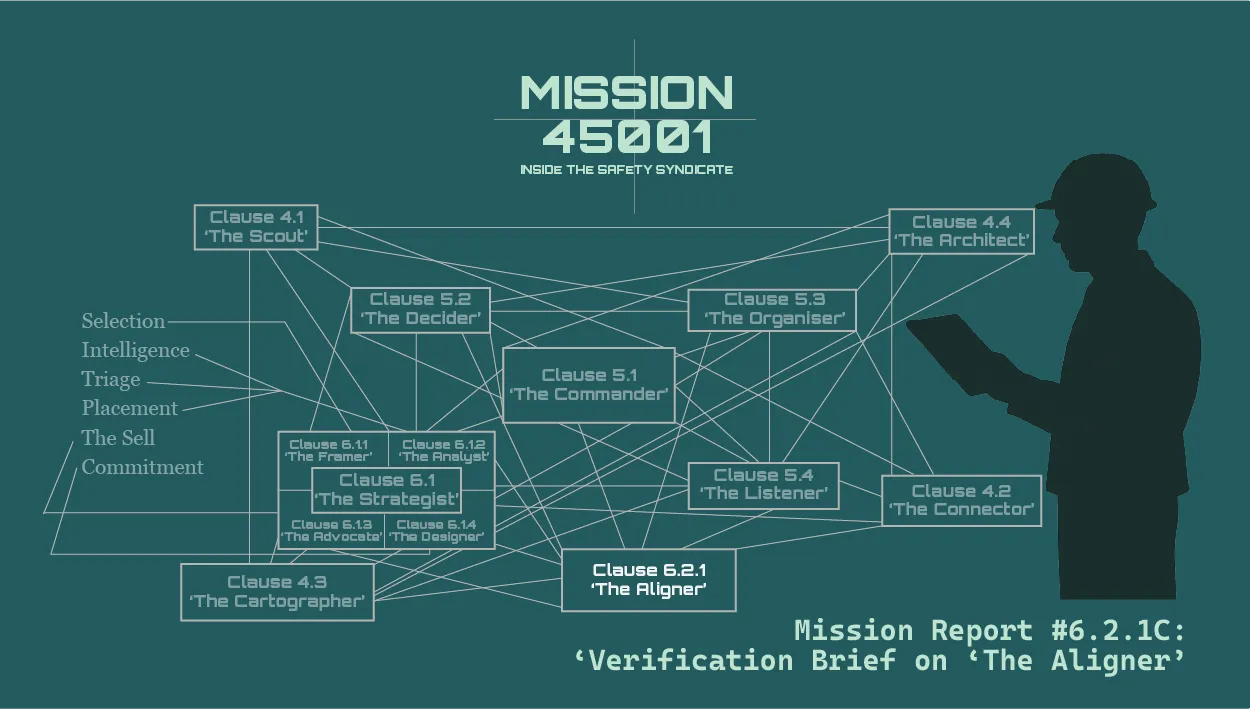
Mission 45001 is our deep dive into ISO 45001:2018, a network of clauses working together to help organisations run safe, resilient operations. Our mission is to show how that network works from the inside. This is our verification brief on 'The Aligner' of the safety syndicate.
This verification brief examines ISO 45001:2018 Clause 6.2.1 and how auditors confirm that OH&S objectives were set as the clause requires and are steering as the organisation claims.
Within the LDP framework (Living, Driving, Proving), this verification brief reads Clause 6.2.1 through the Proving lens: an objective is a claim until the register, the readings and the revision history show a governed cycle, and that evidence is what this brief tests.
ISO 45001 Clause 6.2.1 requirements
Establishing OH&S objectives
- Clause 6.2.1: The organization shall establish OH&S objectives at relevant functions and levels in order to maintain and continually improve the OH&S management system and OH&S performance
- Objectives shall be: consistent with the OH&S policy; measurable (if practicable) or capable of performance evaluation; monitored; communicated; and updated as appropriate
- Objectives shall take into account: applicable requirements, the results of the assessment of risks and opportunities, and the results of consultation with workers and, where they exist, workers' representatives
- Documentation: The organization shall maintain documented information on the OH&S objectives (and, with Clause 6.2.2, on the plans to achieve them)
What verifying objective setting means
Confirming the objectives were set, run and updated as the clause requires
- Verification focus: Confirm OH&S objectives exist at relevant functions and levels, as maintained documented information, carrying every quality the clause lists
- The setting trail: Verify each objective traces to the risk assessment, applicable requirements and worker consultation it claims descent from
- The running trail: Confirm monitoring and communication happen in practice, at the rhythm the organisation claims for them
- The update trail: Verify changes to objectives are dated decisions with recorded reasons, and that silence around a lapsed objective is read as the finding it is
- Audit boundary: Clause 6.2.1 covers the objectives and their qualities; the delivery routes behind them are Clause 6.2.2's evidence, tested separately
Why verifying objective setting matters
The objectives list is easy to write and hard to fake well
- Objectives are cheap to draft: A compliant-looking list can be produced in an afternoon, which is why the trail behind it matters more than the page
- False steering misleads everyone: Unverified objectives let boards report progress the indicators cannot support
- The easiest nonconformity: Objectives incapable of evaluation are among the most commonly raised findings on Clause 6
- Certification reads the cycle: Assessors test whether the objectives cycle actually turns, and a rolled-forward list fails that test outright
- Worker trust rides on the record: Consultation evidence separates objectives workers helped set from objectives they were shown afterwards
Evidence sources for OH&S objectives
Documents that prove the objectives are set, running and governed (AIMED evidence map)
- The objectives register: Maintained documented information on the objectives, their measures, owners and dates, the clause's own documentation duty
- Assessment and consultation records: The Clause 6.1 outputs and consultation minutes the objectives claim descent from, with dates that run in the right order
- Monitoring data: Indicator readings at source, the dashboards built from them, and the review minutes that read them
- Communication evidence: Briefing packs, induction materials and toolbox records carrying the objectives to the field
- Revision history: Dated updates with reasons, and the management review minutes that decided them
Verification criteria for objective setting
What good objective setting looks like on the record
- Documented and current: The register exists, is maintained, and shows this cycle's objectives with owners and dates
- Qualities all present: Each objective shows its policy link, a measure or written evaluation method, a monitoring arrangement, communication and update provision
- Inputs traceable: The assessment, applicable requirements and worker consultation are visible in the objectives that were chosen
- Cascade coherent: Function and level objectives nest into the organisational objectives without orphans
- The cycle demonstrably turns: Monitoring readings provably reach reviews, and reviews provably cause decisions
Risk & compliance impact of poor objective setting
How an ungoverned objectives list becomes findings and exposure
- Progress claims collapse under audit: Advancement asserted with no indicator movement behind it is a finding waiting to be written
- Hidden stagnation: Rolled-forward objectives conceal that the system stopped improving, which Clause 10.3 requires it to keep doing
- Consultation breaches pair up: Objectives set without worker input touch Clause 5.4 as well as Clause 6.2.1, so one gap raises two findings
- Certification exposure: A dead objectives cycle undermines the continual-improvement story the whole certificate rests on
- Misallocated effort: Unverified objectives let budget and attention flow to targets nobody is genuinely pursuing
System linkages for objective setting
Where the objectives evidence must agree with the wider system
- Clause 5.2, OH&S Policy: Policy consistency is testable only against the policy's actual commitments, read side by side
- Clause 5.4, Consultation and Participation of Workers: The consultation the objectives claim must show in the participation records
- Clause 6.1, Actions to Address Risks and Opportunities: The assessment supplies the risks and opportunities the chosen objectives must be recognisable from
- Clause 6.2.2, Planning to Achieve OH&S Objectives: Every adopted objective should hand off to a documented plan with actions, resources, owners and dates
- Clause 9.3, Management Review: Management review must read objective progress as a standing input, and its minutes are where the cycle proves it turns
Interview prompts on OH&S objectives
Testing the objectives at every level they are set
- What are your current objectives?: Ask at every level, top management to crew; each should state the aim and what it serves
- How were these objectives chosen?: Ask leaders what consultation changed, and workers whether they recognise their input
- How is progress read?: Ask the sponsor, the reporting manager and the supervisor; their accounts of the rhythm should match
- When did an objective last change, and why?: Ask the top for the reason, and each level below when they heard
- What happens when an objective is met?: Listen for achievement banked into standard practice, and probe when the answer is a shrug
Compliance check questions on OH&S objectives
Core auditor queries to verify objective setting
- Are OH&S objectives established at the organisational, functional and site levels, and maintained as documented information?
- Do the site and functional objectives add up to the organisational objectives they serve?
- Is each objective consistent with the OH&S policy, and measurable or capable of performance evaluation?
- Can the organisation evidence that assessment results, applicable requirements and worker consultation were taken into account?
- Are the objectives monitored at each level, with readings that reach reviews and provably cause decisions?
- Are updates to objectives dated, reasoned and communicated at every level working under them?
Red flags in objective setting
Signs the objectives list is decoration
- The register is a slide: Objectives exist only in a presentation, with no maintained documented information behind them
- Same list, new year: Targets rolled forward unchanged, with no analysis of why the last cycle missed
- Readings cluster before audits: Indicator data appears in batches dated just ahead of assessments, with long gaps between
- Consultation invisible: No record of worker input, or a record showing input that changed nothing
- Progress without numbers: Review minutes assert advancement while the indicators are flat, stale or absent
Positive indicators of objective setting
Proof the objectives are governing rather than decorating
- Workers recite the objectives: Sampled crews state the current objective in their own words, which evidences communication and ownership at once
- The trail runs both ways: Any objective traces back to the assessment and consultation behind it, and forward to its Clause 6.2.2 plan
- A trigger demonstrably fired: At least one indicator movement provably caused a review decision, which proves the cycle in a single document
- Misses openly analysed: Unmet objectives carry cause analysis and visibly repriced successors
- Banked achievements visible: Met objectives live on as changed standards, procedures and baselines
In summary
Clause 6.2.1 only matters if it can be proven. An objectives list is the easiest artefact in the standard to fake and the hardest to fake well: the objectives themselves take an afternoon, while the setting trail, the reading rhythm and the dated updates only exist where the cycle genuinely ran.
Verification therefore reads the whole loop: descent from assessment and consultation, qualities on every objective, indicators fed from field data, reviews that decide, and revisions with reasons. Where that trail holds, the objectives are governing; where it thins, the list is decoration and the finding writes itself.
Inside the extended edition
Eleven further sections available to subscribers
- Policy implications: Testing the thread from promise to objective
- Leadership implications: Ownership, read from the record
- Planning implications: Testing descent from the assessment
- Support implications: Communication and capability, evidenced
- Operational control implications: The objective at the point of work, on the record
- Performance evaluation implications: Reading the readings
- Improvement implications: Evidence that the cycle compounds
- Cultural implications: What the evidence says about the culture
- System integration implications: One cycle, evidenced across systems
- Documentation requirements: What Clause 6.2.1 requires in writing, and what the verifier reads it for
- Next steps: Trace the Objective. Test the Data. Prove the Cycle
Subscribers gain access to the complete presentation, while higher-tier members can download the full .pptx version for use in their own training programmes.
Background data on 'The Aligner', Clause 6.2.1
Focus: Establishing OH&S Objectives
- Codename: The Aligner
- Function: Objective Setting — guides focus with strategic objective
- System Role: Converts assessed risks, requirements and consultation into the few targets the system will pursue
- Syndicate Caucus: Works with The Commander (Clause 5.1), The Strategist (Clause 6.1), The Navigator (Clause 6.2.2), and The Conduit (Clause 7.4)
- Modus Operandi: Selective, consultative, and insistent that every objective be checkable
- Activation Threshold: Any change in risk profile, requirements, consultation outcomes, or an objective met or missed
- Known For: Short lists, straight sentences, and targets people can recite
- Field Signals: Crews unable to name the site's objective, indicators fed with stale data, suggestions with nowhere to land
- Boardroom Signals: Targets rolled forward unchanged, objectives inconsistent with the policy, progress asserted without indicators
- Audit Signals: Objectives incapable of evaluation, no evidence of communication or update, consultation absent from the record
- PDCA Coordinates: Lives in Plan — sets the objective that The Navigator (Clause 6.2.2) turns into a route
Frequently asked questions
What evidence does an auditor look for under ISO 45001 Clause 6.2.1?
The objectives register as maintained documented information, the assessment and consultation records the objectives descend from, indicator readings traceable to field data, communication evidence such as briefing and induction materials, and a revision history of dated updates with reasons. Together these prove the objectives were set as required and are genuinely steering.
How do you verify that OH&S objectives are measurable?
Check each objective for a baseline, a target and named indicators, then trace the dashboard figures back to source records. Where the organisation claims measurement was impracticable, verify a written evaluation method exists and was demonstrably applied, because the clause permits either path and neither being present is a finding.
What are common audit findings on OH&S objectives?
Objectives incapable of evaluation, consultation absent from the record, targets rolled forward unchanged without analysis of the miss, progress asserted in review minutes with no indicator movement behind it, and adopted objectives with no Clause 6.2.2 plan commissioned to deliver them.
How can worker consultation on objectives be evidenced?
Through consultation minutes and participation records showing input was gathered before targets were fixed, documentation of what that input changed, and interview corroboration on site. A record showing consultation that changed nothing invites the follow-up question of whether it was consultation at all.
What distinguishes a governed objectives cycle from a paper one?
The trail. A governed cycle shows descent from assessment and consultation, indicators fed on a countable rhythm, at least one trigger that provably caused a decision, dated revisions with reasons, and met objectives banked into changed standards. A paper cycle shows a list, a dashboard and a gap where each of those should be.