7 Decisions That Determine Whether Safety Objectives Get Delivered
What top management decides at the setting table, and what each decision costs when skipped
Whether a safety objective is delivered is mostly settled before it is launched. Seven decisions sit with top management at the setting table, and nobody further down the organisation can make them instead.
Each decision skipped shows up later as a gap that effort below cannot close: a list too long to fund, a target nobody owns, a measure that flatters. This piece sets out the seven, and what each one costs when it is left out.
It is written for top management and the leaders who sponsor objectives. It is a companion to our strategy brief on Clause 6.2.1, which reads OH&S objectives as leadership drives them.
Subscribers to the SCAN Series have access to a fuller edition of the brief.
1. How many to choose
The objectives are the organisation's OH&S investment portfolio: a few chosen positions carrying real budget. A list long enough to please every stakeholder dissolves under the first pressure, and none of it gets funded properly.
The cut list is part of the decision. Writing down what was considered and declined shows the choice was made, and gives managers grounds to decline the initiatives that would otherwise fragment the year.
2. Which to rank first
Objectives compete for the same budget, the same shutdown window and the same supervisors' time. A set order settles those conflicts before the meeting does, and settles them the same way on every site.
Without a ranking, each conflict escalates, and the answer depends on who is in the room. With one, middle management can align itself.
3. What to set them from
The biggest risks and best opportunities from the Clause 6.1 assessment should be recognisable in the list. If they are not, either the assessment was decorative or the objectives were chosen for the report, and outsiders can tell which.
Legal and other requirements mark the floor. Objectives that discharge them should be labelled apart from chosen ambition, because a missed legal objective and a missed stretch target carry very different consequences.
4. When to hear workers
Consultation at setting time is intelligence about where the operation really is, gathered before money commits. Objectives fixed first and shown to workers afterwards meet the workforce later, at implementation, as resistance.
The decision is when to consult, and the answer is before the targets are set. The record should then show what the input changed.
5. When to fund them
An objective announced without its budget teaches the organisation that the list is aspiration.
The funding covers more than the fix itself: briefing hours to make the aim recitable, training for the competence it implies, and the data capture its indicators need.
Adoption should also commission the Clause 6.2.2 plan. An objective accepted with no route behind it has not really been decided.
6. Who to name as sponsor
Each top-level objective belongs in a named leader's own reporting line, beyond the safety function's. An objective with a sponsor gets asked about. An orphaned one gets reported on.
The sponsor's attention between reviews is what keeps the objective real. Objectives asked about only at launch are discounted on site within weeks, and objectives authored by the safety function alone carry no weight where budgets are set.
7. How to read progress
Indicators are chosen at the setting table, because a measure picked afterwards tends to be picked to flatter. Where numbers are impracticable, the evaluation method is fixed before adoption.
The same decision sets the rhythm: who reads the indicators, at which review, what movement forces a decision, and the date each objective is due.
Objective progress then becomes a standing input to management review under Clause 9.3, and a dated objective becomes a commitment the sponsor answers for.
The setting meeting
The seven decisions are best made together, in one meeting with the assessment, the consultation results and the budget on the table. Taken separately, they drift apart, and objectives get adopted half made.
| Decision | If it is skipped, it shows as |
|---|---|
| How many to choose | A long list nobody funds properly |
| Which to rank first | Every conflict escalated, settled differently each time |
| What to set them from | Objectives chosen for the report |
| When to hear workers | Resistance at implementation |
| When to fund them | An aspiration list that spends credibility |
| Who to name as sponsor | Objectives reported on and never asked about |
| How to read progress | Progress asserted without numbers |
Conclusion
Objectives that are few, ranked, grounded, consulted, funded, sponsored and measured from the start are the ones that get delivered.
Each of the seven is a decision only leadership can take, and the organisation reads its leaders by which ones they took.
Read leadership's view in our strategy brief on Clause 6.2.1. Subscribers to the SCAN Series have access to a fuller edition of the brief.
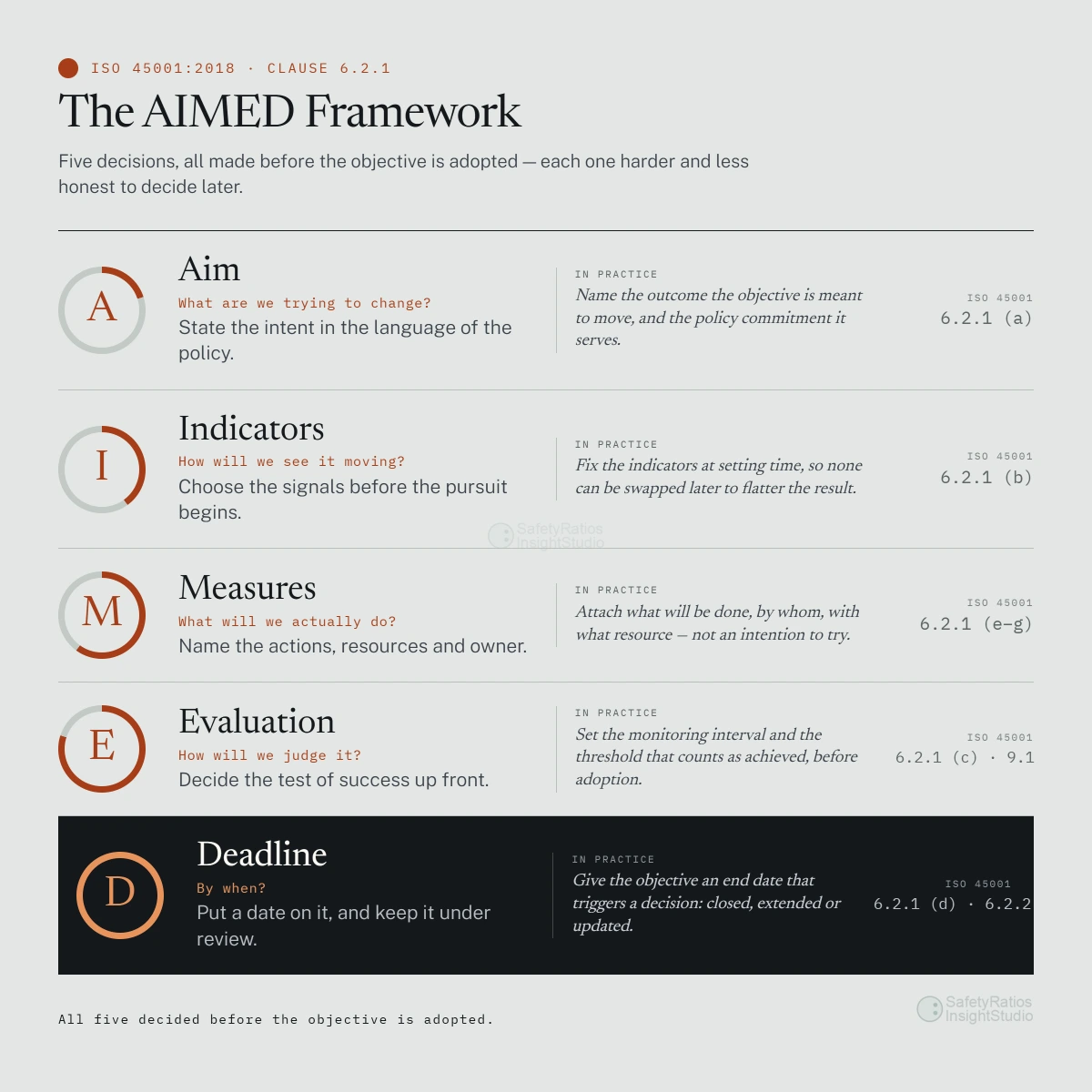
Decide it once and fund it right: see AIMED in Strategy bring it to light.
The AIMED Framework in Strategy takes a leadership team's broad fatigue aim through the five AIMED decisions to an objective nine sites can read. It is part of the Mission 45001 subscriber edition, with the full briefs and all four worked examples.
Subscribe for full access →Frequently asked questions
How many safety objectives should an organisation set?
Few enough that every one can be funded, sponsored and asked about. A list long enough to please every stakeholder dissolves under pressure, and the considered-and-declined list is part of the decision.
Why should safety objectives be funded at adoption?
An objective announced without its budget teaches the organisation the list is aspiration. Funding at adoption covers the fix, the briefing hours, the training and the data capture the indicators need.
Who should sponsor a safety objective?
A named leader whose own reporting line carries the objective, beyond the safety function. Sponsored objectives get asked about between reviews; orphaned ones only get reported on.