Strategy Brief on ISO 45001:2018 Clause 6.2.1
Choosing the few OH&S objectives the organisation will stake its name on
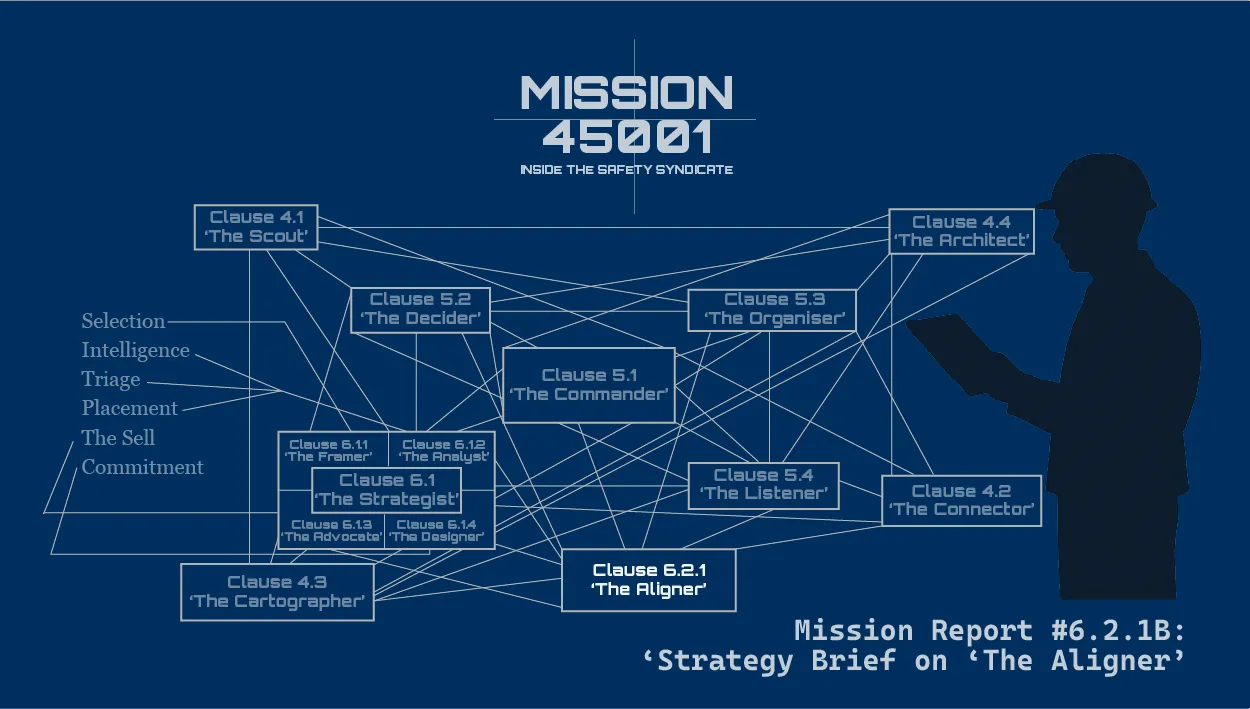
Mission 45001 is our deep dive into ISO 45001:2018, a network of clauses working together to help organisations run safe, resilient operations. Our mission is to show how that network works from the inside. This is our strategy brief on 'The Aligner' of the safety syndicate.
This strategy brief examines ISO 45001:2018 Clause 6.2.1 and how leadership teams choose, fund and govern OH&S objectives: the few dated, measurable positions that turn the policy's promises into a course the organisation can be held to.
Within the LDP framework (Living, Driving, Proving), this strategy brief reads Clause 6.2.1 through the Driving lens: how leadership converts safety commitments into direction, resourcing and oversight, with the set objectives as that conversion's most concrete evidence. Its twin, Clause 6.2.2, turns each objective into a resourced route with owners and dates.
ISO 45001 Clause 6.2.1 requirements
Establishing OH&S objectives
- Clause 6.2.1: The organization shall establish OH&S objectives at relevant functions and levels in order to maintain and continually improve the OH&S management system and OH&S performance
- Objectives shall be: consistent with the OH&S policy; measurable (if practicable) or capable of performance evaluation; monitored; communicated; and updated as appropriate
- Objectives shall take into account: applicable requirements, the results of the assessment of risks and opportunities, and the results of consultation with workers and, where they exist, workers' representatives
- Documentation: The organization shall maintain documented information on the OH&S objectives (and, with Clause 6.2.2, on the plans to achieve them)
What objective setting means in strategy
The organisation's OH&S position, declared
- A chosen portfolio: The objectives are the organisation's OH&S investment portfolio, a few chosen positions carrying real budget, against many candidates that were declined
- Direction declared: Set objectives state what the organisation believes its most material safety problems are, in a form outsiders can read
- Consistency made traceable: Each objective is a policy commitment priced into a dated target, which is the line a board can actually govern
- Consultation as intelligence: Worker input at setting time is strategic information about where the operation really is, gathered before capital commits
- Updating as steering: The duty to update makes the objectives a live instrument of direction, rather than an annual artefact
Why objective setting matters
The objective is where strategy becomes checkable
- Objectives price the policy: Open-ended commitments become dated, resourced positions with a cost the organisation has accepted
- Selection reveals judgement: What leadership ranks first tells the workforce, regulators and investors what it actually believes about its risks
- Measurability enables governance: A board can only steer objectives capable of evaluation; everything else it can only applaud
- The cycle compounds: Objectives met become the baseline the next strategy starts from, so a working cycle banks gains year on year
- Credibility accumulates: A record of objectives set, pursued and closed is strategic capital with every external audience
Impact on organisational direction
How set objectives move through the organisation's decisions
- Budget follows the objectives: Capital and attention flow to the set objectives, in whichever direction they point
- Ranking pre-decides conflicts: When objectives compete for the same window or budget, the set order makes the call before the meeting does
- The objective cascades: Functions and levels inherit their pieces of each objective, and local plans re-form around them
- Indicators enter the reporting: Board packs and reviews carry whatever measures were chosen at setting time, sound or not
- Updates travel at governance speed: Changed risks reopen the objectives only as fast as the review cycle turns
Key factors to watch
Signals that the objectives and the strategy are parting company
- Targets rolled forward unchanged: The same objectives each year suggest a cycle that is documented rather than governed
- Objectives cut loose from the assessment: A target list that ignores the risk profile reads as chosen for the report, and outsiders can tell
- Indicators outrunning outcomes: Measures improving while incidents and exposure do not, a sign the measure has become the target
- Consultation skipped before setting: Objectives fixed before workers were heard, which the workforce meets later as resistance and outsiders read as a governance gap
- Progress asserted without numbers: Board papers claiming advancement with no indicator movement behind the claim
Risks of weak objective setting
Vague Objectives = Weaker Strategy
- Strategy stays rhetoric: Commitments never priced into dated objectives leave leadership asserting progress it cannot govern
- Spend follows the loudest incident: Without a ranked portfolio, OH&S investment is set by the most recent event rather than the biggest exposure
- The board governs blind: Objectives incapable of evaluation leave review reading anecdotes
- Direction dies with its author: Objectives held in one leader's head leave the organisation when they do
- Compounding is forfeited: Cycles that restart from scratch each year surrender the baseline gains a governed cycle banks
- Consultation debt surfaces late: Objectives set without worker input meet the workforce at implementation, as resistance
Benefits of strong objective setting
Clear Objectives = Stronger Strategy
- One story to every audience: Board, regulator, client and workforce hear the same few objectives, told in the same words
- Tenders and due diligence have evidence: A demonstrable objectives cycle answers client and acquirer scrutiny before it is raised
- Middle management aligns itself: A ranked list lets functions settle their own priorities without escalating every conflict upward
- Financial standing improves: Insurers and lenders price a governed objectives record better than a promise
- Opportunity gets a vehicle: The improvements Clause 6.1 surfaced as opportunities become funded objectives instead of parked observations
- The strategy becomes teachable: A short, ranked list is the rare strategy document every manager can carry and repeat
How the system responds
A governed cycle that steers rather than restates
- Monitoring feeds the review: Indicator movement arrives at management review on a set rhythm, and triggers adjustment rather than restatement
- Updates are governed decisions: Changed risks, requirements or consultation outcomes rewrite the objectives, with the reasons minuted and announced
- Consultation refreshes: Worker input is re-gathered as conditions change, keeping the portfolio priced on current reality
- The cascade re-aligns: Site, department and crew objectives are re-nested when the organisational objectives move
- Achievement is banked: Met objectives convert into standards, and the next portfolio is set from the improved position
Role of leadership team
Owning the portfolio, and the noes it requires
- Choose few and rank them: Selecting the portfolio and ordering it is the act only top management can perform, and the cut list is part of the decision
- Sponsor every objective by name: Each top-level objective sits in a named leader's own reporting rather than the safety function's alone
- Resource what was set: Fund each objective's delivery at adoption, because an unresourced objective spends the system's credibility
- Ask about the indicators: Progress questions in routine governance keep the objectives real; launch-only attention makes them posters
- Announce the updates: When conditions change the target, the sponsor gives the change and the reason, so revision reads as steering
Making objectives operational
The AIMED discipline: Aim, Indicators, Measures, Evaluation, Deadline
- Aim: State each objective as one sentence of change the board can govern and the workforce can recognise from the assessment behind it
- Indicators: Choose the signals that will show progress and drift at the setting table, because measurement design is part of the decision
- Measures: Make each objective measurable where practicable, and where not, fix the evaluation method before adoption rather than at review
- Evaluation: Set the governance rhythm, who reads the indicators, at which review, and what movement forces a decision
- Deadline: Date every objective, and treat the date as a commitment the sponsor answers for, revised deliberately or met
Inside the extended edition
Eleven further sections available to subscribers
- Policy implications: The objectives are where the policy's promises get priced
- Leadership implications: The portfolio is the leadership, in writing
- Planning implications: The objectives are what the assessment was for
- Support implications: An objective is only as strong as what is bought for it
- Operational control implications: The objectives set the control agenda
- Performance evaluation implications: The scoreboard governs the governors
- Improvement implications: The cycle is the improvement engine the board can see
- Cultural implications: What the portfolio teaches the organisation
- System integration implications: One portfolio inside the business's own rhythms
- Documentation requirements: What Clause 6.2.1 requires in writing, and what the writing must do
- Next steps: Choose Few. Fund Fully. Govern the Score
Subscribers gain access to the complete presentation, while higher-tier members can download the full .pptx version for use in their own training programmes.
Background data on 'The Aligner', Clause 6.2.1
Focus: Establishing OH&S Objectives
- Codename: The Aligner
- Function: Objective Setting — guides focus with strategic objective
- System Role: Converts assessed risks, requirements and consultation into the few targets the system will pursue
- Syndicate Caucus: Works with The Commander (Clause 5.1), The Strategist (Clause 6.1), The Navigator (Clause 6.2.2), and The Conduit (Clause 7.4)
- Modus Operandi: Selective, consultative, and insistent that every objective be checkable
- Activation Threshold: Any change in risk profile, requirements, consultation outcomes, or an objective met or missed
- Known For: Short lists, straight sentences, and targets people can recite
- Field Signals: Crews unable to name the site's objective, indicators fed with stale data, suggestions with nowhere to land
- Boardroom Signals: Targets rolled forward unchanged, objectives inconsistent with the policy, progress asserted without indicators
- Audit Signals: Objectives incapable of evaluation, no evidence of communication or update, consultation absent from the record
- PDCA Coordinates: Lives in Plan — sets the objective that The Navigator (Clause 6.2.2) turns into a route
Frequently asked questions
What does ISO 45001 Clause 6.2.1 require?
Clause 6.2.1 requires the organization to establish OH&S objectives at relevant functions and levels that are consistent with the OH&S policy, measurable if practicable or capable of performance evaluation, monitored, communicated, and updated as appropriate, taking into account applicable requirements, the assessment of risks and opportunities, and the results of consultation with workers.
Who should set OH&S objectives?
Top management owns the selection and ranking, with objectives established at every relevant function and level and worker consultation taken into account before targets are fixed. Objectives authored by the safety function alone carry no weight at the table where budgets are set, which is why sponsorship by named leaders matters as much as the list itself.
How many OH&S objectives should an organisation set?
Few enough to fund, sponsor and govern properly, ranked so conflicts settle by the set order. A short, ordered portfolio the whole organisation can carry beats a long list that dissolves under budget pressure; the clause sets no number, but everything it demands of each objective argues for selectivity.
How do OH&S objectives connect to business strategy?
They are the mechanism that prices the OH&S policy's commitments into dated, resourced positions, set ideally on the same planning calendar as production and financial objectives and read in the same review pack. A governed objectives cycle also carries external weight, with clients in tenders, acquirers in due diligence, and insurers pricing the organisation's record.
How do Clause 6.2.1 and Clause 6.2.2 differ?
Clause 6.2.1 sets the objective: which objectives the organisation will pursue and what qualities they must have. Clause 6.2.2 builds the route: what will be done, with what resources, by whom, by when, how results are evaluated, and how the actions integrate into business processes. The Aligner chooses the target; The Navigator plans the route.