Field Brief on ISO 45001:2018 Clause 6.2.1
Turning OH&S objectives into a direction the crew can see
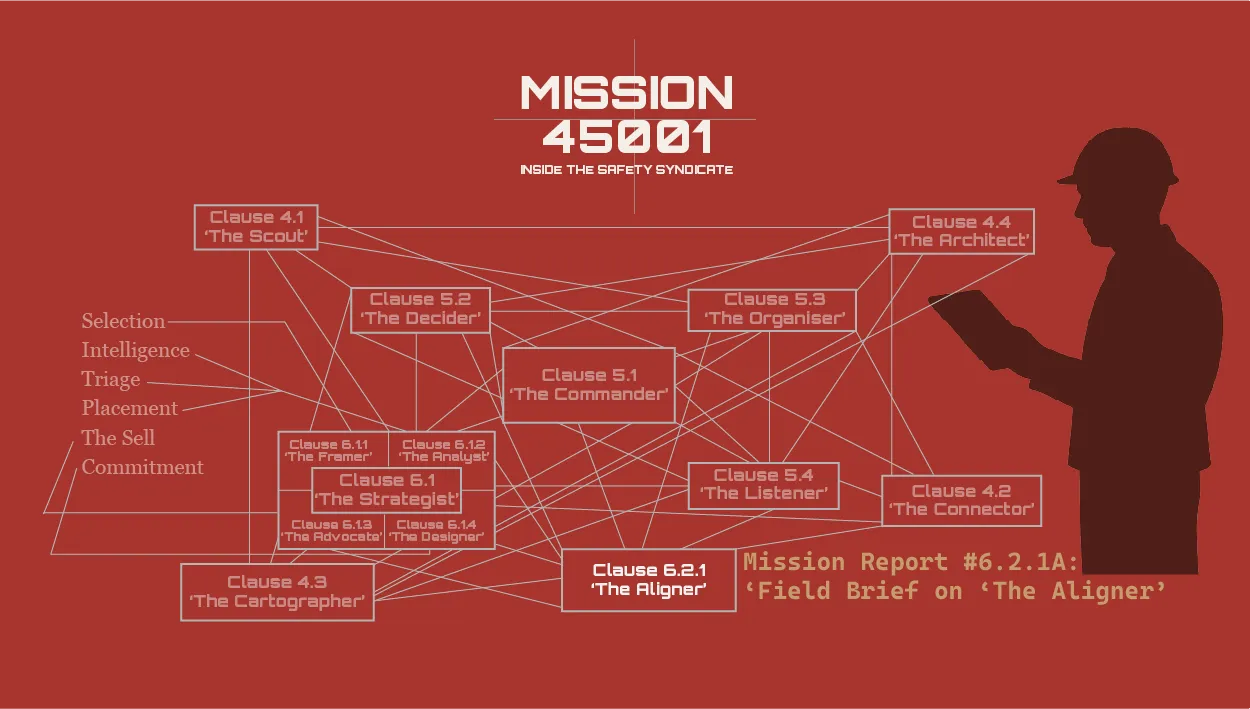
Mission 45001 is our deep dive into ISO 45001:2018, a network of clauses working together to help organisations run safe, resilient operations. Our mission is to show how that network works from the inside. This is our field brief on 'The Aligner' of the safety syndicate.
This field brief examines ISO 45001:2018 Clause 6.2.1 and how operational teams turn OH&S objectives into a direction the crew can see, recite, and read progress against.
Within the LDP framework (Living, Driving, Proving), this field brief reads Clause 6.2.1 through the Living lens: how a set aim shows up in the day's work, in briefings, indicators and priorities the crew can check progress against. Its twin, Clause 6.2.2, then gives that aim a route, with owners, resources and dates.
ISO 45001 Clause 6.2.1 requirements
Establishing OH&S objectives
- Clause 6.2.1: The organization shall establish OH&S objectives at relevant functions and levels in order to maintain and continually improve the OH&S management system and OH&S performance
- Objectives shall be: consistent with the OH&S policy; measurable (if practicable) or capable of performance evaluation; monitored; communicated; and updated as appropriate
- Objectives shall take into account: applicable requirements, the results of the assessment of risks and opportunities, and the results of consultation with workers and, where they exist, workers' representatives
- Documentation: The organization shall maintain documented information on the OH&S objectives (and, with Clause 6.2.2, on the plans to achieve them)
What objective setting means in the field
Choosing an aim the field can carry
- A direction the crew can see: An objective worth having survives translation to the field, what it changes about this week's work is expressible in one sentence
- Few and ranked: A short list the site can hold beats a long list that dissolves under pressure, and ranking resolves conflicts before they arrive
- Built from consultation: Objectives set with worker input inherit field reality from day one, and crews recognise their own words in them
- Measurable in crew terms: Progress reads in numbers or events the team recognises from its own work, beyond the dashboard the office keeps
- Communicated until recitable: The objective has landed when a sampled worker can say what the site is trying to improve, however long the noticeboard has carried it
Why objective setting matters
Direction is a control
- Focus follows clarity: A crew that knows this quarter's aim spends its discretionary attention where the system needs it
- Progress becomes discussable: Indicators turn "how is safety going?" into a question with an answer, at the toolbox as well as the board
- Consultation earns ownership: Targets workers helped set are defended on site without supervision present
- Improvement compounds: Objectives met become the new baseline, and the next cycle starts further forward rather than starting again
- Credibility accrues: Aims visibly achieved teach the workforce that the system's word means something
Impact on daily work
How a set aim shapes the job
- Priorities arrive pre-decided: The set objective decides what gets attention when time is short, whichever direction it points
- The aim appears in routines: Briefings, toolbox talks and reviews carry the objective, so the crew meets the current aim wherever the day already gathers them
- Progress is reported from the field: The indicators draw on what crews record, so reporting quality directly shapes what the system believes
- Feedback has a target: Suggestions and concerns get read against the aim, which tells the crew which of them will move
- Updates travel at communication speed: When conditions change the objective, the crew works to the old aim until the change reaches the field
Key factors to watch
Signals that the aim and the work are parting company
- Objectives nobody can recite: If the crew cannot name the current aim, communication has failed however widely it was posted
- Indicators drifting from reality: Numbers improving while the field feels unchanged, a sign the measure has become the target
- Consultation as ratification: Workers shown finished objectives rather than involved in setting them, participation in form but not substance
- Objectives that never change: The same targets rolled forward each year suggest a cycle that is documented rather than run
- Aims cut loose from assessment: Objectives that ignore the site's actual risk profile read as chosen for the report rather than the work
Risks of weak objective setting
Vague Aims = Weaker Safety
- Effort scatters: Without agreed priorities, improvement energy spreads thin and nothing moves
- Progress becomes unknowable: Objectives incapable of evaluation give no early warning, and the annual review becomes an annual surprise
- Workers disengage: Aims imposed without consultation read as management's targets rather than the site's
- The system loses standing: Objectives announced and quietly abandoned teach the workforce to discount the next announcement
- Policy and practice split: Aims inconsistent with the stated policy expose the policy as decorative
- Nobody can keep score: Objectives with neither a measure nor a way of judging progress leave the crew nothing to record and no reading to hear back
Benefits of strong objective setting
Clear Aims = Stronger Safety
- Discretionary effort gets a target: Suggestions, fixes and spare attention flow toward the aim, so the site's volunteer energy lands where it counts
- Asks from the field get answered: A specific, dated aim lets a supervisor ask for the glove, the guard or the hour of training in terms the site has already agreed to
- New starters orient fast: An aim every hand can repeat transmits the site's priorities to joiners and contractors before any procedure is read
- Shifts pull the same way: Days and nights work to one direction without supervision having to bridge them
- Fixes travel between crews: An objective met by one crew carries its fixes and lessons to every crew facing the same risk
- The aim shields against fads: A committed course gives grounds to decline the initiative churn that would otherwise fragment the year
How the system responds
The system adjusts as the aim progresses or drifts
- Monitoring feeds back: Indicator movement triggers review, and review triggers adjustment rather than restatement
- Objectives are updated: Changed risks, requirements or consultation outcomes rewrite the target, and the change is communicated
- Consultation recurs: Worker input is refreshed as conditions change rather than gathered once at launch
- Functions and levels align: Site, department and crew objectives nest, so local aims add up to the organisational one
- Achievement resets the cycle: Met objectives are banked into standard practice, and the next aims start from the improved position
Role of operations team
Making the aim theirs
- Voice in the setting: Bring field reality into consultation so objectives are achievable and worth achieving
- Translation to the task: Turn the aim into briefing points and checks the crew actually runs
- Honest progress reporting: Feed indicators with true readings, the aim can only steer with real data
- Early warning upward: Flag when the objective is losing contact with conditions on the ground
- Evidence of achievement: Show what changed in the work itself, the objective's real close-out is in the field before it is in the register
Making objectives operational
The AIMED discipline: Aim, Indicators, Measures, Evaluation, Deadline
- Aim: The one sentence the crew can say: what will be different in this work, chosen from the site's own risks and the crew's own input
- Indicators: What the crew records: the logs, observations and reports that feed the aim, which is why honest recording decides whether it steers
- Measures: How the crew can tell: the baseline, the target, and the number or judgement that shows progress, explained at the briefing that launched it
- Evaluation: When the reading comes back: the shop meeting or toolbox talk where the indicators are read with the crew, and what movement sends the task back for review
- Deadline: When the close-out shows: the date the crew is working to, the checkpoint on the way, and the briefing that explains any change
Inside the extended edition
Eleven further sections available to subscribers
- Policy implications: How crews connect the aim to the promise behind it
- Leadership implications: How crews read leaders through the aims they set and hold
- Planning implications: How crews recognise their risks in the aims
- Support implications: How the aim reaches crews, and what carries it
- Operational control implications: The aim at the point of work, whoever holds it
- Performance evaluation implications: How crews feed the score, and feel it read back
- Improvement implications: How crews see aims land in the baseline, or vanish
- Cultural implications: What the aims teach the workforce
- System integration implications: How crews hold their piece of a nested aim
- Documentation requirements: What Clause 6.2.1 requires in writing, and what the writing must do
- Next steps: Know the Aim. Feed the Score. Flag the Drift
Subscribers gain access to the complete presentation, while higher-tier members can download the full .pptx version for use in their own training programmes.
Background data on 'The Aligner', Clause 6.2.1
Focus: Establishing OH&S Objectives
- Codename: The Aligner
- Function: Objective Setting — guides focus with strategic aim
- System Role: Converts assessed risks, requirements and consultation into the few targets the system will pursue
- Syndicate Caucus: Works with The Commander (Clause 5.1), The Strategist (Clause 6.1), The Navigator (Clause 6.2.2), and The Conduit (Clause 7.4)
- Modus Operandi: Selective, consultative, and insistent that every aim be checkable
- Activation Threshold: Any change in risk profile, requirements, consultation outcomes, or an objective met or missed
- Known For: Short lists, straight sentences, and targets people can recite
- Field Signals: Crews unable to name the site's aim, indicators fed with stale data, suggestions with nowhere to land
- Boardroom Signals: Targets rolled forward unchanged, objectives inconsistent with the policy, progress asserted without indicators
- Audit Signals: Objectives incapable of evaluation, no evidence of communication or update, consultation absent from the record
- PDCA Coordinates: Lives in Plan — sets the aim that The Navigator (Clause 6.2.2) turns into a route
Frequently asked questions
What does ISO 45001 Clause 6.2.1 require?
Clause 6.2.1 requires the organization to establish OH&S objectives at relevant functions and levels that are consistent with the OH&S policy, measurable if practicable or capable of performance evaluation, monitored, communicated, and updated as appropriate, taking into account applicable requirements, the assessment of risks and opportunities, and the results of consultation with workers.
Do OH&S objectives have to be measurable?
Measurable if practicable; otherwise they must at least be capable of performance evaluation. In practice each objective needs indicators that can show progress and drift, which is where field data quality decides whether the aim can actually steer.
At what levels should OH&S objectives be set?
At relevant functions and levels: organisational aims cascade into site, department and crew objectives that nest, so local targets add up to the organisational one and every level can see its own part of the direction.
What role does worker consultation play in setting objectives?
Clause 6.2.1 requires the results of consultation with workers to be taken into account. Objectives set with worker input inherit field reality from the start and are defended by the people who helped set them; objectives merely shown to workers after the fact read as management's targets and lose the site.
How do Clause 6.2.1 and Clause 6.2.2 differ?
Clause 6.2.1 sets the aim: which objectives the organisation will pursue and what qualities they must have. Clause 6.2.2 builds the route: what will be done, with what resources, by whom, by when, how results are evaluated, and how the actions integrate into business processes. The Aligner chooses the target; The Navigator plans the route.