The AIMED Framework for Safety Objectives
Aim, Indicators, Measures, Evaluation, Deadline: how OH&S objectives become a course the organisation can hold
Most safety objectives fail before any work is done on them. They are written as wishes ("improve manual handling"), measured by whatever number happens to be lying around, reviewed annually if at all, and rolled forward when the year runs out. The workforce learns to read them as wallpaper.
The AIMED framework is our discipline for setting OH&S objectives that steer instead: Aim, Indicators, Measures, Evaluation, Deadline. Five decisions, all made at setting time, that between them satisfy every quality ISO 45001 Clause 6.2.1 demands of an objective and leave the evidence to prove it.
Definition and Core Purpose
AIMED is a setting-time discipline: all five elements are decided before an objective is adopted, because each one becomes harder and less honest to decide later. An indicator chosen after six months of pursuit gets chosen to flatter. A deadline added at review time gets added to excuse.
The framework exists to close the gap between what Clause 6.2.1 requires on paper and what organisations typically write. The clause asks for objectives that are consistent with the policy, measurable or capable of evaluation, monitored, communicated and updated. AIMED turns each of those adjectives into a concrete decision with a name.
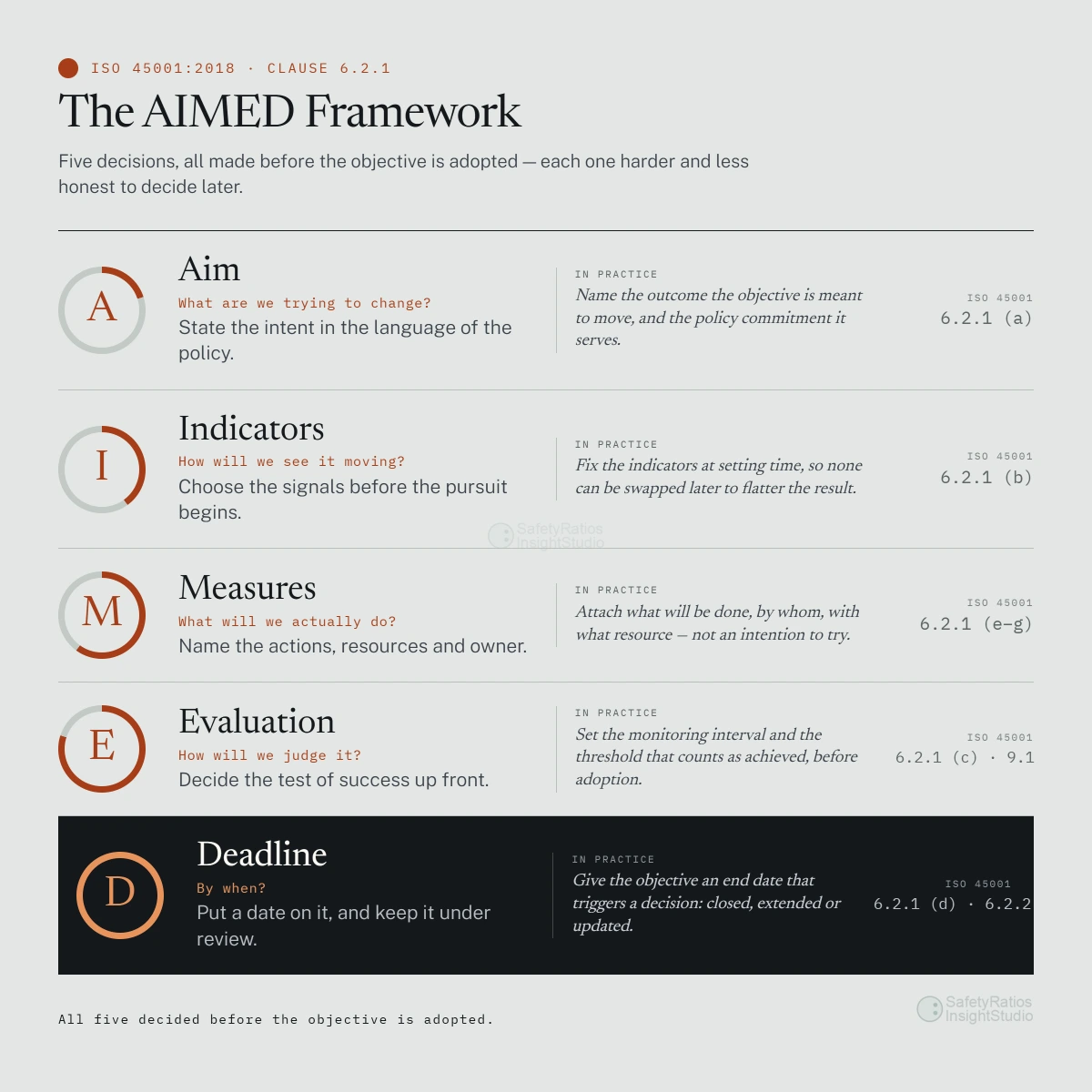
Aim
The Aim is one sentence of change: what will be different, where, for whom. It must be recognisable from the risk assessment and consultation that justified it, and traceable to a policy commitment it makes specific. A crew hearing the aim should be able to connect it to their own work without translation.
The failure tell is an aim that describes activity rather than change: "roll out the new permit system" is a plan, "cut permit violations on live work to zero" is an aim. Activity aims complete themselves regardless of whether anything improved.
Indicators
Indicators are the signals that will show progress and drift, chosen from data the operation actually generates. Good indicator sets mix leading signals (observations, condition checks, reported friction) with lagging ones (injuries, events), so movement shows before harm does.
Indicators chosen at setting time discipline everything downstream: they decide what the field must record, what the dashboard must carry, and what an honest review will read. An objective with no indicator is a hope with a title.
Measures
Measures put numbers on the indicators where numbers are practicable: the baseline, the target, and the coverage the data must reach to be believed. Where an objective genuinely cannot carry numbers, the measure decision becomes an evaluation method: how progress will be judged, by whom, against what.
The clause's own wording, measurable if practicable or capable of performance evaluation, is a fork with no third path. AIMED forces the fork to be taken deliberately at setting, so no objective arrives at review with neither.
Evaluation
Evaluation sets the reading rhythm: who reads the indicators, how often, and what movement triggers a decision. A trigger agreed in advance ("two months rising trend reopens the task review") turns drift into action in weeks. A rhythm left to the annual review turns drift into a surprise.
Deadline
The Deadline dates the objective and names the checkpoint on the way. It also carries the update duty: when risks, requirements or consultation outcomes change, the aim is revised deliberately, with the reason announced, rather than left to lapse. A dated aim can be kept, revised or missed; an undated one can only fade.
How AIMED Maps to ISO 45001 Clause 6.2.1
Each element discharges specific wording in the clause, which is what makes AIMED auditable as well as usable.
| Element | Clause 6.2.1 wording it discharges | Evidence it leaves |
|---|---|---|
| Aim | Consistent with the OH&S policy (6.2.1 a); takes into account the assessment of risks and opportunities and the results of worker consultation (6.2.1 c 2–3) | The objective's one-sentence statement, traceable both ways |
| Indicators | Monitored (6.2.1 d) | Named signals, fed from field data, on the record from day one |
| Measures | Measurable (if practicable) or capable of performance evaluation (6.2.1 b) | Baseline, target and coverage, or a written evaluation method |
| Evaluation | Monitored (6.2.1 d); communicated (6.2.1 e) | A reading rhythm with owners and agreed triggers, minuted in use |
| Deadline | Updated as appropriate (6.2.1 f) | Dates, checkpoints, and a revision history with reasons |
AIMED Through the LDP Lenses
Within the LDP framework (Living, Driving, Proving), an AIMED objective performs on all three: it is lived when crews can recite the aim and feed its indicators from their own work, driven when leadership funds it at adoption and asks about it in routine governance, and proven when the register, the readings and the revision history show a governed cycle.
Our Mission 45001 briefs on Clause 6.2.1 apply exactly those lenses: the field brief reads objective setting as the crew meets it, with the strategy and verification briefs to follow.
Where AIMED Breaks
A setting discipline has its own failure modes, and each one converts the framework from a steering tool into paperwork. The remedy follows each in italics.
- The measure becomes the target. Indicators improve while the field feels unchanged, because effort has moved to feeding the number.
Remedy: pair every leading indicator with a lagging one, and treat divergence between them as a trigger in its own right. - Aim inflation. A list long enough to please every stakeholder dissolves under pressure, and none of it gets funded properly.
Remedy: rank the list and cut it until every surviving aim has a sponsor and a budget. - Consultation as ratification. Workers are shown finished objectives, so the aims never inherit field reality and are defended by nobody.
Remedy: consult before targets are fixed, and let the record show what the input changed. - Deadline rollover. The same aims reappear each year with fresh dates, which teaches the organisation that the dates mean nothing.
Remedy: every rollover is treated as a miss and analysed for cause before the aim is reset.
Using AIMED
In practice the framework runs as a one-page test applied to every candidate objective before adoption: can the aim be said in one sentence a crew would recognise, are the indicators named and fed, has the measure fork been taken, does evaluation have owners and triggers, and is the deadline real. A candidate that fails any element goes back for work, and a candidate that fails several was probably a wish.
The companion piece, The AIMED Framework in Practice, walks the discipline through worked examples at field, strategy, verification and command level.
Frequently Asked Questions
What is the AIMED framework?
AIMED is a setting-time discipline for OH&S objectives: Aim, Indicators, Measures, Evaluation, Deadline. All five decisions are made before an objective is adopted, so that every quality ISO 45001 Clause 6.2.1 demands, consistency, measurability, monitoring, communication and update, exists as a concrete, evidenced choice rather than an adjective.
How does AIMED relate to ISO 45001 Clause 6.2.1?
Each element discharges specific clause wording: the Aim carries policy consistency and the assessment and consultation inputs, Indicators carry the monitoring duty, Measures take the clause's measurable-or-evaluable fork deliberately, Evaluation sets the monitored and communicated rhythm, and the Deadline carries the updated-as-appropriate duty with a dated revision history.
What is the difference between indicators and measures in AIMED?
Indicators are the named signals that will show progress and drift, chosen from data the operation actually generates. Measures put numbers on those signals: the baseline, the target and the coverage required, or, where numbers are impracticable, a written method for how performance will be judged.
How is AIMED different from SMART objectives?
SMART is a generic goal-writing test applied to a finished sentence. AIMED is built for OH&S objectives under ISO 45001: it starts earlier, requiring the aim to trace to the risk assessment and worker consultation, and reaches further, fixing the monitoring rhythm, the governance triggers and the update duty that SMART never touches.
How many objectives should AIMED be applied to?
Every adopted objective, which is itself an argument for adopting few. The framework's demands, a sponsor, fed indicators, a reading rhythm, a funded route, are affordable for a short ranked list and impossible for a long one, so AIMED naturally enforces the selectivity that makes objective setting work.