Australian Workplace Fatalities: Trends, Industries and Causes 2009–2025
Declining Totals Alongside Persistent Concentration in Transport, Agriculture and Construction
Australian workplace fatalities fell from 258 in 2009 to 180 in 2025, with the national fatality rate declining from 2.29 to 1.3 per 100,000 workers. While the headline trend is clearly lower, fatalities remain heavily concentrated in Transport and Warehousing, Agriculture, and Construction, and vehicle incidents continue to account for the largest share of annual workplace deaths. The long term improvement has reduced overall fatality counts without materially changing where or how those fatalities occur.
Australia's workplace fatality figures have declined substantially over the long term, although the latest data shows fatalities remain heavily concentrated within specific industries and incident types.
Between 2009 and 2025, annual workplace fatalities fell from 258 to 180, while the national workplace fatality rate declined from 2.29 to 1.3 fatalities per 100,000 workers.
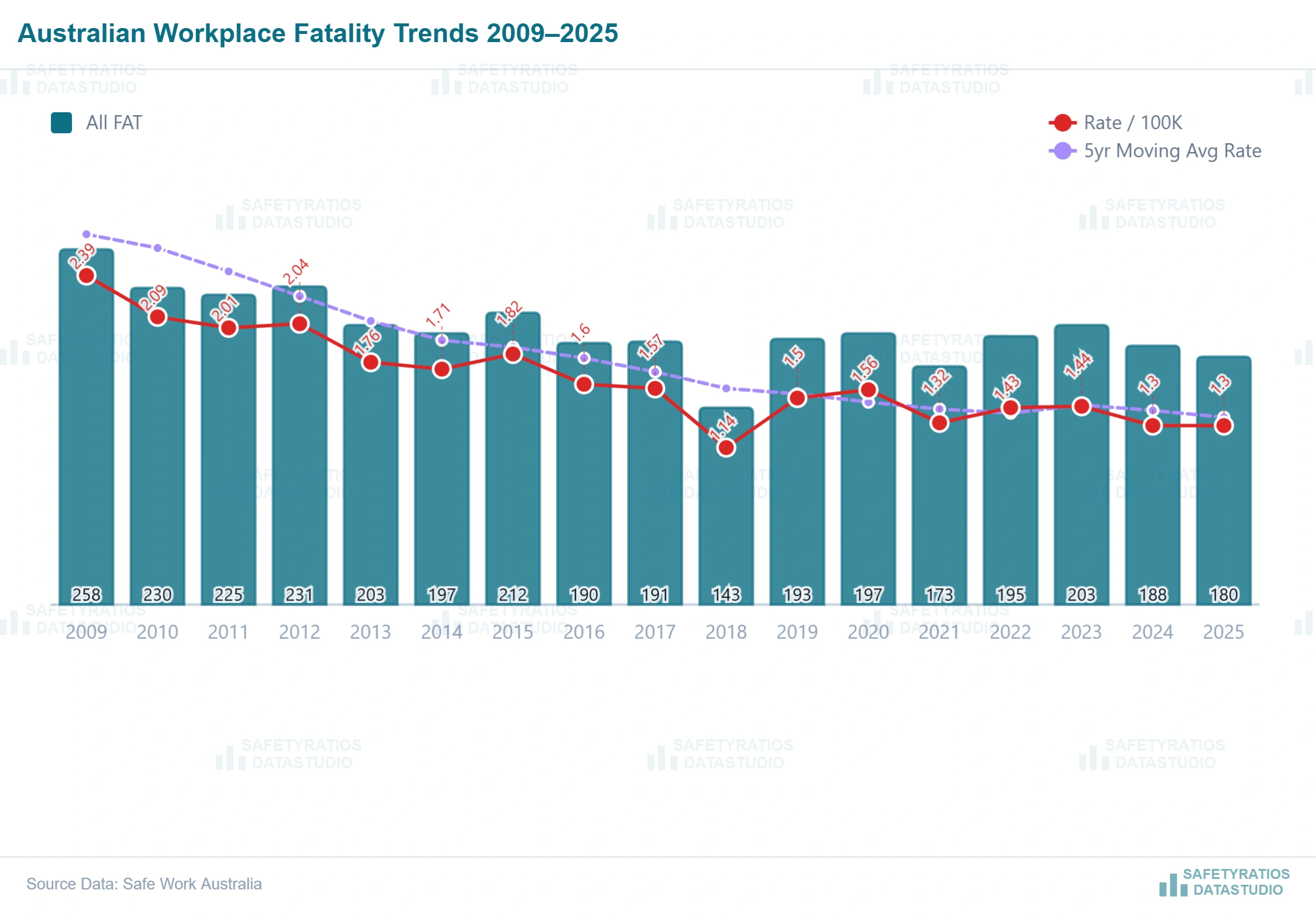
Long Term Workplace Fatality Trends Continue Downward
The broader trend across the dataset remains clearly downward despite periodic increases in individual years.
The sharpest reduction occurred between the earlier years of the dataset and the post-2018 period, where both fatality totals and fatality rates stabilised at materially lower levels than those recorded during the late 2000s and early 2010s.
The data also shows the:
- 5 year moving average fatality rate
- annual fatality rate
- total workplace fatality count
have gradually converged lower over time.
However, the decline has not been linear.
The dataset shows several shorter term reversals, particularly during:
- 2015
- 2020
- 2023
where annual fatality counts increased before subsequently moderating again.
The latest figures from 2024 and 2025 suggest workplace fatalities may now be entering a slower phase of improvement, with fatality rates stabilising around 1.3 per 100,000 workers after earlier declines.
Workplace Fatalities Remain Concentrated in Specific Industries
Although overall fatalities have declined nationally, the distribution across industries has remained relatively concentrated throughout the period.
Transport and Warehousing, Agriculture, Forestry and Fishing, Construction, and Services continue accounting for the largest share of annual workplace fatalities.
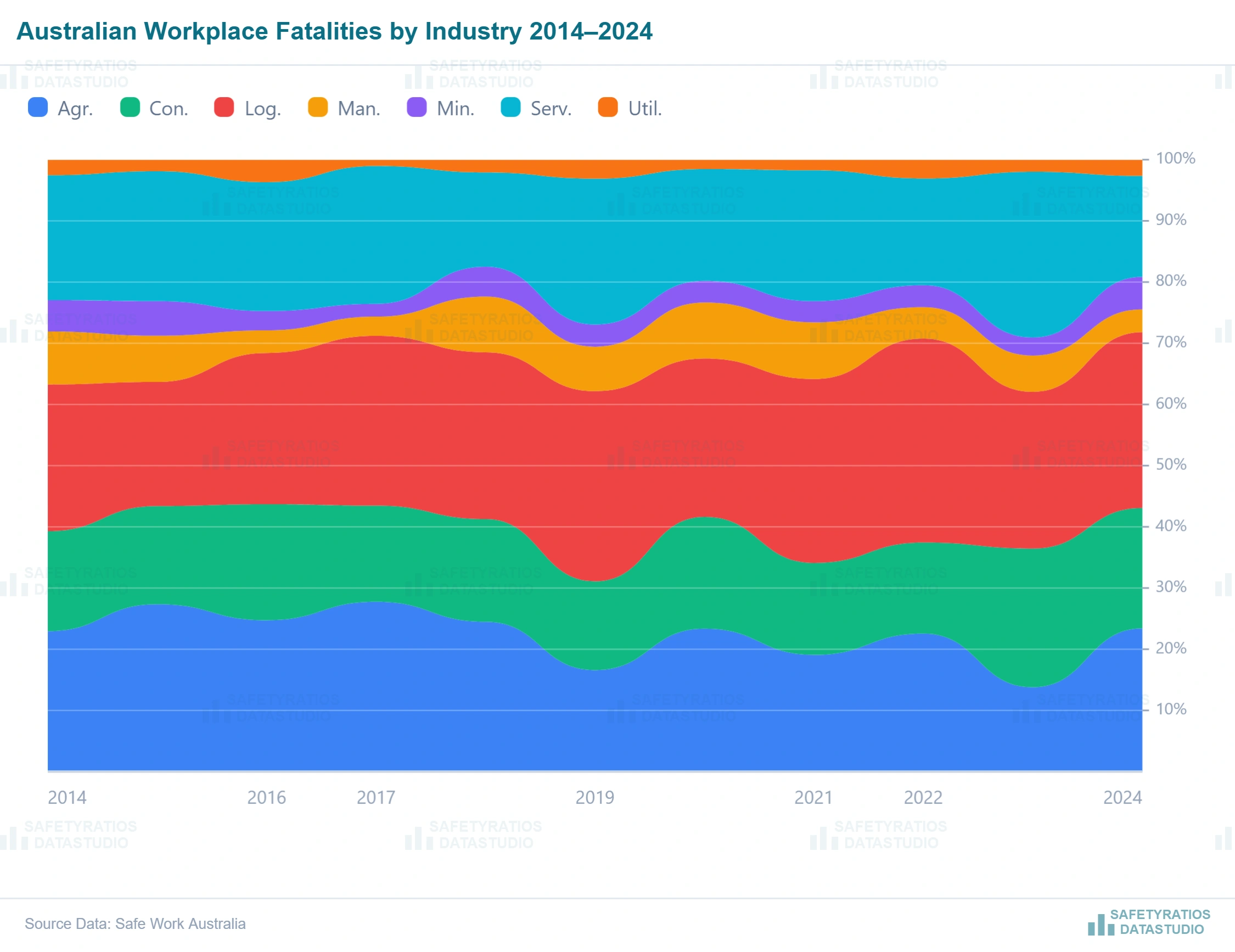
The industry trend data shows several notable structural patterns:
- Transport and Warehousing has consistently represented one of the largest fatality categories
- Agriculture maintains a persistently high share despite workforce size differences
- Construction remains elevated across most years
- Mining contributes a comparatively smaller share of total fatalities despite historically higher perceived risk
The relative consistency of these distributions suggests the national decline in fatalities has occurred without materially changing the industries where fatal incidents remain most concentrated.
Fatality Rates Tell a Different Story Than Total Fatalities
The fatality rate distribution across industries reveals a more uneven risk profile than fatality counts alone.
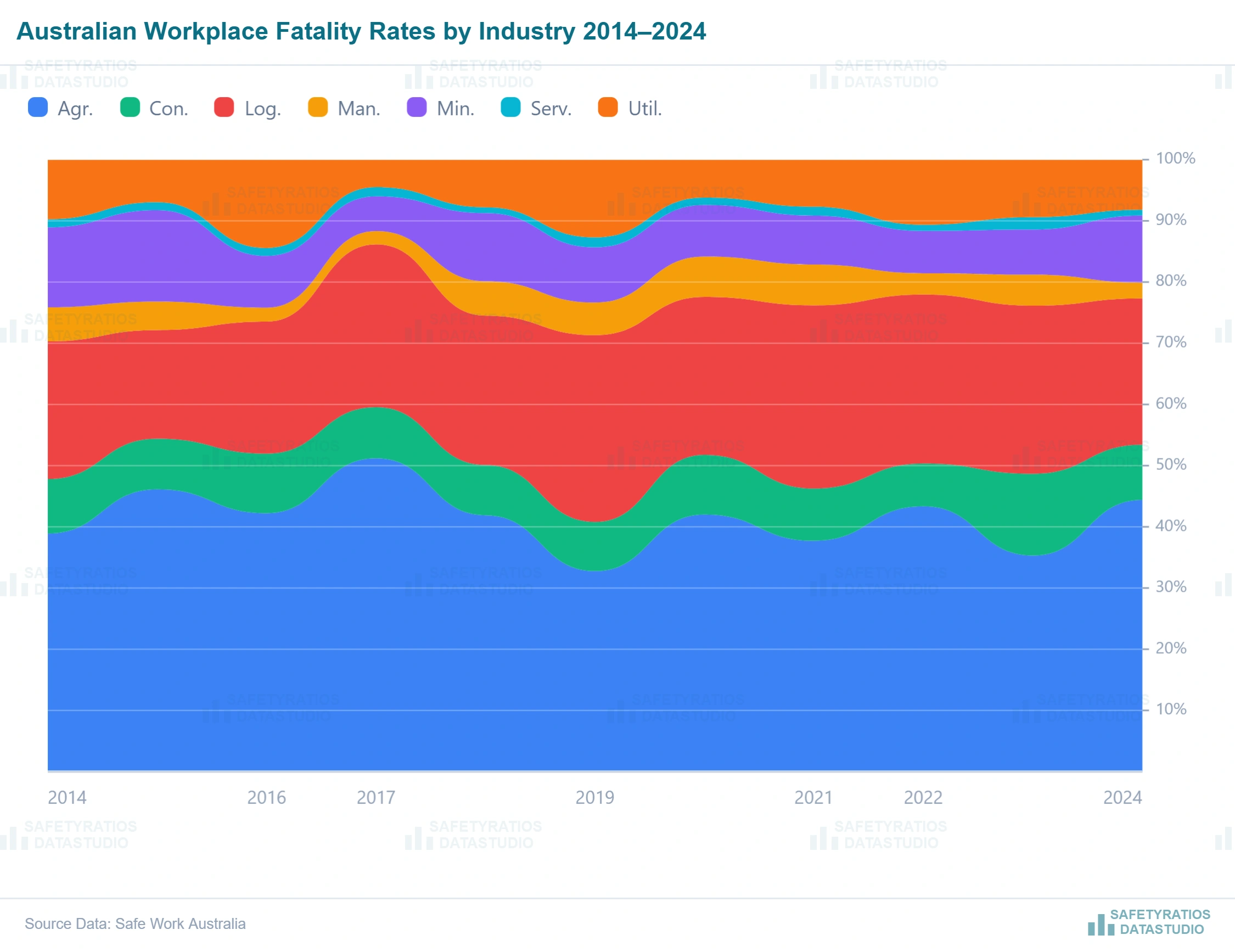
Agriculture, Forestry and Fishing consistently represents the highest fatality rate exposure across the dataset, substantially exceeding most other industries across multiple years.
Transport and Warehousing also maintains a persistently elevated fatality rate profile, while Construction remains structurally higher than lower risk service sectors.
This distinction is important because industries with lower total fatality counts can still carry disproportionately high fatality rates once workforce size is considered.
Viewed together, the industry fatality count and fatality rate charts suggest the long term national improvement has not reduced risk evenly across all sectors.
Vehicle Incidents Continue Dominating Workplace Fatalities
The distribution of workplace fatalities by cause shows a striking long term pattern.
Vehicle incidents remain the single largest fatality mechanism across the dataset, consistently accounting for the largest share of annual workplace deaths.
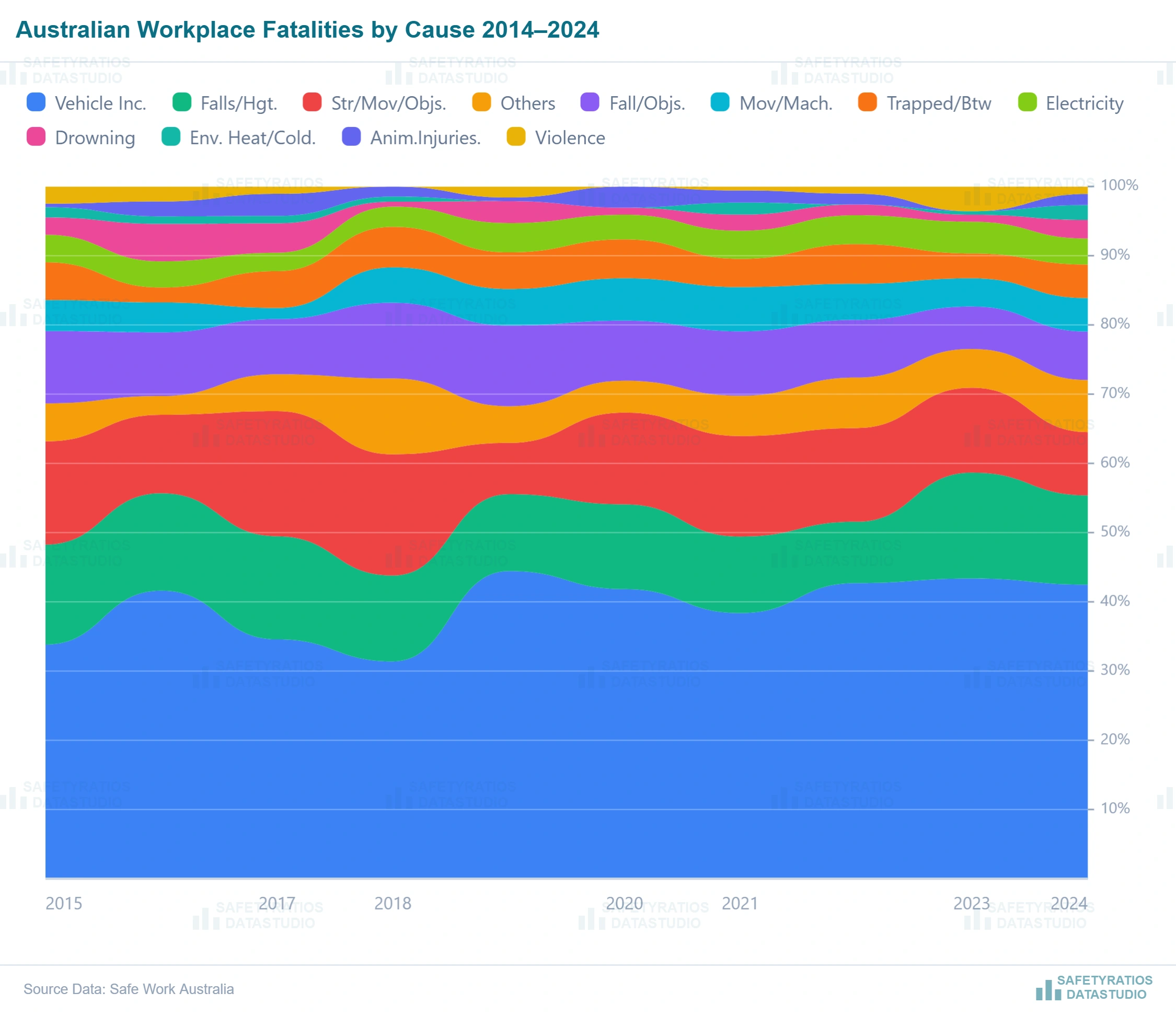
Falls from height, struck by moving objects, and moving machinery incidents also remain persistently elevated across most years.
While individual causes fluctuate year to year, the broader composition has remained relatively stable over time, suggesting the underlying mechanisms contributing to workplace fatalities have changed less dramatically than the overall fatality totals themselves.
This is one of the more important findings within the dataset.
The long term reduction in fatalities appears to reflect:
- broad reductions across existing risk categories
rather than:
- the elimination of particular fatality mechanisms altogether
The Long Term Decline Masks Persistent Structural Risk Concentrations
The national workplace fatality trend is clearly lower than earlier historical levels, particularly when compared with the peak fatality years recorded during the 2000s.
However, the supporting industry and cause data shows fatalities remain persistently concentrated within:
- transport related incidents
- agriculture
- construction
- vehicle interactions
- falls
- moving object incidents
This creates an important distinction within the broader dataset.
The overall fatality trend has improved materially over time, but the structural distribution of fatality risk across industries and event types has remained comparatively stable.
In other words, workplace fatalities have declined nationally, but the underlying concentration of risk has proven far more persistent.
Frequently Asked Questions
How have Australian workplace fatalities changed over time?
Australian workplace fatalities have declined substantially over the long term. Annual fatalities fell from 258 in 2009 to 180 in 2025, while the workplace fatality rate declined from 2.29 to 1.3 fatalities per 100,000 workers.
Which industries record the highest workplace fatalities in Australia?
Transport and Warehousing, Agriculture, Forestry and Fishing, Construction, and Services consistently account for the largest share of Australian workplace fatalities across the dataset.
Which industry has the highest workplace fatality rate in Australia?
Agriculture, Forestry and Fishing records the highest workplace fatality rate across most years in the dataset, substantially exceeding many other industries when workforce size is considered.
What is the leading cause of workplace fatalities in Australia?
Vehicle incidents remain the largest workplace fatality mechanism nationally, accounting for the highest share of fatalities across most years in the dataset.
Why are workplace fatality rates important?
Fatality rates provide a more accurate measure of workplace risk because they account for workforce size. Industries with lower fatality totals can still have disproportionately high fatality rates.
Have workplace fatality risks changed across industries?
While overall workplace fatalities have declined nationally, the distribution of fatalities across industries and incident types has remained relatively stable, with transport, agriculture, construction, and vehicle related incidents continuing to dominate the dataset.
What does the 5 year moving average fatality rate show?
The 5 year moving average fatality rate smooths yearly fluctuations and highlights the broader long term trend in workplace safety performance. The moving average has steadily declined across the dataset, indicating long term improvement despite periodic yearly increases.