The AIMED Framework in Practice
Worked examples at field and strategy level
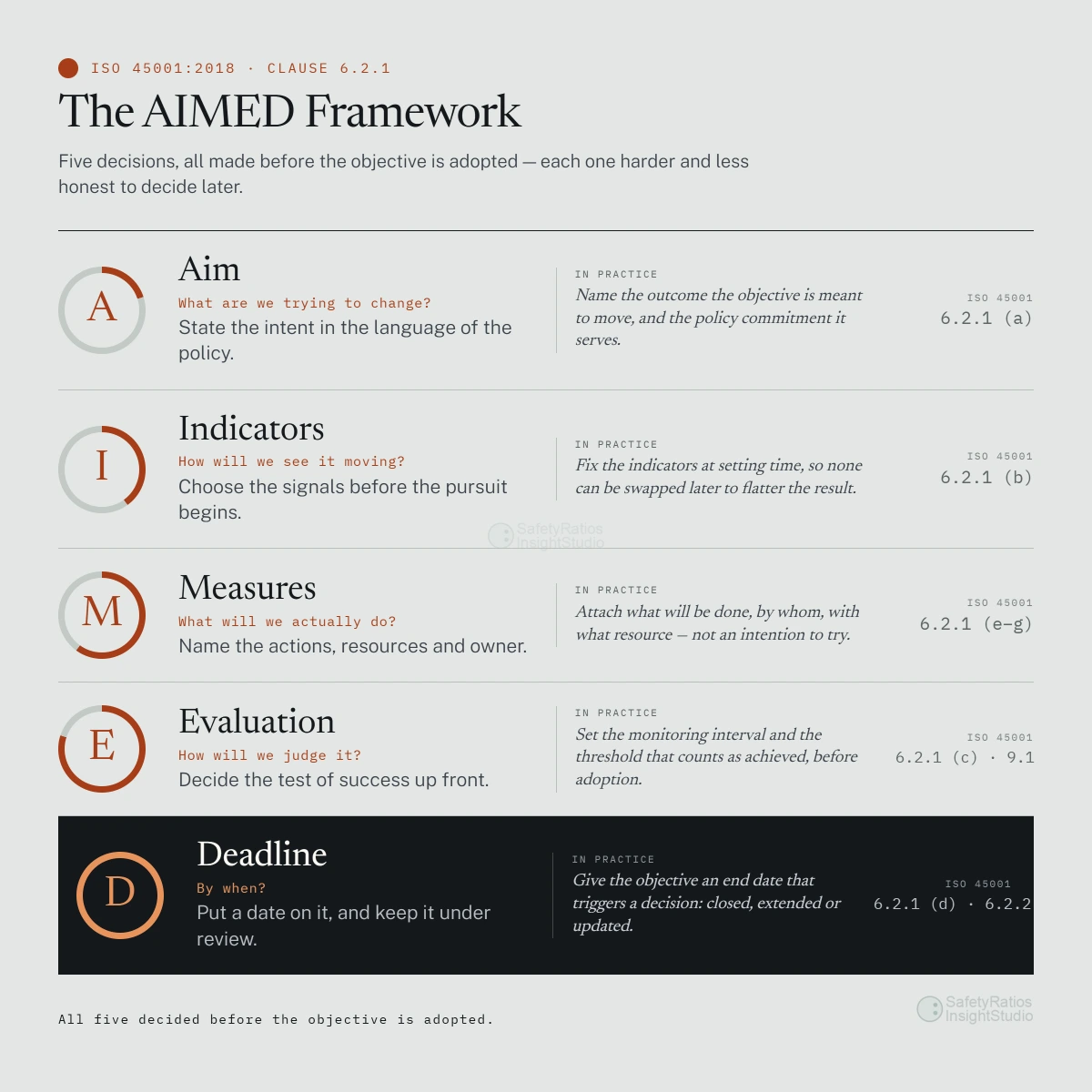
The AIMED framework sets OH&S objectives through five decisions made at adoption: Aim, Indicators, Measures, Evaluation, Deadline. This companion walks the discipline through worked examples, because a setting framework is only convincing when it survives contact with a real objective.
The examples run at two levels, matching the lenses of the LDP framework and the structure of our Mission 45001 briefs: a field example, the objective as a crew lives it, and a strategy example, the objective as leadership drives it.
A Field Example: Hand Injuries in the Fabrication Shop
The scenario. A fabrication shop of forty workers closes the year with fifteen hand injuries: twelve first-aid cases and three medical treatments, clustered around deburring and sheet handling. At the toolbox consultation, the crew's reading is blunt: the issued gloves are wrong for deburring, and two guards force awkward grips. The risk assessment agrees with them.
Aim. "Halve hand injuries in the fabrication shop within twelve months by fixing the tasks that cause them." One sentence, sayable at a pre-start. It traces backwards to the assessment and the crew's own words, and upwards to the policy commitment on injury prevention. Nobody in the shop needs it translated.
Indicators. Three signals, all from data the shop already produces or can start producing on Monday: the monthly first-aid log count, a weekly task observation of deburring and sheet handling, and glove-fit issues raised at toolbox talks. Two leading, one lagging, so movement shows before harm does.
Measures. Baseline fifteen hand injuries a year, target seven or fewer. Observation coverage of at least four tasks a week, because an observation indicator nobody feeds is decoration. Numbers are practicable here, so no proxy evaluation method is needed.
Evaluation. The supervisor reads the log and the observation sheet monthly at the shop meeting; the safety committee reads the trend quarterly. Two triggers are agreed in advance: any medical-treatment case reopens the task review immediately, and two consecutive rising months do the same.
Deadline. Twelve months, with a checkpoint at six. One update rule is written down at adoption: if the shop's work mix changes materially, a new contract, new plant, the aim is re-tested against the new tasks rather than left to drift.
What happened. The glove trial ran in week three because the crew had named the fix themselves. The deburring rework landed at month four. At the six-month checkpoint the count stood at five against a pro-rata seven, and a sampled apprentice could recite the aim. The objective closed at year end on six injuries, and the revised gloves and guards became the shop standard: the gain banked into routine.
A Strategy Example: Fatigue Across Nine Sites
The scenario. A civils contractor running night works across nine sites watches fatigue-related near-misses climb for three quarters. The 6.1 assessment ranks fatigue above two competing candidates, night concreting and long plant-transfer drives carry the exposure, and consultation adds a detail the roster data missed: relief cover is so thin that crews push through rather than report.
Aim. "Bring fatigue-related reportable incidents on night works to zero within eighteen months, with hours-compliance visible at every site." Sponsored by the operations director in their own reporting line, and priced at adoption: rostering software and a funded relief pool, budgeted before the aim was announced.
Indicators. Rostered versus actual hours per site per month, fatigue reports and their response times, and near-miss classifications tagged for fatigue. Site readings roll up to one board dashboard, so the organisational aim and its nine local pieces read from the same data.
Measures. Hours-compliance at ninety-seven per cent or better per site, fatigue-report response inside seventy-two hours, and the reportable count itself. The baseline quarter is measured before launch, because a target without a baseline is a slogan with a number attached.
Evaluation. Monthly at each site's operations review, quarterly at board level. The agreed trigger is deliberately supportive: any site below ninety-five per cent for two consecutive months gets a resourcing review, and the framing matters, because a compliance trigger read as blame teaches sites to game the roster data.
Deadline. Eighteen months, checkpoints at six and twelve. Mid-cycle the company wins a large night-works contract; because the portfolio was ranked at setting, the new work joins the fatigue aim's scope by rule, with the relief pool expanded, and the objective survives the growth that would have quietly killed an unranked one.
What happened. Two sites drew on the relief pool in the first quarter, which the board read as the system working rather than failing. Hours-compliance stabilised above target by month ten. The reportable count reached zero in month fifteen and held, and the rostering rules moved into the company standard at close-out, resetting the baseline for the next portfolio.
Conclusion
Both examples run on the same five decisions, made at the same moment: before adoption. The fabrication shop needed a toolbox talk and a log it already kept; the contractor needed a board sponsor and a dashboard. The discipline stayed the same at both scales, and only the machinery carrying it grew.
That is the practical case for AIMED: setting time is when honesty is cheap. Baselines are measured before anyone has a result to defend, triggers are agreed before anyone is embarrassed by them, and deadlines are dated before anyone needs an excuse. Every one of those decisions gets harder the moment pursuit begins.
Read the five elements in full in The AIMED Framework for Safety Objectives, and see how objective setting reaches the crew in our field brief on Clause 6.2.1. An objective that survives both readings, the framework's five tests and the workface's daily use, is one the organisation can actually hold.
Frequently Asked Questions
Can AIMED work for a single crew or workshop?
Yes, and the field example shows the whole discipline running inside one fabrication shop: an aim the crew helped set, indicators from data the shop already produces, monthly reading at the shop meeting, and a dated close-out. The framework scales down as cleanly as it scales up because all five decisions exist at any size.
Does every objective need numbers?
Every objective needs the Measures fork taken deliberately: numbers where practicable, a written evaluation method where they genuinely are not. Both worked examples carry numbers because their signals allowed it; what no objective may do under ISO 45001 Clause 6.2.1 is arrive at review with neither.
What happens when conditions change mid-cycle?
The Deadline element carries the update duty: the aim is revised deliberately, with the reason announced, as the strategy example shows when a new night-works contract joined the fatigue objective's scope by rule. Deliberate revision reads as steering; a silent lapse teaches the organisation to discount the next aim.