Command Brief on ISO 45001:2018 Clause 6.2.1
Holding the objectives cycle together across the field, the boardroom and the record
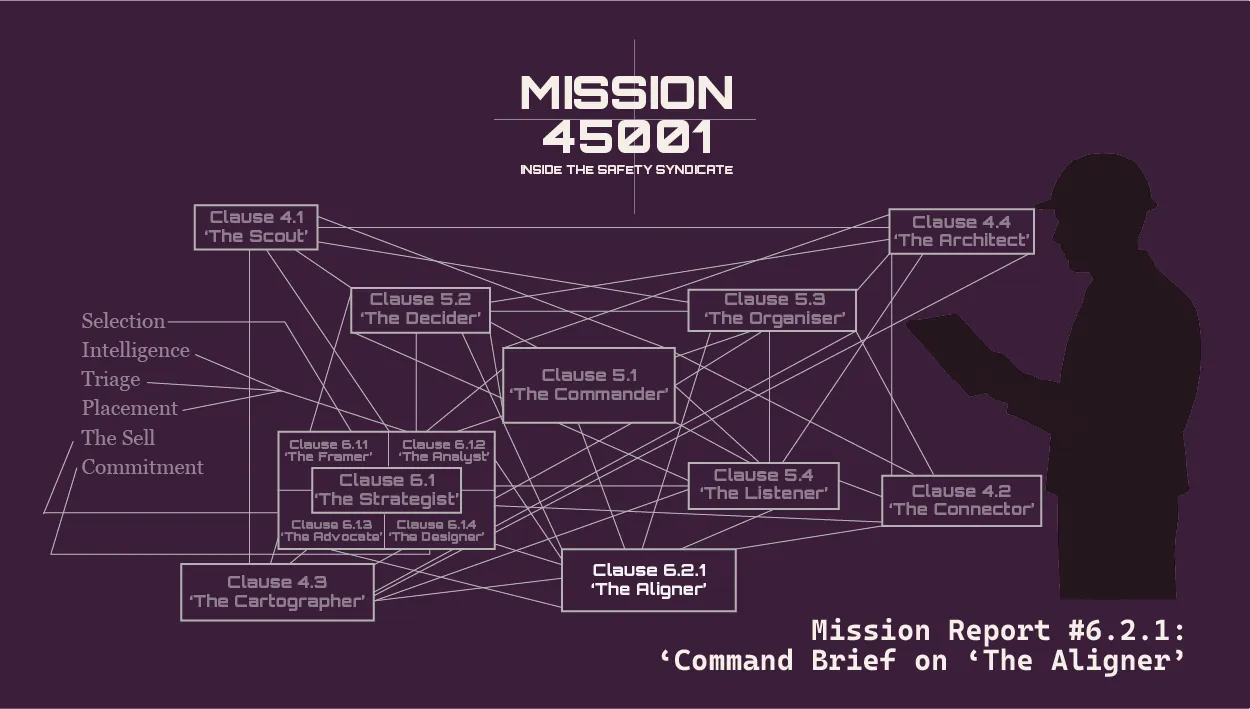
Mission 45001 is our deep dive into ISO 45001:2018, a network of clauses working together to help organisations run safe, resilient operations. Our mission is to show how that network works from the inside. This is our command brief on 'The Aligner' of the safety syndicate.
This command brief examines ISO 45001:2018 Clause 6.2.1 as a whole: how OH&S objectives are chosen, funded, lived, monitored and proven, and how the person accountable for the system holds all of that together at once.
It is written for the people who own the system across all three audiences: safety directors, heads of HSE and other system owners, who see the field, the boardroom and the record at once and answer for whether the three tell the same story.
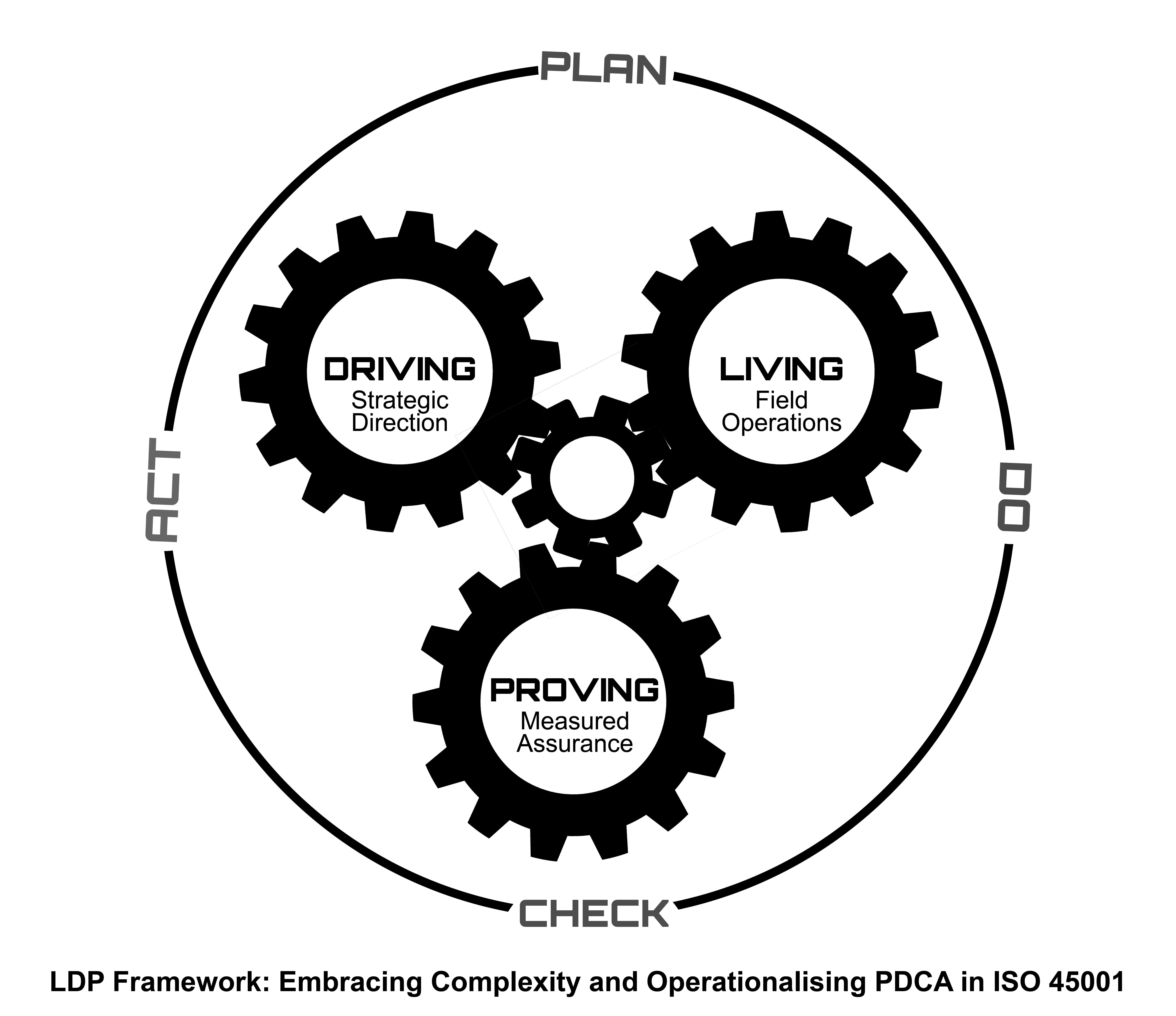
Within the LDP framework (Living, Driving, Proving), this command brief reads Clause 6.2.1 through all three lenses: objectives are lived on site as recitable direction, driven in the boardroom as funded, sponsored positions, and proven in the record as a governed cycle. Holding the three readings together is the command task.
ISO 45001 Clause 6.2.1 requirements
Establishing OH&S objectives
- Clause 6.2.1: The organization shall establish OH&S objectives at relevant functions and levels in order to maintain and continually improve the OH&S management system and OH&S performance
- Objectives shall be: consistent with the OH&S policy; measurable (if practicable) or capable of performance evaluation; monitored; communicated; and updated as appropriate
- Objectives shall take into account: applicable requirements, the results of the assessment of risks and opportunities, and the results of consultation with workers and, where they exist, workers' representatives
- Documentation: The organization shall maintain documented information on the OH&S objectives (and, with Clause 6.2.2, on the plans to achieve them)
Clause 6.2.1 in the LDP framework
One set of objectives, three readings (AIMED through the lenses)
- Living: The objective reaches the day's work as direction a crew can recite, and the day's work feeds it back as honest indicator data
- Driving: Leadership chooses few, ranks them, funds them at adoption, and asks about them on a rhythm that outlasts the launch
- Proving: The register, the readings and the revision history evidence a cycle that genuinely turns, from setting through update to close-out
- The command reading: Where the three lenses disagree, the disagreement itself is the finding, and it names which correction comes first
Where the lenses disagree
Reading the gaps only the system owner can see
- Green board, silent crew: Living is behind; brief the objective until crews can recite it, then re-read the indicators, because data fed by a site that does not know the aim is suspect
- Recited aim, idle budget: Driving is behind; fund it and name its sponsor before the workforce learns the list was aspiration
- Clean register, batched data: Proving is behind; wire the readings into meetings that already happen, and count how many arrive on time
- Funded objective, stale target: Proving is behind; reopen the register against the current Clause 6.1 assessment before spending further
- Strong indicator, unchanged site: Living is behind; review the indicator before celebrating the result, and pair it with a lagging measure
- Honest field, flattering minutes: Driving is behind; repair the reporting channel before trusting either reading
The field, the board pack and the record can each pass on their own while the objective fails as a whole. Each pattern is set out in full in our companion piece, 6 Things Most Organisations Get Wrong About Safety Objectives.
What effective objective setting means
What the system owner sees when the three readings agree
- One aim, three readings: The objective the crew recites, the one the board pack reports and the one on the register are the same objective in the same words
- Descent visible from every side: Crews recognise their own risks in it, leaders can name the Clause 6.1 assessment it came from, and the record dates those inputs before adoption
- Qualities held on one page: The register carries each objective's policy link, measure or method, rhythm and date, and every level reads that page
- A cascade that sums: Site and crew pieces add up to the organisational objective, with no orphan at either end
- Readings that cause decisions: Indicator movement reaches a review, and the review provably changes something
- Changes heard everywhere at once: Revisions are dated in the record, announced by the sponsor and re-briefed on site within the same cycle
Why effective objective setting matters
The one artefact every audience reads
- The policy is priced here: Open commitments become dated, resourced positions the organisation can be held to
- Direction survives pressure: A ranked short list settles conflicts when schedules and budgets tighten
- Improvement compounds: Met objectives bank into standards, and the next cycle starts further forward
- All three lenses meet: Objectives are read daily on site, quarterly at the board and in full at audit, which no other single artefact achieves
- Credibility accrues in every direction: Workforce, regulators, clients and insurers all price the organisation on its objectives record
- Stagnation shows here first: A rolled-forward list is the clearest single sign that a system has stopped improving
Systemic impact of effective objective setting
What moves when the objectives cycle works
- Focus concentrates: Discretionary effort, budget and attention align on the few chosen positions
- Planning gains a destination: Clause 6.2.2 routes, resourcing and training all form around the set objectives
- Measurement gains meaning: Indicators exist because objectives need them, and data quality becomes a leadership concern
- Reviews gain an agenda: Clause 9.3 reads objective progress as a standing input, which disciplines the whole reporting chain beneath it
- Culture reads the record: Kept objectives build belief, and the workforce prices every future announcement on what happened to the last one
- The system learns in cycles: Set, pursue, bank, reset becomes the organisation's visible improvement engine
Systemic indicators of strong objective setting
Signals the cycle is genuinely turning
- Recitation on site: Sampled workers state the current objective in their own words
- A thread that runs both ways: Any objective traces back to assessment and consultation, and forward to its funded Clause 6.2.2 plan
- Triggers that fire: Indicator movements provably cause decisions between scheduled reviews
- Sponsors in the minutes: Named leaders ask about their objectives in routine governance
- Honest scorekeeping: Misses are minuted plainly, with cause analysis priced into the next cycle
- Baselines that move: Successive registers start from improved positions
Systemic indicators of weak objective setting
Signals the list is decoration
- The list survives every year: Targets rolled forward unchanged, with the misses never analysed
- Unevaluable objectives reach review: Objectives with neither measure nor written evaluation method sit on the register uncorrected
- Consultation exists as signatures: Participation recorded, with no trace of what any input changed
- The register reads as safety-department paperwork: Objectives authored, briefed and defended by one function at every level
- Data arrives in batches: Indicator readings cluster just before audits and reviews, with long silence between
- Announcements travel without budgets: Objectives launched with resourcing left to be argued for later
Embedding effective objective setting
Building the cycle into how the organisation already runs
- One calendar: Set objectives inside the business planning cycle, so money and targets move together
- The AIMED discipline at adoption: Run every candidate through the AIMED framework before it joins the register, so the clause's qualities exist as decisions; the worked examples show it in practice, in strategy, in evidence and in the LDP framework
- Rank and cut: Adopt only what can be sponsored, funded and governed, and record what was declined
- Read inside existing meetings: Shop meetings monthly, reviews quarterly, the board on agreed triggers, with no new forum invented
- Consult before fixing targets: Gather worker input while it can still change the list, and publish what it changed
- Close out loudly: Bank achievements into standards, analyse misses openly, and reset the baseline in view of the people who moved it
Inside the extended edition
Eleven further sections available to subscribers
- Policy implications: The promise and the price, held together
- Leadership implications: Ownership that shows in the record
- Planning implications: The assessment's output, commissioned properly
- Support implications: What the objective is given to live on
- Operational control implications: The objective at the point of work
- Performance evaluation implications: A scoreboard that can be trusted
- Improvement implications: A cycle that compounds on the record
- Cultural implications: What the cycle teaches, and how to hear it
- System integration implications: One cycle inside the business
- Documentation requirements: What Clause 6.2.1 requires in writing, and what command reads it for
- Next steps: Drive the Choice. Live the Objective. Prove the Cycle
Subscribers gain access to the complete presentation, while higher-tier members can download the full .pptx version for use in their own training programmes.
Background data on 'The Aligner', Clause 6.2.1
Focus: Establishing OH&S Objectives
- Codename: The Aligner
- Function: Objective Setting — guides focus with strategic aim
- System Role: Converts assessed risks, requirements and consultation into the few targets the system will pursue
- Syndicate Caucus: Works with The Commander (Clause 5.1), The Strategist (Clause 6.1), The Navigator (Clause 6.2.2), and The Conduit (Clause 7.4)
- Modus Operandi: Selective, consultative, and insistent that every aim be checkable
- Activation Threshold: Any change in risk profile, requirements, consultation outcomes, or an objective met or missed
- Known For: Short lists, straight sentences, and targets people can recite
- Field Signals: Crews unable to name the site's aim, indicators fed with stale data, suggestions with nowhere to land
- Boardroom Signals: Targets rolled forward unchanged, objectives inconsistent with the policy, progress asserted without indicators
- Audit Signals: Objectives incapable of evaluation, no evidence of communication or update, consultation absent from the record
- PDCA Coordinates: Lives in Plan — sets the aim that The Navigator (Clause 6.2.2) turns into a route
Frequently asked questions
What does ISO 45001 Clause 6.2.1 require?
Clause 6.2.1 requires the organization to establish OH&S objectives at relevant functions and levels that are consistent with the OH&S policy, measurable if practicable or capable of performance evaluation, monitored, communicated, and updated as appropriate, taking into account applicable requirements, the assessment of risks and opportunities, and the results of consultation with workers.
Who owns OH&S objectives in an organisation?
Top management owns the selection, ranking and resourcing, with each top-level objective sponsored by a named leader in their own reporting line, functions and crews owning their nested pieces, and workers consulted before targets are fixed. A register authored and defended by the safety function alone is one of the clearest weak signals the cycle gives.
How do OH&S objectives connect the field, the boardroom and the audit?
Through the three LDP lenses: the same objective is lived on site as recitable direction feeding honest indicator data, driven in the boardroom as a funded and sponsored position, and proven in the record as a register, readings and dated revisions. Where the three readings disagree, the disagreement itself names the correction needed.
How often should OH&S objectives be reviewed and updated?
On a set rhythm wired into existing meetings, typically monthly at operational level and quarterly at review level, with triggers agreed in advance so significant indicator movement forces a decision between scheduled readings. Updates happen whenever risks, requirements or consultation outcomes change, as dated decisions with announced reasons.
How do Clause 6.2.1 and Clause 6.2.2 differ?
Clause 6.2.1 sets the objective: which targets the organisation will pursue and what qualities they must have. Clause 6.2.2 builds the route: what will be done, with what resources, by whom, by when, how results are evaluated, and how the actions integrate into business processes. The Aligner chooses the target; The Navigator plans the route.