6 Things Most Organisations Get Wrong About Safety Objectives
Reading the field, the board pack and the record against each other
Every OH&S objective is read three times. Crews read it on site, the board reads it in the pack, and auditors read it in the record. Within the LDP framework those are the three lenses: Living, Driving, Proving.
Each reading can pass on its own while the objective fails as a whole. The system owner is the one person placed to read the three against each other, and where they disagree, the disagreement is the finding. It also names which correction comes first.
This piece is a companion to our command brief on Clause 6.2.1, written for safety directors, heads of HSE and other system owners. Subscribers to the SCAN Series have access to a fuller edition of the brief.
It sets out the six things most organisations get wrong, how each one shows as a mismatch between the three readings, and where to send the correction.
How to read a disagreement
Take one objective and read it three ways in the same quarter. Ask a handful of workers on site to state it in their own words. Read the line the board pack gives it. Pull the register entry, the dated readings and the revision history.
Where all three tell the same story, move on. Where one reading parts company with the other two, that lens is behind, and it is the one to fix first. The other two are waiting on it, so correcting them first spends effort on a reading that will move again.
The three readings come from the three audience briefs: the field brief for the site, the strategy brief for the board and the verification brief for the record.
Six things organisations get wrong
Green board, silent crew. The board pack shows the objective on track, and the register agrees, but sampled workers cannot name it. Progress is being reported from the office.
Fix Living first: brief the objective until crews can recite it, then re-read the indicators, because data fed by a site that does not know the aim is suspect.
Recited aim, idle budget. Crews can state the objective, but no budget line or named sponsor stands behind it.
Belief is running ahead of commitment. Fix Driving first, before the workforce learns the list was aspiration and stops believing the next one.
Clean register, batched data. The register passes audit, but the readings cluster in the days before each review.
The cycle is documented and not run. Fix Proving first: wire the readings into meetings that already happen, and count how many arrive on time.
Funded objective, stale target. Budget and sponsor are in place, but the risk profile has moved since the objective was set.
Commitment is pointed at last year's problem. Reopen the register against the current Clause 6.1 assessment before spending further.
Strong indicator, unchanged site. The numbers improve while crews report no change in the work. The measure has become the target, and effort has moved to feeding the number.
Review the indicator before celebrating the result, and pair it with a lagging measure so the two can be read against each other.
Honest field, flattering minutes. Friction reports reach supervisors, but review minutes record steady progress. Bad news stops partway up the line.
Repair the channel before trusting either reading, since neither the field nor the minutes can be read as the whole picture until it is.
Routing the correction
The system owner reads the disagreement; the correction belongs to the owner of the lens that is behind. Each mismatch goes to the briefing, the sponsor or the record, and the next quarter's reading shows whether it closed.
| Pattern | Lens behind | First correction | Sent to |
|---|---|---|---|
| Green board, silent crew | Living | Brief until recitable | Supervisors |
| Recited aim, idle budget | Driving | Fund and sponsor | Top management |
| Clean register, batched data | Proving | Wire readings into meetings | Register owner |
| Funded objective, stale target | Proving | Reopen the register | Register owner and sponsor |
| Strong indicator, unchanged site | Living | Review the indicator | Indicator owner |
| Honest field, flattering minutes | Driving | Repair the channel | Review chair |
One line in the quarterly board pack carries the result: where the field, the board pack and the record disagreed that quarter, and which correction came first.
It is the one line no single lens would write, and it keeps the board reading the objective as a whole.
When the readings agree
Agreement is the goal, and it is worth testing. Three shallow readings can agree because all three were taken from the same summary. Sample the board figures back to field records each quarter, so the agreement rests on the work itself.
Agreement over several quarters is also the signal to close out. A met objective whose three readings agree is ready to be banked into a standard, and the cycle can start further forward.
Conclusion
None of the six mistakes shows from a single reading. Each looks acceptable to the crew, the board or the auditor alone, and only appears when the three are laid side by side.
Reading them together, and letting the disagreement set the order of correction, is the command task.
Read the system owner's view in our command brief on Clause 6.2.1. Subscribers to the SCAN Series have access to a fuller edition of the brief.
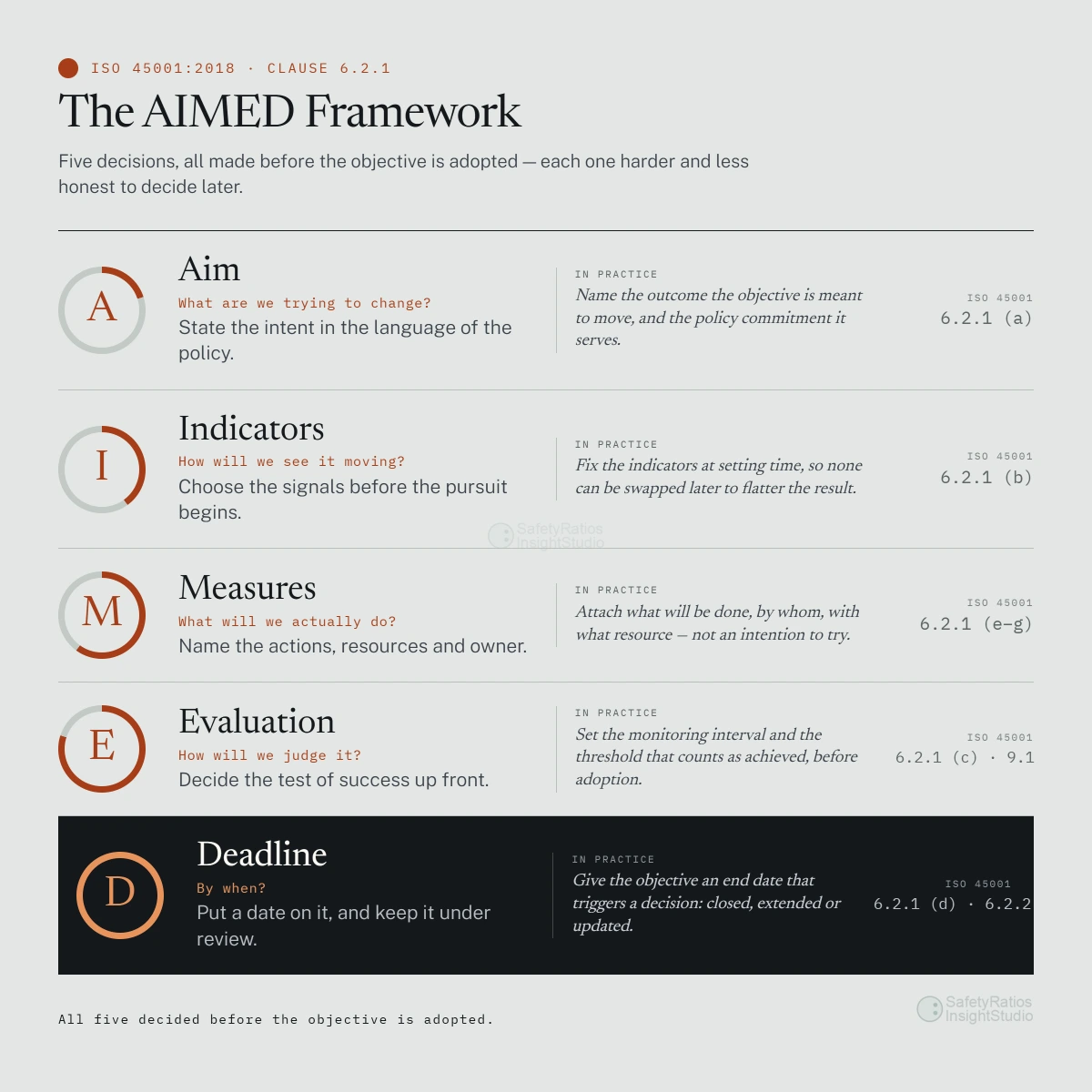
Three readings, one design: see AIMED in the LDP Framework bring them into line.
The AIMED Framework in the LDP Framework shows a safety director turning a lost-time rate target into a group objective on fatal-risk precursors, taking each AIMED decision across the whole organisation. It is part of the Mission 45001 subscriber edition, with the full briefs and all four worked examples.
Subscribe for full access →Frequently asked questions
What does it mean when the LDP lenses disagree?
One reading of an objective has parted company with the other two. The lens that is behind is the one to fix first, because the other two are waiting on it.
Which mistake is most common?
Green board, silent crew: the board pack and the register show an objective on track while sampled workers cannot name it. Progress is being reported from the office, so the briefing on site is corrected first.
Who fixes a disagreement between lenses?
The system owner reads it and routes it. The correction belongs to the owner of the lens that is behind: supervisors for the field, top management for funding and sponsorship, the register owner for the record.