The One Reason We Keep Getting Culture Wrong
The 7 Misreadings That Result from a Simplistic Framing of Culture
Culture programmes fail at a rate that would end any other kind of programme. Campaigns launch and fade, surveys are run and filed, values are workshopped and laminated, and two years later the same behaviours are back, sometimes better hidden, while the organisation concludes that culture is simply hard. The difficulty is real; it is just a different difficulty from the one being treated.
For the most part, the effort and the sincerity are real. The failures trace to a single failure of recognition, shared across all of them, and everything else follows from it.
The practice is serious too. Modern climate surveys probe the beliefs beneath the words; behavioural programmes sample what happens when nobody is watching; just-culture policies are carefully drawn. The tools are real. What fails is the frame they operate in, and the frame taints everything done inside it.
The One Reason
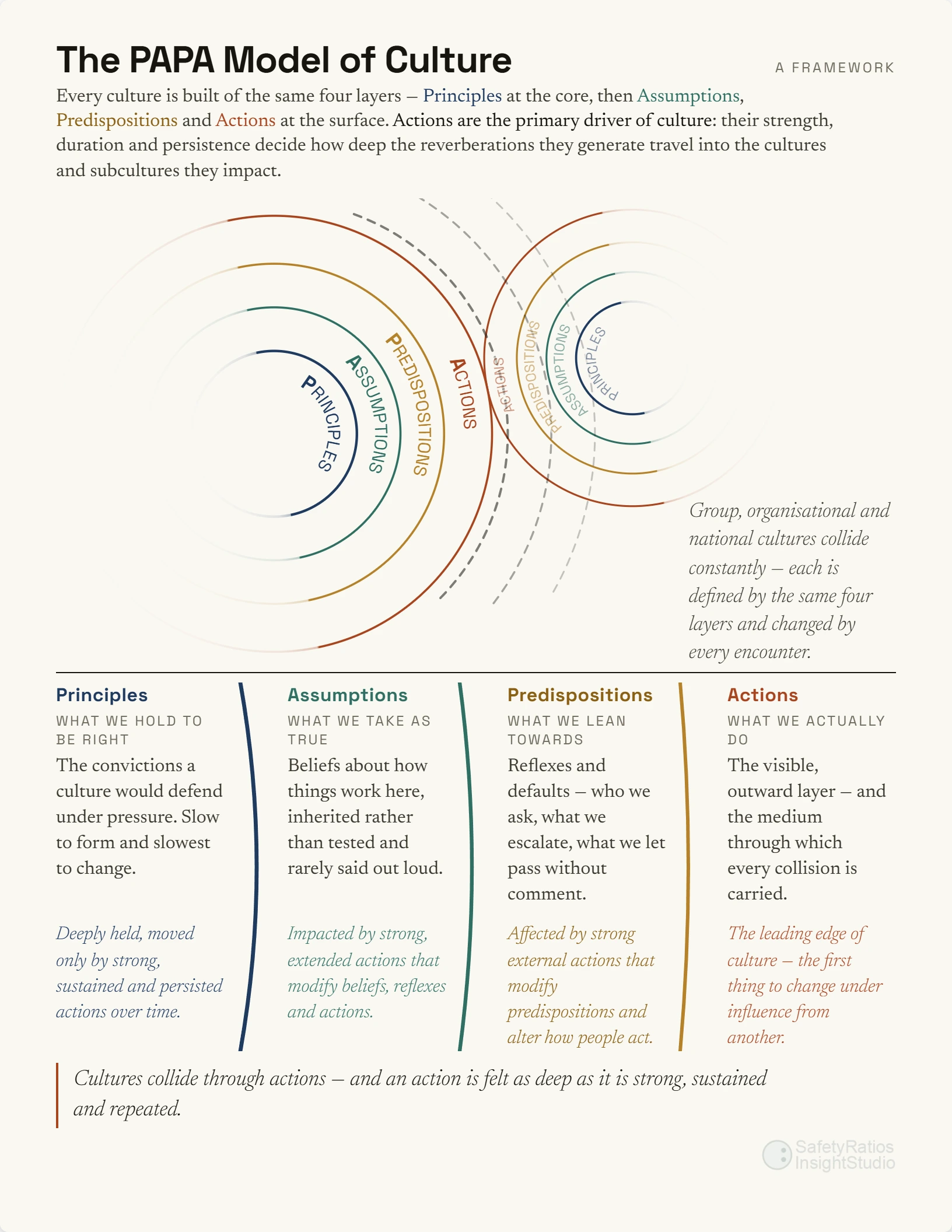
Culture is a complex, constant interplay of subcultures, and we keep treating it as something simpler.
An organisation is a complex structure of many subcultures, each formed by the deliberate actions of those seeking to shape it and by the re-actions of everyone else within it. Inside an organisation, the familiar ones are finance, production, safety and leadership.
Beyond the organisation sit the regulatory, stakeholder, national and civilisational cultures, each shaping organisational culture and being shaped by it in turn. And across the board, every culture, at every scale, is built from the same four layers.
This broader, holistic view is also why this article focuses on culture itself rather than the narrower safety culture: a subset of organisational culture, and one that cannot function outside it.
Those layers are the ones the PAPA Model describes: convictions (principles) at the core, then beliefs (assumptions), then reflexes (predispositions), then action at the surface.
And the cultures interact in only one way: through actions and re-actions. Every action leaves its culture at the surface, powered by its principles, shaped by its assumption layer and automated by its predisposition layer. When it strikes another subculture, it presses back through that culture's layers, towards its core principles.
How deep any arriving action reaches depends on its strength against the resistance of the layers it meets. That, in general, is how culture works.
Mood, messages, value sets and programme targets are all just readings of it. The culture itself is this standing, structured interplay, and it never pauses to be worked on. Which means there is nothing settled to measure and nothing settled to change: by the time you measure the culture in an organisation, it has already changed.
What was captured is a reading of the interplay at one instant; the interplay itself, the ceaseless changing, is the only thing that persists, and the only thing that can actually be affected.
Miss that, and the mistakes follow a pattern, because every simpler model fails against the same mechanics. Here are the things we get wrong with current approaches.
Misreading 1: We Read Culture as Changeable, but Largely Static
The vocabulary gives it away: morale, mood, atmosphere, climate, how things are done around here. These words describe culture as something that settles over an organisation, changeable in principle but stable enough to be measured at a time, t, and read off as a shape and form.
But the tangle of interacting subcultures that produces what we call the mood, morale and other terms is in fact countless waves crossing a web of layered subcultures, every one following the same mechanics, and still moving while the measurement is being filed.
The consequence is that: a safety-culture drive designed off a survey taken before a major financial downturn is aseessing conditions before the such downturns that are often seminal in nature. The onset of financial pressure re-teaches the beliefs the survey mapped, and the programme, built to the old map, misses the impact the new pressure brings.
The correction: read culture as structure in motion, or not at all. Every behaviour is the expression of principles, assumptions and reflexes that power it.
Misreading 2: We Act on the Surface and Call It Change
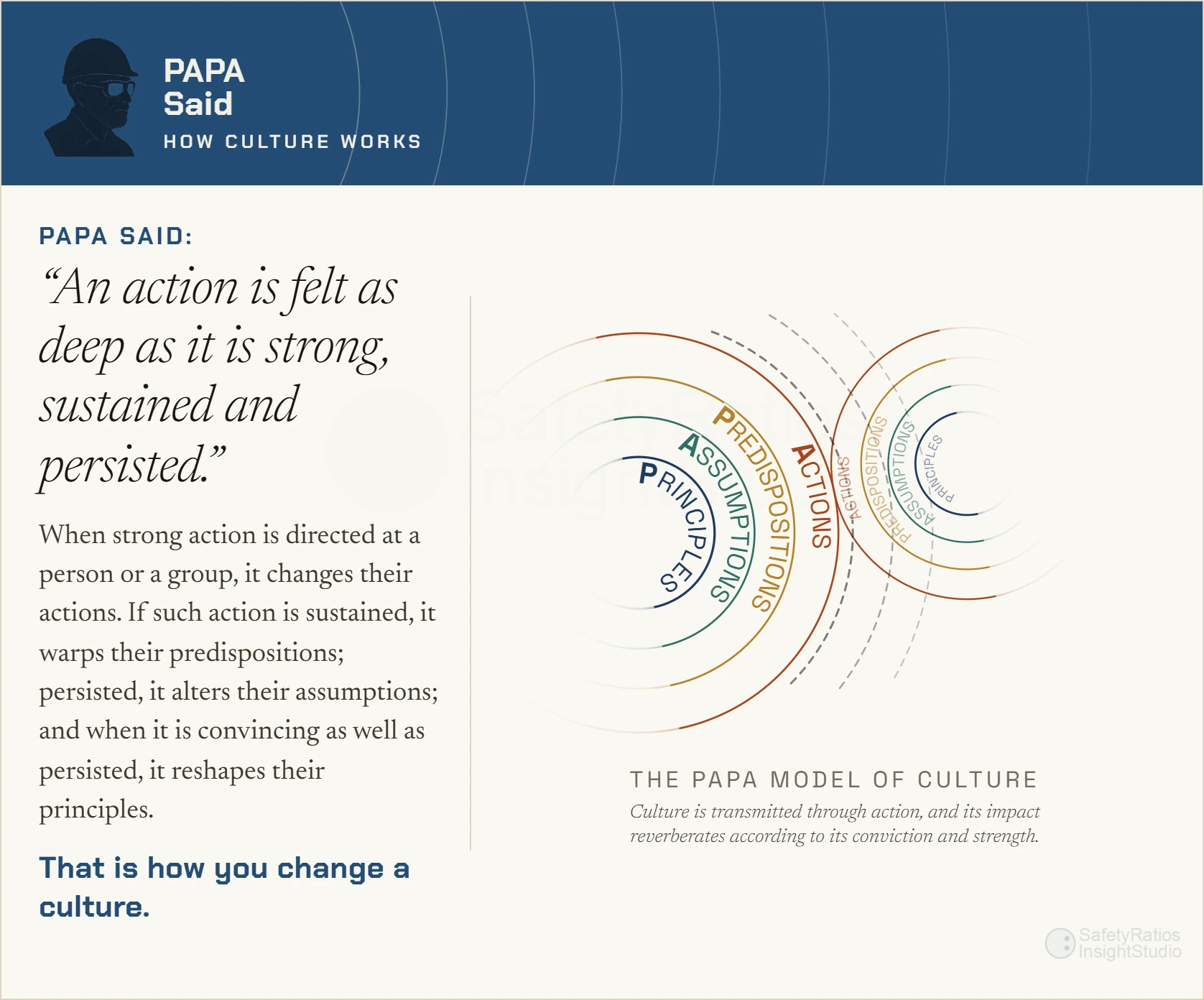
Behavioural programmes know this ground well: good ones aim past behaviour at habits, coach rather than police, and sample the jobs nobody scheduled for observation. Within their own remit, they work.
What they miss is the remit. The belief beneath the behaviour is being taught daily by decisions the programme does not control such as budgets, schedules, promotions. A surface corrected by coaching is re-corrected by whatever those keep teaching.
So the dashboard improves, purporting that the lessons of the behaviour-modification exercise have stuck, but the same old behaviour is simply re-taught by the underlying driver the intervention never addressed.
The correction: the surface is the entry point, never the whole target. An intervention closes when the belief beneath the behaviour has changed, and the decisions still teaching the old belief have stopped.
Misreading 3: We Mistake Words for Evidence
Organisations put enormous weight on words, in both directions. Outbound, words are offered as proof of commitment: the values on the wall, the safety-first announcements, the pledges. Inbound, words are collected as proof of state: survey answers, interview transcripts, workshop outputs. Both treat what is said as evidence of the culture.
The workforce weighs words differently. Talk costs nothing, so on its own it proves nothing. Every pledge is priced against the most recent decision that actually cost something: one budget line moved teaches more than a year of messaging, and conversely, one costly decision in the wrong direction cancels every message that pointed the right way.
The words collected inward carry the same discount. Even a well-run assessment, interviews across shifts, documents checked against walkdowns, mostly gathers what people are willing to say, and only as at the moment they said it. The audit the workforce runs is different: the last three decisions made under pressure, re-scored every time a new one lands, including after the assessor has gone.
The correction: treat words as claims and decisions as evidence. Judge every stated principle by the most recent moment it was expensive to hold, and re-judge it whenever the pressure changes, because the workforce does.
Misreading 4: We Overfocus on Behaviour
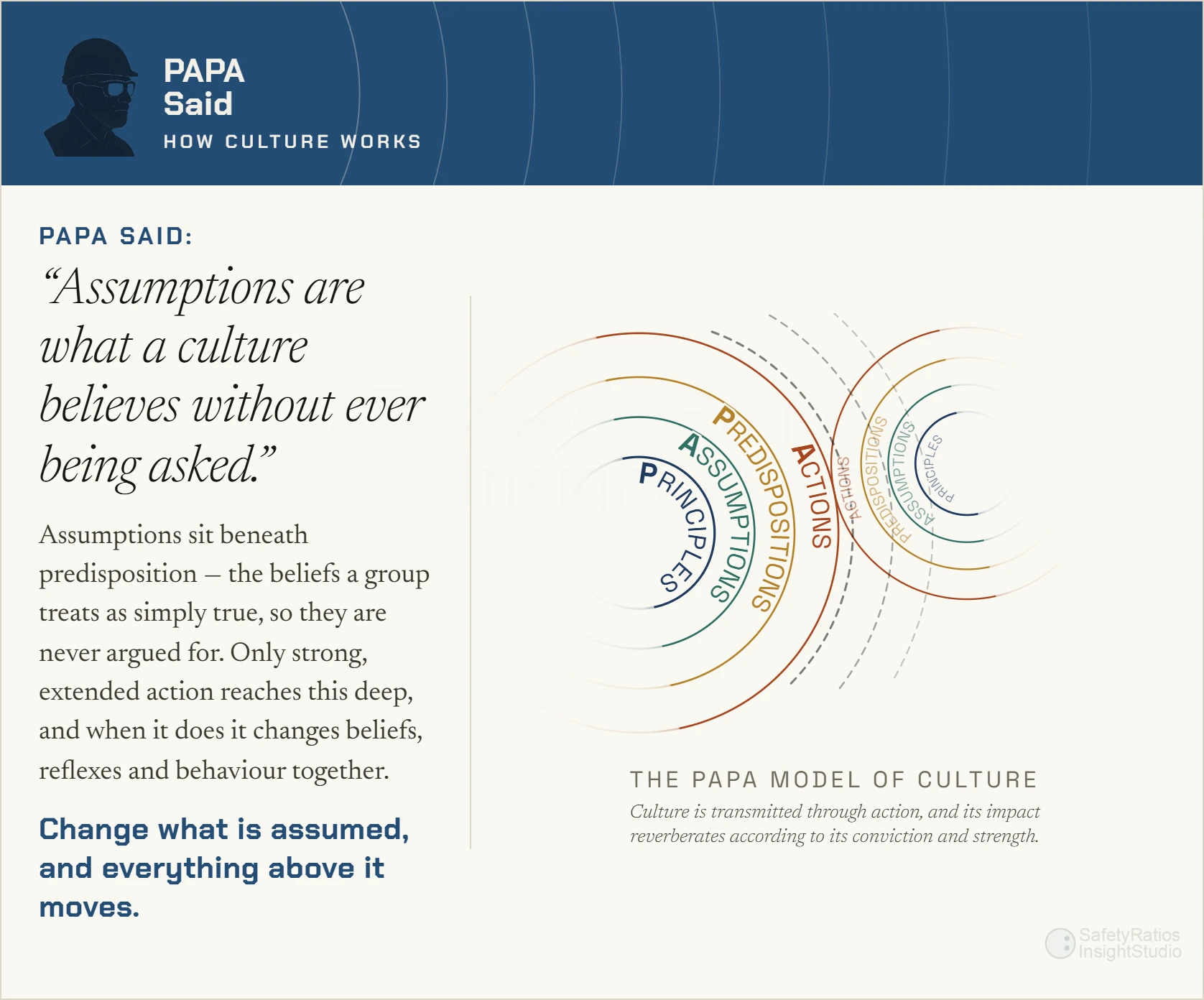
Behaviour is where culture shows, so behaviour is what gets watched, counted and managed, and that is valid as far as it goes. The good programmes go further: they look past the act for the attitude or perception behind it, and ask why it made sense to the person at the time.
What even the good ones miss is that behaviour is a running answer rather than a standing property to be read off. Every behaviour is a re-action to actions still arriving, the decision announced this morning, the report ignored last week, the shortcut a supervisor waved through last night, and it shifts as those exchanges shift.
Read behaviour without the traffic driving it, and the diagnosis dates as soon as the traffic changes: the observed crew was answering last month's evidence, and by the time the finding is written, they are answering this month's.
The correction: behaviour is the output; the actions and re-actions arriving are the input. Track what has been done and decided lately, and what it taught, and the behaviour explains itself.
Misreading 5: We Expect the Core to Move
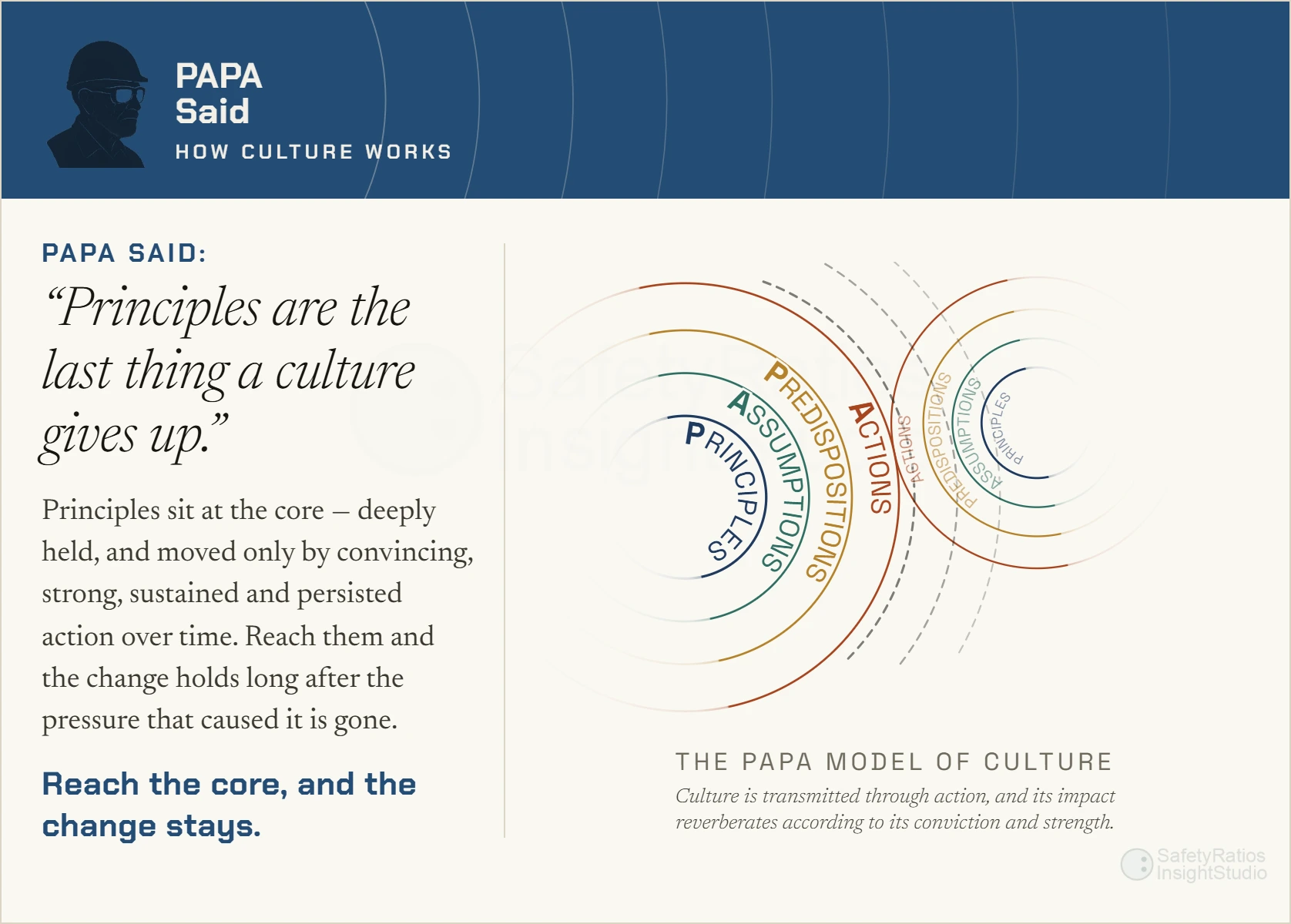
Programmes that aim for hearts and minds aim at the deepest layer, the convictions people privately hold, and give themselves a programme's lifespan to move it.
The core does move, but on its own terms: conviction yields only to conviction, lived in front of people, at visible cost, over years. A leader who holds a principle and keeps holding it when it is expensive will, in time, convince others. A campaign seldom does, because they are rarely long, durable and convincing enough to.
So the programme harvests either disappointment, belief surveys that keep coming back mixed, or performance, a workforce that learns to say the right things in the right rooms, while the layers that do move on programme timescales, beliefs, reflexes, behaviour, go under-worked.
The correction: match the ambition to the layer. Beliefs and reflexes can change within a programme's lifetime, so aim programmes there. Convictions change only when someone holds a principle visibly, at cost, for years, so expect movement at the core over a leader's tenure rather than a campaign. And do not use surveys to test whether hearts have changed; a survey can rarely tell conviction from performance.
Misreading 6: We Stop the Wave and Expect its Impact to Endure
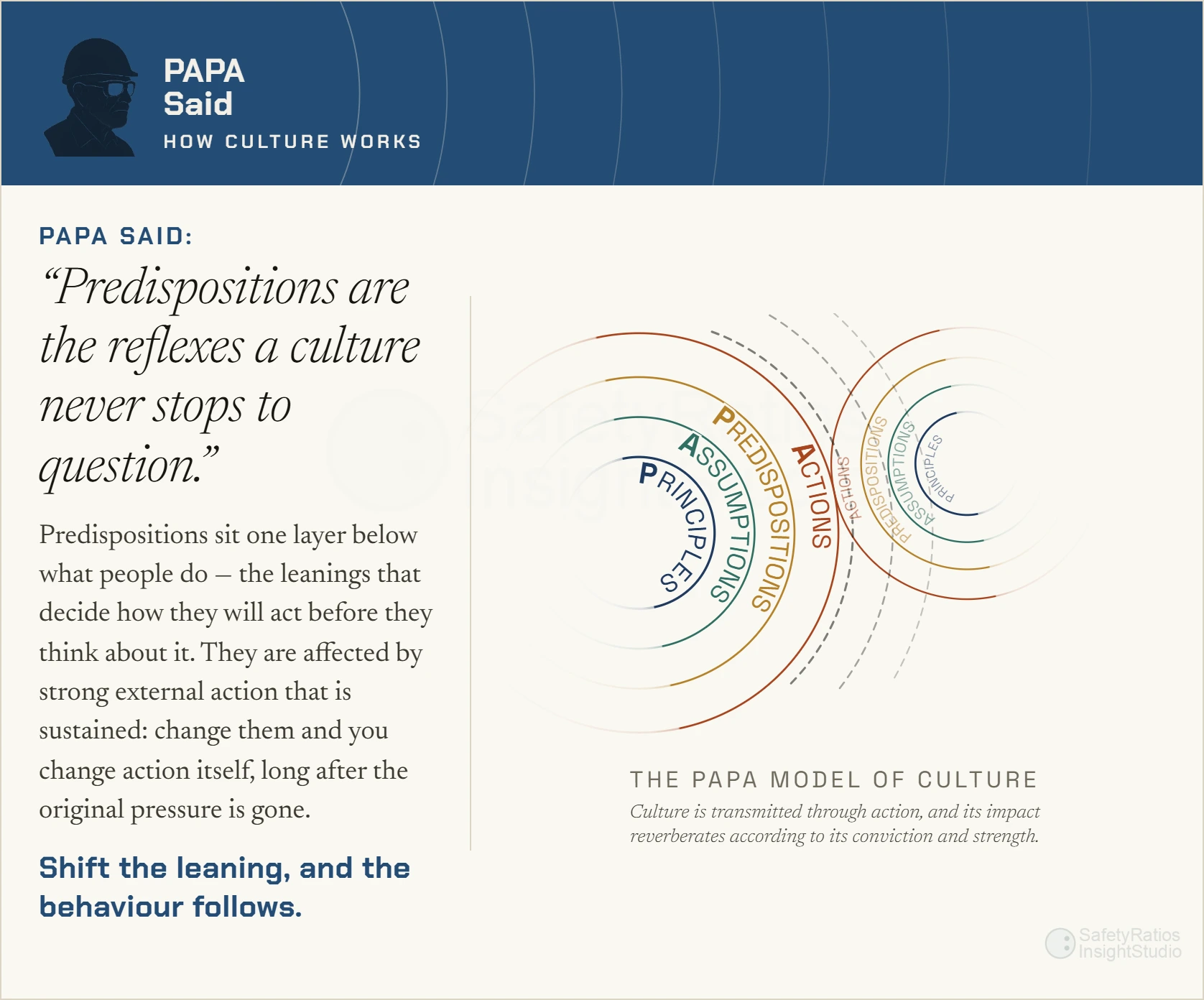
A good intervention lands, the belief revises, the behaviour follows, and the programme closes, its budget line with it. The layers then do what layers do when a sustaining wave stops arriving: settle back toward the old evidence, which is still there, embedded in the unchanged incentives, rosters and structures around them. Six months later the finding is that "the culture reverted", as though it had misbehaved.
The correction: anchor every change to structure, a standing rule, a devolved authority, a recurring visible act, so the wave keeps arriving without anyone spending fresh effort. Goodwill rotates; structures stay.
Misreading 7: We Work One Subculture in Isolation
This is the crux the other six lead to. A safety culture programme, however well designed, is one subculture among many, and it is routinely assessed, planned and run in isolation from the rest, which renders it moot the day another subculture turns up the pressure.
While the safety campaign runs its briefings, finance is issuing procurement decisions, performance is issuing targets, leadership is issuing everything it does, and any of those can carry more force than the whole safety programme.
A safety culture is routinely rewritten by decisions that were never safety decisions, the worked example watches budget, schedule and promotion decisions inadvertently changing the safety culture in one direction while the safety culture programme is being implemented to drive it in another direction.
The correction: no safety culture transformation in isolation. Map the other subcultures and what they are teaching before writing the programme, and re-map when conditions change. The question should always transcend "what shall we say about safety?" to "what is everything else we do teaching about it, and what will it teach under next year's pressures?"
Culture Is Always Changing, and That Is the Opening
The seven misreadings are one reason wearing seven faces: we keep engaging culture one subculture at a time, at one moment in time. The tools have their limits, but the deeper problems are the scope and the tense.
The way out is to stop treating culture as a settled object. Culture is dynamic, always changing: changing while it is being surveyed, changing whether or not anyone attends to it, because the interplay never pauses.
And that is the opening. A settled mass would have to be moved; a system already in motion only has to be steered. Steering starts with knowing the system: who the subcultures are, what each believes, and what each is doing and deciding.
No one can hold the interplay still, but anyone can change what keeps arriving. Do different things, at a cost that makes them believable, and build them into structure so they keep happening after the attention moves on. The change never stops running; let it carry the new shape instead of the old one. Any description of a culture is a snapshot; what you do next is the lever.
Frequently Asked Questions
Why do culture surveys keep misleading?
Surveys read the weather: they aggregate what people are willing to say into a score that reports mood rather than structure. They cannot see which beliefs produce the scores, which evidence taught the beliefs, or which subculture is emitting the wave that will move the numbers next quarter. Used as a thermometer they have some value; used as a diagnosis they mistake the observer's summary for the system's state.
Why do behaviour campaigns fail so reliably?
They aim at the surface with episodic force. The behaviour moves while watched, the layers beneath are untouched, and when the campaign ends the layers push the old behaviour back out, often better hidden, because the workforce has meanwhile learned what the organisation wants to see. Sustained structural action at the same surface works, because it keeps arriving until the belief beneath gives.
Is getting culture wrong a leadership failure?
Partly, but not in the usual sense. Leaders rarely fail culture by insincerity; they fail it by transmitting more than they know. Every decision under pressure, every budget line, every sanction applied or withheld is a wave into the workforce's layers, and most leaders account for almost none of it. The failure is unawareness of one's own emissions, which is a model failure before it is a character failure.
Should culture be measured at all?
Not as a settled state, which is what most measurement attempts chase: a score for a thing that has moved before the report is bound. What can be usefully read is the change in motion. Actions are observable: what is reported, challenged, walked past, awarded, emitted by which subculture at what persistence.
Beliefs respond to structured listening: ask "what happens here to the person who reports?" rather than "do you feel safe?" Read the flows and the layers they are working on, and the current state falls out as a by-product; chase the state alone and it is stale on arrival. The core cannot be read at all, and attempts to survey it collect performance rather than data.
What replaces the culture programme?
Standing practice aimed at the ceaseless change rather than a campaign aimed at the state: an inventory of what the organisation's actions currently teach, correction of the evidence stream through costly, structural, persistent action, and diagnosis that runs from behaviour to belief to the action that taught it. A programme has an end date, which is precisely the property the change never has.